What does ceramic window tint cost in Langley?
Ceramic tint costs the posted starting price for your package plus a ceramic upgrade the shop quotes for your vehicle. The posted prices are for LLumar ATC dyed film; IRX and AIR are priced per package, and the shop quotes the ceramic figure for your car.
| Package | Windows covered | Starting price (ATC dyed) | IRX or AIR ceramic |
|---|---|---|---|
| Sports coupe, rear glass | 3: both rear quarters, back glass | $220 | Quoted per package |
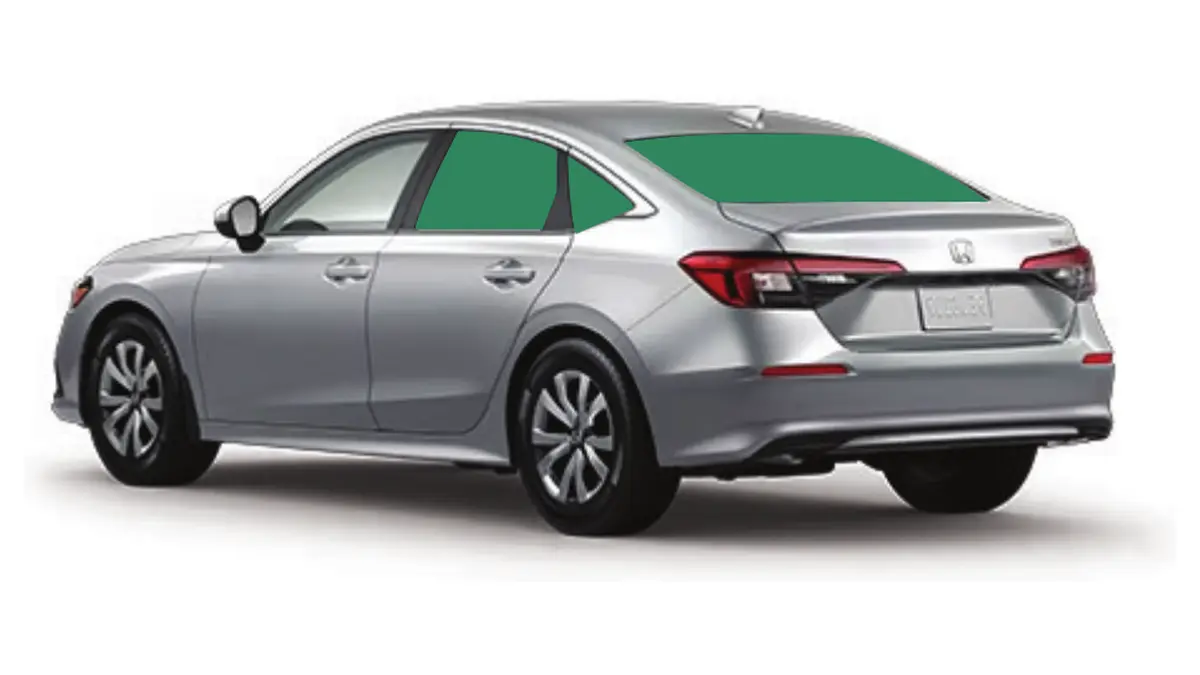
| Sedan or pickup, rear glass | 5: rear doors, rear quarters if any, back glass or slider | $240 | Quoted per package |
| Full-size SUV or wagon, rear glass | 7: rear doors, quarters, extended windows, hatch | $260 | Quoted per package |
Each package comes with genuine LLumar film, cut on the plotter to your car’s pattern so no blade goes near the glass or trim, and backed by a lifetime warranty on the film and the labour. The full price list, with diagrams of each package, is on the window tint prices page. Several packages done in one visit normally total less than their list prices, so ask for one number.
Ceramic can also go on the front doors ($140 for a sedan, coupe or wagon, $160 for a full-size SUV or pickup, before the upgrade) and on a full windshield ($200). Neither is road-legal in BC. MVAR s. 7.05(8) permits no film, whatever the shade, on the two front side windows, and on the windshield nothing below the top 75 mm. A tint ticket typically costs $109, police can require the film’s removal and an inspection, and the shop explains that risk before you decide. The rule itself is set out in the BC front-window tint answer.
What do LLumar IRX and AIR measure on the spec sheet?
Across its shades, IRX turns back 50–62% of total solar energy (TSER) and 59–61% of infrared energy (IRER); AIR 80 manages 43% and 60%. LLumar publishes them in data sheet LL0116NAEN (03/26), tested on one clear 6 mm sheet of glass, so the windows in a real car will read differently.
| Film and shade | Visible light (VLT) | Total solar energy rejected (TSER) | IR energy rejection (IRER) | Selective IR rejection (SIRR) |
|---|---|---|---|---|
| IRX 05 | 6% | 62% | 60% | 86% |
| IRX 15 | 20% | 59% | 61% | 88% |
| IRX 35 | 39% | 54% | 60% | 87% |
| IRX 50 | 54% | 50% | 60% | 87% |
| AIR 80 | 77% | 43% | 60% | 86% |
| AIR 90 | 84% | 30% | 40% | 57% |
| ATC 35, dyed, for comparison | 38% | 35% | 22% | 29% |
Three heat numbers sit on that sheet, and they don’t mean the same thing. TSER counts all of the sun’s energy the film turns away: visible light, infrared and UV together. IRER counts infrared energy from 780 to 2,500 nm, including heat the film absorbs and re-radiates, which LLumar’s sheet calls “a more complete measurement.” SIRR, selective IR rejection, is the biggest figure and the one behind most “blocks up to 88% of infrared” claims. When anyone quotes you a heat number for ceramic film, ask which of the three it is.
Film names carry a product code rather than a measurement: IRX 05 measures 6% and IRX 15 measures 20%. The shop sells IRX in 5, 15, 35 and 50%, and AIR in 70, 80 and 90%. LLumar’s sheet publishes AIR 80 and AIR 90 only, so this page gives no numbers for the lightest AIR shade.
How much more heat does ceramic stop at the same shade?
Matched for darkness, IRX turns away an extra 18–22 percentage points of the sun’s total energy compared with ATC, and its infrared energy rejection is close to triple (IRER 60–61% against 22%). You keep the shade you wanted and lose a large share of the heat.
| Shade the shop sells | ATC TSER | IRX TSER | Difference |
|---|---|---|---|
| 5% | 44% | 62% | +18 points |
| 15% | 40% | 59% | +19 points |
| 35% | 35% | 54% | +19 points |
| 50% | 28% | 50% | +22 points |
The visible light is close between the two at each shade, with one exception worth knowing: ATC 50 measures 60% and IRX 50 measures 54%, so the lightest IRX is a touch darker. Whether that gain justifies the upgrade for your driving is its own question, answered in is ceramic window tint worth it. The film-against-film breakdown lives in ceramic vs dyed window tint.
Will ceramic tint interfere with phone, GPS or radio signals?
No. IRX and AIR are nano-ceramic films with no metal layer, and LLumar lists “easy electronic connectivity” among IRX’s features. None of the three films the shop sells, ATC, IRX or AIR, is metallized.
That matters more on newer cars, some of which build the antenna into the glass. Polestar’s owner’s manual for the Polestar 2 tells drivers to avoid “tinted film with a metallised surface coating on the rear window,” because the radio antenna sits inside that window. With ceramic film the choice between shades is about heat and privacy, not about reception.
IRX or AIR: which ceramic film suits which windows?
IRX is for glass you want darker; AIR is for glass you want to keep looking factory. On the rear glass, the choice comes down to how much privacy you want.
IRX on the rear glass
IRX gives you the four shades and the most heat rejection on the sheet. For side glass behind the driver, BC sets no darkness limit, and the back window can take film when the vehicle carries an outside mirror on each side. The LLumar IRX film page has every shade on the sheet.
AIR over factory privacy glass
Many SUVs and trucks leave the factory with dark privacy glass behind the front doors. LLumar aims AIR squarely at that glass, saying factory privacy glass looks good and hides the cabin but handles heat poorly. AIR 80 matches IRX on infrared energy rejection (IRER 60%) while passing 77% of visible light, so the car keeps its factory look and sheds heat. More on the film is on the LLumar AIR page.
AIR on the windshield
AIR is also the usual choice for a full windshield, a job with its own legal catch in BC, covered on the windshield tint page.
How do you book ceramic tint at the Langley shop?
Send the year, make and model, the windows you want done, and which film you’re leaning towards, an IRX shade or AIR. The shop replies with the dyed and ceramic prices side by side, so you can see the upgrade in dollars before you book.
Most cars leave the same day; a whole sedan or SUV usually needs two to four hours in the bay. Don’t lower the windows for three to five days, and don’t worry about faint haze or tiny water bubbles during that first week, which dry out on their own. Wipe ceramic film with soft microfibre and a cleaner free of ammonia, and keep blades and scrapers away from it. If old film has to come off first, add tint removal to the same visit. Start with the ceramic tint quote form; the shop also answers calls and texts at 604 534 6433.