Why isn’t there one right number of coating layers?
Because the coating’s maker decides how many layers its product is built for, and makers disagree. A layer count only means something next to the name of the product being layered.
Two makers’ instructions show how far apart the advice can be:
| Coating | Maker’s guidance on layers |
|---|---|
| CarPro CQ.UK 3.0 | “Additional coats may be applied after 60 mins. We recommend 2-3 layers maximum.” (CarPro instructions) |
| Gtechniq Crystal Serum Ultra | “We do not recommend stacking layers of Crystal Serum Ultra over previous layers,” because its tests showed no advantage; a different top coat can go over it (Gtechniq FAQ) |
Neither is the product Brookswood Tint applies. They’re here to show why “how many layers?” has no single answer: a second layer of one product is part of the maker’s design, and a second layer of another adds nothing by its maker’s own testing. The shop’s own graphene-ceramic is sold in one-, two- and four-layer packages, and the layer count comes with different prep and coverage in each.
What do the one-, two- and four-layer packages include?
One layer covers the paint over at least one polishing stage; two layers sit on a two-stage correction and reach the wheel faces and glass; four layers go over full correction and cover paint, PPF, wheels, glass and trim.
| Package | Who the shop builds it for | Layers | Correction under it | Surfaces coated |
|---|---|---|---|---|
| Essential | Daily drivers and lease returns | 1 | Decontamination, clay and at least one polishing stage | Paint |
| Performance | Hand-washed cars you plan to keep | 2 | Two-stage correction | Paint, glass, wheel faces |
| Signature | New exotics and cars in full PPF | 4 | Full paint correction | Paint and PPF, plus wheels, glass and trim |
Wheel and caliper coating, glass coating and interior leather and fabric protection are also offered as add-ons, so a one-layer car can still have its glass done.
Does the prep under a coating matter more than the number of layers?
Often it does. A coating seals the paint in whatever state it finds it, so four layers over swirled paint are four layers of preserved swirls, while one layer over corrected paint starts from a clean finish.
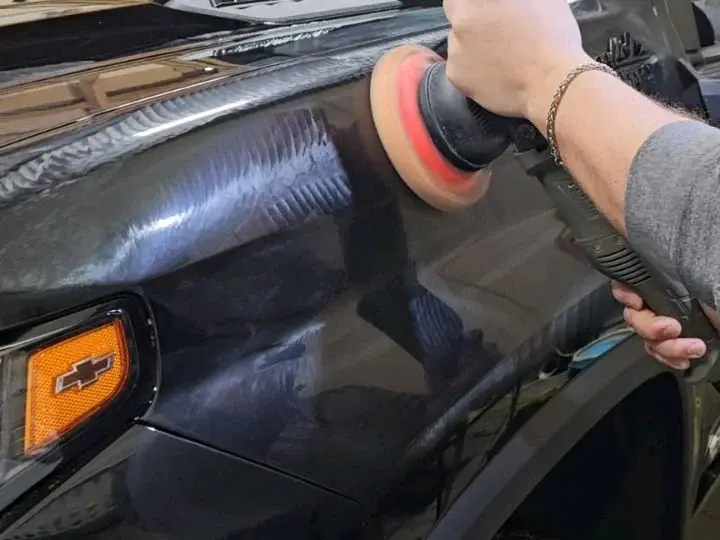
That’s why prep scales with the package. An enhancement polish is a single stage that takes out light swirls and haze; on a newer car, it’s the shop’s usual groundwork for a coating. A two-stage correction, with a cutting compound and then a finishing polish, removes deeper wash marring, water spots and most light scratches. Full correction goes further again on paint that needs it. Before any of it, the shop measures paint thickness, so polishing only removes what it has to.
If the car is new, ask whether its paint needs more than the package includes; the shop finds dealer prep and transport often leave new cars with more swirls than owners expect. The polishing side is explained in whether you need paint correction before a ceramic coating and on paint correction.
What does a second or fourth layer actually change?
It changes the finish and the coverage, not the coating’s job. The shop describes its two-layer package as giving deeper gloss and tighter beading than one, and its four-layer package covers every exterior surface the shop coats.
What extra layers don’t change matters just as much:
- Stone chips. A coating is microns thick whether it has one layer or four, and it puts nothing between a stone and the paint. That job belongs to film, compared in PPF vs ceramic coating and in whether ceramic coating prevents scratches or rock chips.
- Washing. A four-layer car still needs washing; it just releases dirt more readily.
- Bad prep. No number of layers fixes paint that wasn’t corrected first.
A lifespan in years isn’t the number to buy layers by. Ask the shop what to expect for your car and the way you use it.
How do you choose the right number of layers for your car?
Start with how long you’ll keep the car and how it’s washed, then look at what else is on it. The table is a starting point; the quote is where it gets specific to your paint.
| Your situation | Package to start from |
|---|---|
| Lease, or a car you’ll sell in a few years | Essential, 1 layer |
| Daily driver parked outside, washed by hand | Performance, 2 layers |
| You want the glass and wheels done without add-ons | Performance, 2 layers |
| New exotic, or the car has full or front PPF | Signature, 4 layers |
| Paint that’s swirled or dull now | Whichever package includes the correction it needs |
How do you book a one-, two- or four-layer coating?
Send the year, make and model and a description or photos of the paint through the coating quote form; every package is quoted per vehicle. The car is usually in the bay for one to three days, and preparation takes up the bulk of that; afterwards, give it 24 hours away from water. The factors behind the price are explained on ceramic coating cost; for the full package descriptions, see ceramic coating.