Does BC have a medical exemption for window tint?
No. MVAR s. 7.05 lists where film may go and contains no exemption, permit or medical process, and the 2025 Vehicle Inspection Manual has no exception for the front side windows or the windshield. We found no current RoadSafetyBC or provincial page offering one.
The clearest official word is old. A 2008 bulletin from Commercial Vehicle Safety and Enforcement, no longer on the CVSE site but reproduced by DriveSmartBC, said: “There are NO EXEMPTIONS, PERMITS OR PERMISSIONS available to contravene this regulation.” The same bulletin encouraged people with sunlight sensitivity “to seek out solutions that do not compromise their driving safety”. DriveSmartBC is a secondary source, so treat the bulletin as the province’s last known position. The regulation itself, which has no exemption in it, is the current law.
How does Alberta’s medical tint exemption work?
Alberta runs a formal permit, and it shows how narrow a medical exemption is even where one exists. The rules under Alberta’s program:
| Requirement | Alberta’s rule |
|---|---|
| Who can apply | Holders of a valid Alberta driver’s licence |
| Conditions considered | Diagnosed or recurrent skin cancer (melanoma, basal or squamous cell), Bullous Pemphigus |
| Not considered | Photophobia, migraine, cataracts, rosacea |
| Proof | A physician’s letter that clearly states the condition |
| Film allowed | Clear UV film, combined visible light transmittance of 50% or more |
| Fee | $55 |
| On the road | Permit carried in the vehicle and shown to police or the courts when asked |
Even Alberta only allows clear film, and it turns away light sensitivity and migraine. Washington State has its own route: RCW 46.37.430 allows darker film where a licensed physician verifies the driver or passenger must be protected from sunlight. Neither permit is part of BC law, and s. 7.05 has no provision for recognizing one.
How much UV gets through a car’s front side windows?
More than through the windshield, and the amount varies a lot from one vehicle to the next. Windshields are laminated, while side glass is usually tempered, and tempered glass, according to the Skin Cancer Foundation, “does not block UVA rays effectively”. Two studies measured the gap:
| Study | Windshield UVA blocked | Driver’s side window UVA blocked |
|---|---|---|
| Boxer Wachler, JAMA Ophthalmology 2016, 29 cars | 96% average | 71% average; 4 of 29 above 90% |
| Axelson et al., Archives of Dermatological Research 2025, 34 models from 2015 to 2025 | 99.25% average | 88.78% average; from 72% to 100% |
UV through side glass is associated with more skin damage on the driver’s side; a 2010 study in the Journal of the American Academy of Dermatology found more skin cancers on patients’ left sides than their right. The spread in the 2025 study is the useful part for a BC driver: the driver’s window ranged from 72% of UVA blocked to all of it, depending on the vehicle.
What legal options do light-sensitive BC drivers have?
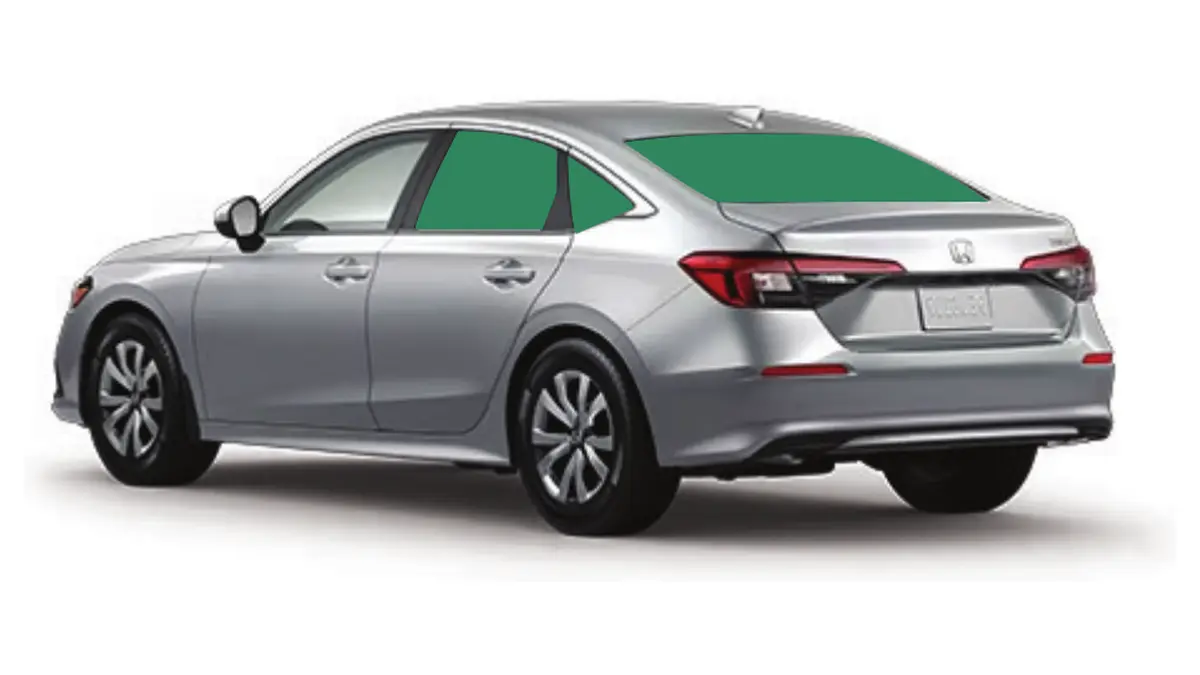
Several, as long as nothing goes on the front side glass or below the windshield strip.
Factory glass that blocks more UV
Glass that leaves the factory with UV protection built in isn’t film “affixed to or placed on” a window, so the film rule doesn’t reach it. With driver’s windows ranging from 72% to 100% UVA blocked across recent models, ask about the front door glass when you shop for your next vehicle. Factory tint in that glass must still meet federal light-transmittance standards under s. 7.05(9).
Clear UV film behind the driver
Every pane behind the driver can take film, with the back glass needing an outside mirror on each side of the car. LLumar AIR 80 and AIR 90 block more than 99% of UV while letting through 77% and 84% of visible light on LLumar’s performance data sheet. That protects a light-sensitive passenger in the back, though it does nothing for the driver’s own window.
The legal sun strip
The top 75 mm of the windshield can carry film of any shade. A band that narrow takes the edge off a low sun and leaves the view below untouched.
What you wear
The Skin Cancer Foundation’s general advice includes “sun-safe clothing” and “UV-blocking sunglasses”. On the arm nearest the driver’s window, a long sleeve gives cover that no tint rule restricts.
Not cling or suction-cup shades
The regulation covers material “placed on” a window as well as material stuck to it. Cling and suction-cup shades on the front windows while you drive fall under the same rule as film.
What if you already drive with front film for a medical reason?
It’s treated like any other front film. A doctor’s letter doesn’t prevent a $109 ticket, a Notice & Order or an inspection failure, because neither the regulation nor the inspection manual has an exception for it. What each of those costs is set out in BC tint fines and orders.
Brookswood Tint will put film on the front doors if a customer asks. With or without a medical letter, that film is not legal on BC roads, and the shop explains the ticket, order and inspection risk before anyone decides. If you’d rather take it off, the shop can strip just the two front windows and leave legal film behind the driver.
How do you book UV protection that stays legal?
Ask for clear AIR or ceramic IRX on the glass behind the driver, plus a top windshield strip if glare is the problem. In ATC, the rear-glass package costs from $240 on a sedan or pickup; LLumar AIR and IRX are quoted as upgrades, and a strip is priced per vehicle. Film and workmanship carry a lifetime warranty.
Tell the shop what you drive using the window tint enquiry form, or text 604 534 6433. Every window rule in one place is in the 2026 BC tint law guide.