What does BC’s window tint law say in 2026?
BC’s tint law is a single sentence in the Motor Vehicle Act Regulations, and it reads the same in 2026 as it did in the 1990s. Here is MVAR s. 7.05(8) in full:
“No person shall drive or operate on a highway a motor vehicle which has affixed to or placed on the windshield or a window any material that reduces the light transmitted through the windshield or window unless the material is affixed to or placed on (a) the windshield but not more than 75 mm below the top of the windshield, (b) a side window that is behind the driver, or (c) the rear window if the motor vehicle is equipped with outside rear view mirrors on the left and right side of the motor vehicle.”
It works as a ban with three exceptions. Light-reducing material is prohibited on all glass, then permitted in three areas only: the uppermost 75 mm of the windshield, any side window to the rear of the driver, and the rear window of any vehicle with outside mirrors left and right. Glass that isn’t on that short list takes no film, whatever the shade. BC never asks how dark a film is, only where it sits.
Three dates frame the rule this year:
- October 6, 2026. The BC Laws consolidation of the regulation is current to this date.
- 1992. Subsection (8) has carried the same amendment history since B.C. Reg. 21/92. The point-in-time table shows the only recent change to s. 7.05 was B.C. Reg. 64/2021, which made subsection (2) gender-neutral.
- September 2, 2025. The 2025 Vehicle Inspection Manual replaced the previous edition as the inspection standard, according to CVSE Notice 04-2025. It sets out the tint rejects item by item.
Which windows can you tint in BC?
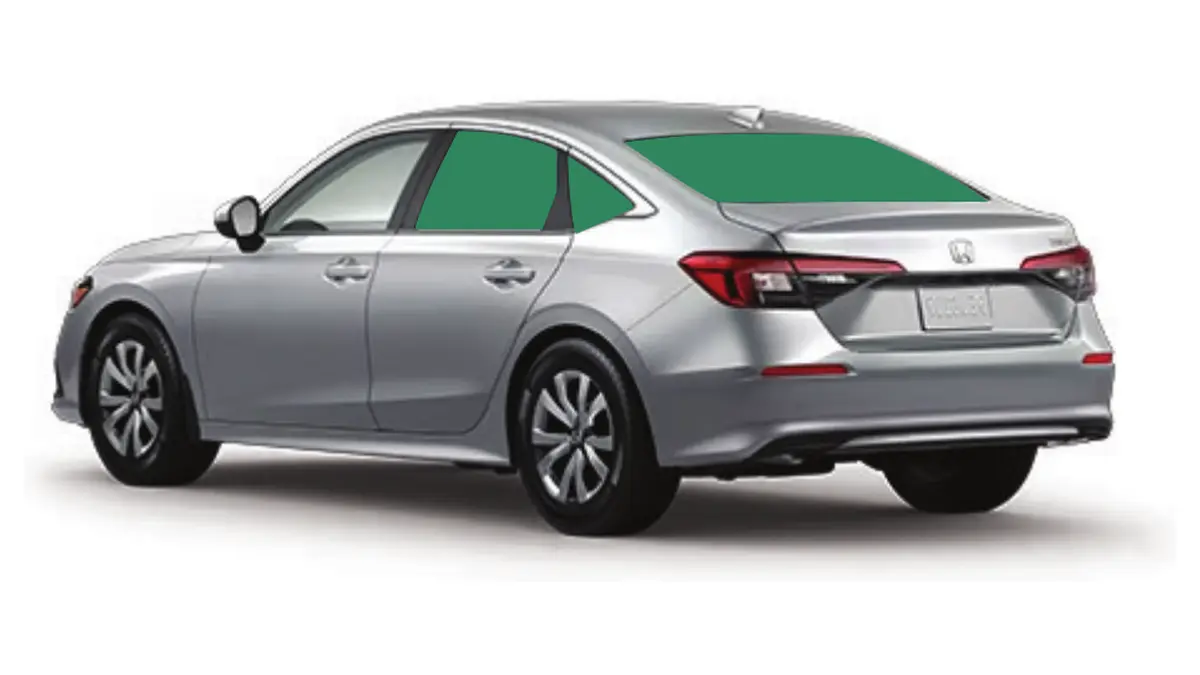
Behind the driver, any shade; ahead of the driver, nothing except the top 75 mm of the windshield. This is how the regulation and the inspection manual line up, pane by pane:
| Glass | What BC allows | 2025 inspection item |
|---|---|---|
| Windshield | Film in the top 75 mm only | 12e |
| Driver and front passenger windows | No film | 13d |
| Side windows behind the driver | Any darkness | No tint reject |
| Back glass | Any darkness, with outside mirrors on both sides | 14c |
Windshield
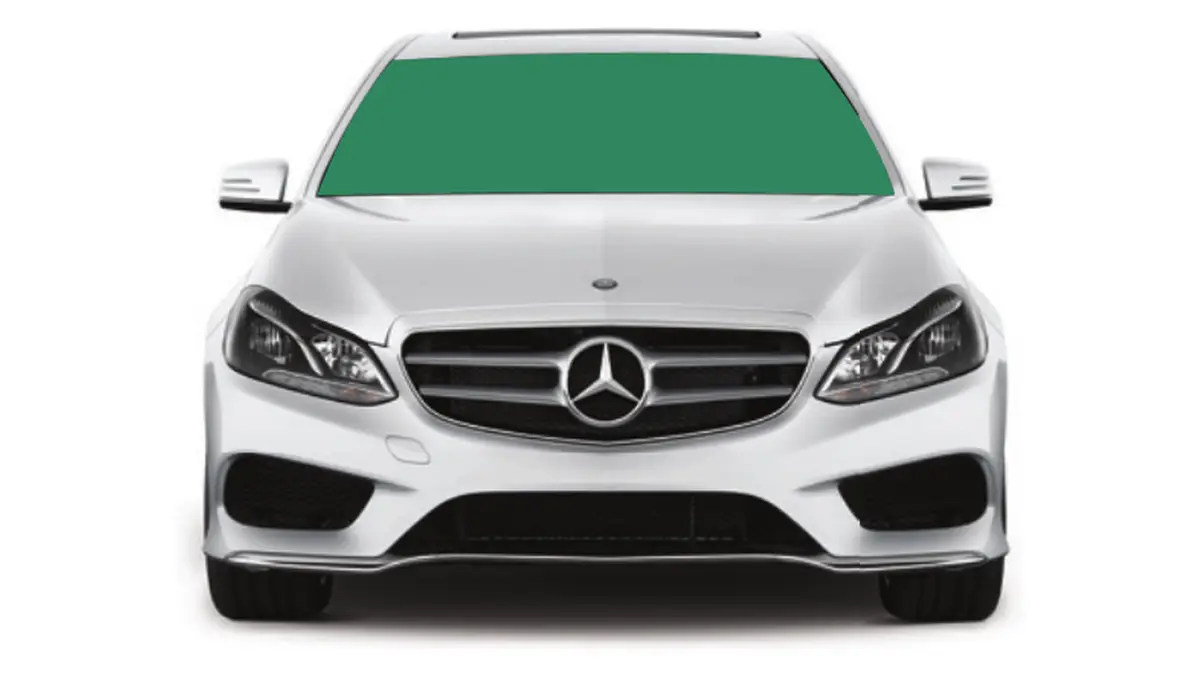
A band no deeper than 75 mm, just under 3 inches, may carry film of any shade. Below that line nothing is allowed, and a full windshield in near-clear ceramic fails item 12e like a dark one. Strip depth, cameras and the AS-1 mark each get a section in the windshield tint answer.
Front side windows
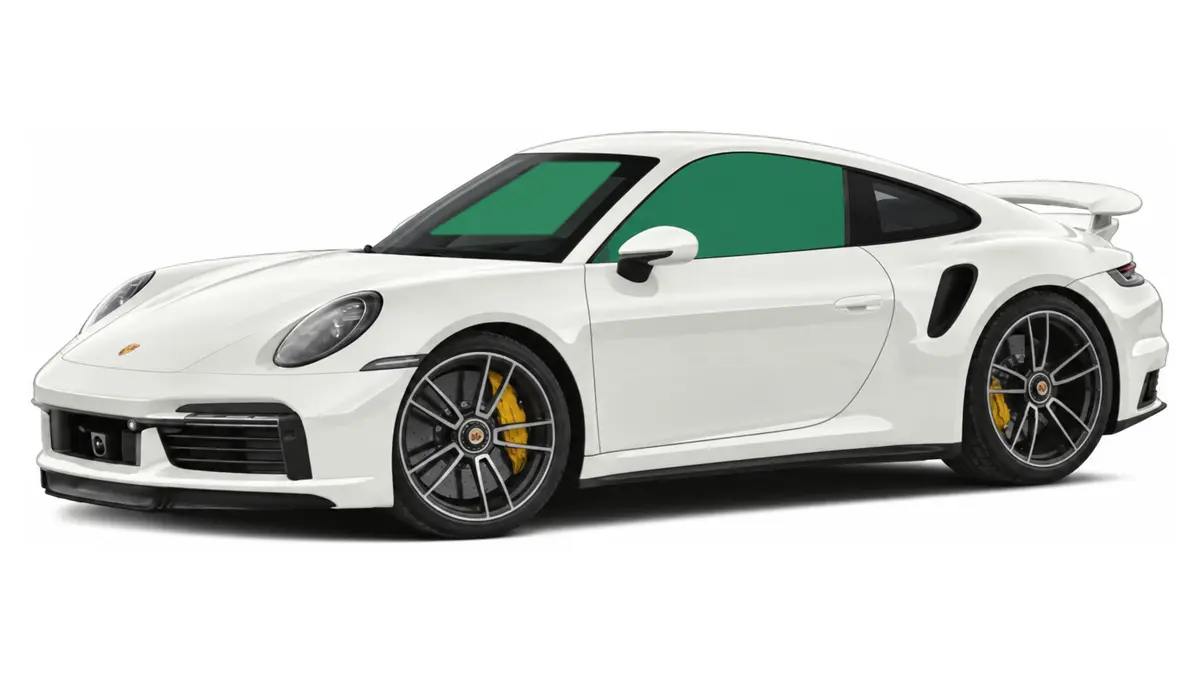
The driver’s and front passenger’s windows can’t carry film of any kind. Inspectors draw the line at the driver’s seat back, so fixed vent panes ahead of it count as front glass. The reasoning, and why clear ceramic doesn’t escape it, is laid out in the answer on front window tint.
Side windows behind the driver
Rear doors, rear quarters and the extended side glass on SUVs and vans can go to any shade, 5% included. The inspection manual has no tint item for this glass at all. Measured light transmission for each shade, and how it compares across borders, is in the tint darkness answer.
Back glass
Any shade is allowed when the vehicle has outside rear-view mirrors on the left and the right; item 14c fails tinted back glass without them. One quirk: the schedule attached to Division 7 of the regulation (its item 29) leaves the back-glass allowance out, but the inspection manual follows s. 7.05(8)(c), so tinted back glass on a car with two mirrors passes.
Buses, limos and taxis
The same subsection applies to every motor vehicle, and the Passenger Transportation Regulation adds no tint rules of its own. Buses face one extra check: item 29d fails aftermarket tint on the windows directly to the left and right of the driver, door windows included.
Do factory, clear and reflective tints count?
Factory tint has its own rule; clear film and reflective film are both judged as film.
Factory privacy glass
Tint that’s part of the glass is handled by s. 7.05(9) instead, which points to federal light-transmittance requirements. Those sit in CMVSS 205, the federal glazing rule, which in turn relies on ANSI/SAE Z26.1-1996. The minimum usually quoted for glass the driver looks through is 70%, but the ANSI text is paywalled and BC’s regulation doesn’t print a number, so treat 70% as commonly cited.
Clear and near-clear film
Clear film still reduces light. On LLumar’s performance data sheet, AIR 90 measures 84% visible light transmission and AIR 80 measures 77%. Because the rule catches any reduction, near-clear film on a front door or across a full windshield sits in the same legal position as limo tint. BC has no “legal if light enough”.
Reflective and mirror film
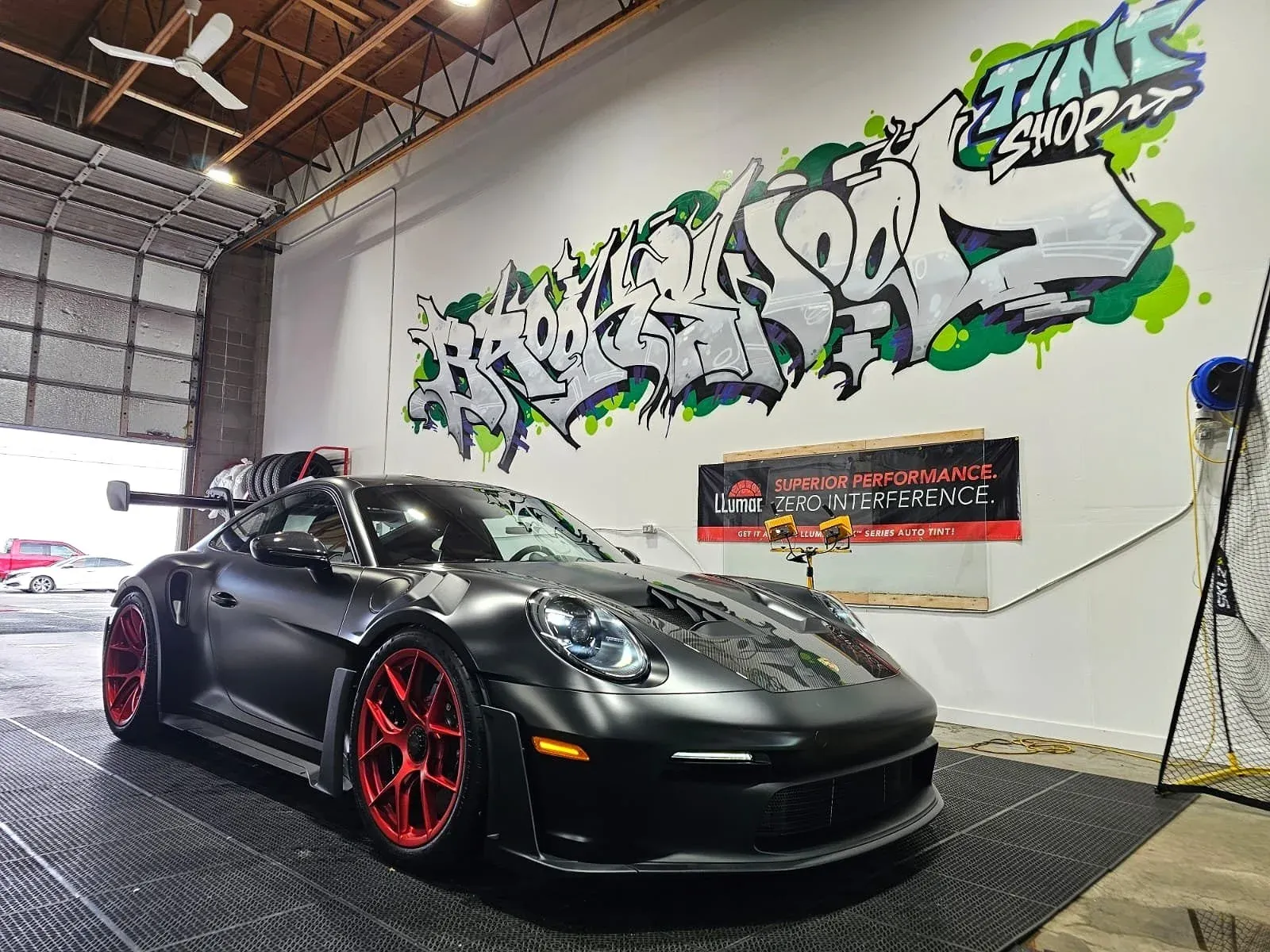
The regulation names no reflectivity figure, but items 12e, 13d and 14c of the inspection manual each reject tint of a “reflective type”. The LLumar films Brookswood Tint installs list 5 to 9% visible light reflection, far from a mirror finish.
What are the penalties for illegal tint in BC?
A $109 ticket, and the officer can add an order that leaves you 30 days to strip the film and get through a complete inspection. These are the consequences a stop can lead to, with the source for each:
| Consequence | Amount or effect | Source |
|---|---|---|
| Violation ticket | $109, or $84 inside 30 days | Fines regulation, catch-all row |
| Penalty points | None; s. 7.05 isn’t in the point schedule | MVAR Division 28 |
| Box 2 Notice & Order | Film off, complete inspection at a designated facility within 30 days | Mission RCMP |
| Box 1 Notice & Order | Off the road until it passes, towing at the owner’s cost | CVSE |
| Deadline missed | A $598 ticket ($573 when settled inside 30 days) | MVAR s. 25.30(4) |
| Selling with an open order | The buyer can’t license or insure the car with ICBC | CVSE |
Box 1 and Box 2 orders are logged on ICBC’s Vehicle Information Database. An order carries no fine of its own; the money comes from the ticket, the removal, the inspection and, if the clock runs out, the $598. Each amount is broken down in the illegal tint fine answer, and getting the film off in time is the subject of Notice & Order tint removal.
How do out-of-province vehicles pass a BC inspection with tint?
They pass once the front film, and any windshield film below 75 mm, is gone. MVAR 25.24 and 25.25 require a vehicle of up to 3,500 kg net that was previously registered outside BC to pass a designated-facility inspection before ICBC registers it. ICBC’s import page applies that to cars from other provinces and other countries alike, and US vehicles clear the Canada Border Services Agency first. The facility works from the same 2025 manual, so front film fails item 13d and a full windshield fails item 12e.
Some vehicles skip the inspection. CVSE Circular 08-19 exempts qualifying private vehicles last registered to the applicant in Alberta, Saskatchewan or Manitoba that are the current, upcoming or previous 3 model years, or that passed that province’s inspection within 90 days. Commercial, salvage and custom vehicles, and any raised or lowered more than 10 cm, don’t qualify. Skipping the inspection doesn’t exempt the glass from s. 7.05(8), so an Alberta car with front film can be registered here and still be ticketed on the drive home.
The removal job is described in out-of-province inspection tint removal, and the whole inspection, lights included, in the out-of-province vehicle inspection guide.
How do BC’s tint rules compare with Alberta, Ontario and Washington?
BC and Alberta allow no front film at all, the strictest line of the four, while BC is more relaxed than Alberta on the windshield. This is how the four compare on the questions drivers ask most:
| Jurisdiction | Windshield | Front side windows | Base fine | Medical exemption |
|---|---|---|---|---|
| BC | Top 75 mm | No film | $109 ticket | None |
| Alberta | No film | No film | $88 | Yes: clear UV film, 50% or more combined, $55 permit |
| Ontario | No aftermarket film on 2017 and newer vehicles; top 75 mm on older ones | 70% minimum on 2017 and newer vehicles | $85 set fine | No statutory exemption found |
| Washington | Top 6 inches | 24% or more, combined | $48 before assessments | Yes, with a physician’s verification |
The sources are Alberta’s AR 122/2009 s. 70 and Procedures Regulation; Ontario’s Highway Traffic Act s. 73(3), MTO inspection standard and set fines; and Washington’s RCW 46.37.430 and IRLJ 6.2.
Cross-border trips cut both ways. Washington’s limit applies to anyone driving on its highways, so a BC sedan with 5% rear film, legal in Langley, sits below Washington’s 24% line for cars. Ontario’s 70% is a safety-certificate inspection standard rather than wording in the Highway Traffic Act.
Medical exemptions
BC has none. Neither s. 7.05 nor the inspection manual offers one, and a 2008 CVSE bulletin, since taken off CVSE’s site and preserved by DriveSmartBC as a secondary source, ruled out any “EXEMPTIONS, PERMITS OR PERMISSIONS”. Alberta’s permit only covers Alberta licence holders with skin cancer or Bullous Pemphigus, and only allows clear film. The legal alternatives for light-sensitive drivers are listed in the medical exemption answer.
Why tint the legal glass: UV, heat and Fraser Valley summers
The glass behind the driver is where BC lets you block UV and heat with no limit, and in the Fraser Valley both are worth blocking.
UV through side and back glass
The Skin Cancer Foundation explains that windshields are laminated and “treated to shield drivers from some UVA”, while side, back and sunroof glass is tempered and lets more through. It adds that window film “can block more than 99% of UVA and UVB”. LLumar puts every film the shop carries, clear AIR included, above 99% UV protection on its spec sheet.
On the driver’s side, Butler and Fosko counted 52.6% of skin cancers on the left against 47.4% on the right, a gap just short of statistical significance overall, and 74% of melanoma in situ on the left. UV through the driver’s window is associated with that pattern; the study doesn’t prove driving produced it.
Heat by film line
Heat rejection depends more on the film line than on the shade. LLumar’s figures, measured on 6 mm clear glass:
| LLumar film | Light let through (VLT) | Solar energy rejected (TSER) | IR energy rejected (IRER) |
|---|---|---|---|
| ATC, dyed | 5 to 60% | 28 to 44% | 22% |
| IRX, nano-ceramic | 6 to 54% | 50 to 62% | 59 to 61% |
| AIR 80, clear ceramic | 77% | 43% | 60% |
| AIR 90, clear ceramic | 84% | 30% | 40% |
Each ceramic line has its own page with the full shade list: LLumar IRX and LLumar AIR.
Fraser Valley summers
Inland summers run warmer than the coast. At Abbotsford Airport, the federal climate normals for 1981 to 2010 show July averaging 24.0 °C at the daily high and August 24.4 °C, with 8.7 days a year over 30 °C and 1,886.7 sunshine hours annually. Vancouver Airport averages 22.2 °C in July.
What will Brookswood Tint install, and how do you book?
Any LLumar shade on the legal glass; front doors and full windshields only on request, after the legal facts; and no exterior windshield protection film. These are the starting prices in LLumar ATC, with IRX and AIR quoted per package:
| Glass | Vehicle | Panes | From | Road-legal in BC? |
|---|---|---|---|---|
| Rear glass | Sedan or pickup | 5 | $240 | Yes, any shade |
| Rear glass | Sports coupe | 3 | $220 | Yes, any shade |
| Rear glass | SUV or wagon, full-size | 7 | $260 | Yes, any shade |
| Front doors | Sedan, coupe or wagon | 2 | $140 | No |
| Front doors | SUV or pickup, full-size | 2 | $160 | No |
| Windshield, whole | Any | 1 | $200 | No; film is allowed in the top 75 mm only |
Front-door film and the full windshield service go on only when a customer asks for them. Neither is legal on a BC road in any shade, and the $109 ticket, the Notice & Order and the failed inspection that can follow are all explained before anything is booked. For cars that need to pass, the shop strips just the front two windows with steam, priced per window, usually in 1 to 3 hours.
Tinting a whole sedan or SUV usually takes 2 to 4 hours, so most cars go home the day they come in, and the film needs 3 to 5 days with the windows closed to cure. Film and workmanship carry a lifetime warranty. Compare packages on tint pricing, then ask for a price on your car through the tint quote request or by phone at 604 534 6433. The address is Unit 312, 20560 Langley Bypass, with hours of 9:00 to 17:00, Monday through Saturday.