Who needs an out-of-province inspection in BC?
Almost every car, truck and SUV that was registered somewhere else and is now being registered here. MVAR 25.24(1) covers a motor vehicle that “is registered, titled or licensed, or was previously registered, titled or licensed, at a place outside British Columbia,” is presented to ICBC for registration, and has a net weight of no more than 3,500 kg.
Section 25.25 then blocks registration until the vehicle has been through a designated inspection facility (DIF) and an authorized inspector has certified it as passed. The inspection has two jobs under that section: confirming the vehicle “complies with the standards for motor vehicles,” and confirming its frame or unibody “has not been compromised.” ICBC puts it plainly: “Vehicles from other provinces and countries must be inspected at a B.C. designated inspection facility.”
| Vehicle coming in | Inspection before ICBC registers it? |
|---|---|
| Used vehicle from Ontario, Quebec, the Atlantic provinces or the territories | Yes |
| Vehicle from the US or another country | Yes, after Canada Border Services Agency processing |
| Private vehicle last registered to you in Alberta, Saskatchewan or Manitoba | Not if it meets CVSE Circular 08-19 |
| Vehicle branded salvage, totalled or written off | Yes, plus a structural integrity assessment first |
| New, never-registered vehicle | ICBC lists new vehicles as exempt |
| Motorcycle | No; Schedule 2 exempts it from this inspection |
Two practical points follow from ICBC’s out-of-province registration checklist (MV1430). Vehicles from the US or overseas “must be processed by Canada Border Services Agency before they can be registered.” And a branded vehicle needs its structural integrity assessment, done by a trade-qualified autobody technician, before it goes for the safety inspection. For a move between provinces, ICBC adds that the federal import requirements “do not apply.”
The inspector has no discretion to wave a car through. Section 25.27 says an authorized person must not certify a pass “unless the authorized person is satisfied that the motor vehicle complies with the standards and is safe for operation on the highway.”
Does a vehicle from Alberta, Saskatchewan or Manitoba need the inspection?
Often not. CVSE Compliance Circular 08-19, issued under the New West Partnership Trade Agreement and effective November 19, 2019, exempts some private vehicles moving between those provinces and BC.
The vehicle qualifies when all three of these are true:
- It was last registered in Alberta, Saskatchewan or Manitoba to the person applying.
- It has a “normal” status, meaning not rebuilt, salvaged or written off, on the Inter-provincial Records Exchange.
- It is either the current, upcoming or one of the previous three model years, or it passed that province’s government inspection within the previous 90 days.
The circular’s own example: in 2019, model years 2016 through 2020 were eligible. Applied to 2026, that works out to 2023 through 2027 models. For an Alberta vehicle on the 90-day route, “the Out of Province Vehicle Inspection Certificate is the ONLY inspection accepted.”
The exemption does not extend to commercial or business vehicles, salvage or non-repairable vehicles, custom, u-built, replicar and replikit vehicles, or anything “raised or lowered more than 10 cm” from factory specification. A vehicle that isn’t currently registered to you in the originating province doesn’t qualify either.
Exempt is not the same as legal: the circular waives the inspection, not MVAR s. 7.05(8). An exempt Alberta truck with tinted front windows can be registered without an inspection and is still illegal to drive on a BC road.
What does the 2025 inspection manual check on tinted glass?
Three items decide it: film is rejected on side glass forward of the driver’s seat back, on the windshield beyond its top 75 mm, and on the back glass when the vehicle lacks a mirror on either side. Reflective film fails in all three places.
The 2025 Vehicle Inspection Manual became the mandatory standard on September 2, 2025. Most passenger cars, SUVs and pickups fall in inspection Class 1, “Light Motor Vehicle with LGVW of 5500 kg or less”, and all three glass items apply to that class. The wording, from Section 8:
| Item | Glass | Rejected if |
|---|---|---|
| 12e | Windshield | “any after-market tint is applied unless the material is affixed to or placed on the windshield but not more than 75 mm below the top of the windshield” |
| 13d | Side glass forward of the driver’s seat back | “any after-market tint (by film or any material or coating) is applied” |
| 14c | Rear window | after-market tint “if the motor vehicle is not equipped with outside rear view mirrors on the left and right side” |
| 12e, 13d, 14c | All three | “tint or sunscreen other than that allowed by ANSI/SAE Z26.1 standards”; “any tint that is reflective type”; “driver’s normal vision is materially impaired” |
What that means in practice
- No percentage applies. Film ahead of the seat back fails at 5% and at 90%. There is no light enough shade.
- Small panes count. A fixed vent window in a front door sits forward of the seat back.
- Coatings count. Item 13d names “film or any material or coating”, so a sprayed-on tint is treated the same as film.
- Rear side windows aren’t on the list. Glass behind the driver can be any shade.
- Factory glass is a separate rule. Tint built into the glass falls under s. 7.05(9) and federal CMVSS requirements, commonly cited as 70% light transmittance.
For the regulation itself, the fine schedule and the everyday driving rules, read the 2026 guide to BC window tint laws.
What does the inspection check on headlights, tail lights and signals?
Lamps are inspected switched on, and a lamp fails if its lens is clouded, passes less light than it should, is hard to see, or is covered. Section 6 of the manual opens with a blanket rule, “All lamps, lenses and bulbs must meet CMVSS/FMVSS standards”, and the inspector checks them “with head lamps and all other auxiliary lamps on and with brakes applied.”
| Section 6 item | Lamp | Rejected if |
|---|---|---|
| 1.0(a) | Every lamp | “lens is clouded or reduces transmission of light, is not clearly visible or is covered in any manner”; “moisture is present inside the lamp assembly”; “not clearly labelled with CMVSS or compliant ECE function markings” |
| 1.1(a) | Headlamps | “not capable of displaying white light”; “HID or LED bulb is installed in an incandescent headlamp housing” |
| 1.1(b) | Tail lamps | “not capable of displaying only red light” |
| 1.1(c) | Stop lamps | “not capable of displaying only red light” |
| 1.1(e) | Turn signals | front signals not able to show “white or amber light”; rear signals not able to show “red or amber light” |
| 1.2(d) | Off-road lamps | “not concealed with opaque covers” |
Aim and mounting height
Headlamp aim is checked with aiming equipment or an aiming screen under item 6 of Section 6, and item 1.1(a) rejects headlamps whose centre sits outside 56 to 137 cm above the road. Tail, stop and signal lamps must sit between 38 and 183 cm. Those numbers matter on lifted and lowered imports, which the Alberta exemption already excludes past 10 cm.
Hazardous lamp conditions
The same section lists a hazardous condition where “any required lamp is inoperative or obstructed during times when the lamp is required.” Item 1.0(a) applies to every inspection class, from light vehicles to motorcycles.
How do tinted, smoked or filmed lamps fare?
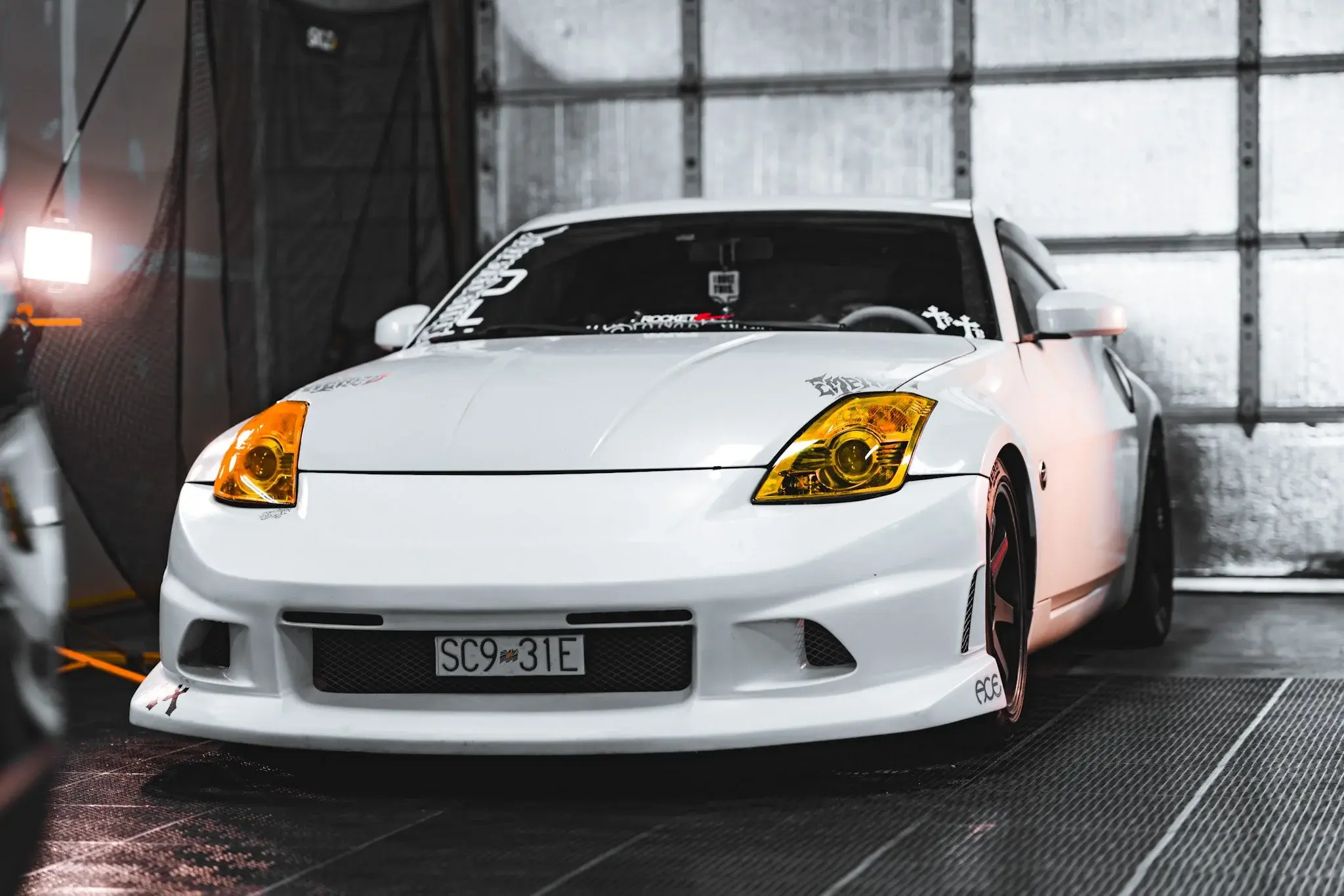
On the manual’s wording, smoked film on a headlamp, tail lamp or signal is a reject, because reducing light transmission is what it is designed to do. Yellow film on a headlamp fails twice over, and clear film raises a question the manual doesn’t settle.
Smoked film on tail lights and signals
Item 1.0(a) rejects a lens that “reduces transmission of light”. A 30% or 50% smoke film reduces it by design. Plan to have it off before the inspection.
Yellow film on headlamps
A yellow film covers the lens, which item 1.0(a) rejects, and turns the beam yellow, while item 1.1(a) requires a headlamp capable of “displaying white light.”
Clear protection film
Clear film still sits over the lens, and item 1.0(a) rejects a lens “covered in any manner” without making an exception for clear material. The manual doesn’t say how inspectors should treat clear protection film, so ask the facility before you book, or have it taken off first.
Clouded, yellowed and fogged lenses
A lens that is “clouded” fails on its own, film or no film. Surface haze and yellowing can usually be fixed with headlight restoration, and yellow headlight restoration covers lenses that have already turned. Moisture inside the assembly is its own reject item, and internal fogging is a replacement job, not a polishing one.
Off-road light bars
These run the other way: item 1.2(d) wants them hidden behind opaque covers, so an uncovered bar can fail.
The shop’s light films (STEK 30% and 50% smoke, yellow and clear) can be heated and peeled off, leaving the lens as it was. The full range is on headlight and taillight tint.
In what order should you prepare the vehicle and paperwork?
Settle the exemption question first, fix the glass and lamps second, inspect third, and register last. Doing it in that order avoids paying for an inspection the car was always going to fail.
- Check the exemption. If the vehicle came from Alberta, Saskatchewan or Manitoba, confirm against Circular 08-19 whether it needs inspecting at all.
- Clear the border, if it’s from the US or overseas. ICBC’s checklist asks for CBSA’s Vehicle Import Form (Form 1) “with two approval stamps” plus the matching customs document.
- Get a structural assessment, if it’s branded. Salvage, totalled or written-off vehicles need it before the safety inspection.
- Strip the film the glass items reject. That usually means the two front doors, and sometimes a windshield strip that runs too low or mirrored back-glass film.
- Sort out the lamps. Remove smoked or yellow film, and restore clouded lenses.
- Book the DIF. ICBC notes that “the cost of inspections varies” and suggests asking the facility for a price quote.
- Register with an Autoplan broker. Bring the original passed Vehicle Inspection Report (form CVSE0013 or CVSE0014), proof of ownership, identification and the out-of-province plates.
- Insure before you drive. MV1430 says that once registered, “you must purchase a B.C. licence and insurance or a Temporary Operation Permit before operating the vehicle on highway.”
Do the tint and light rules still apply after registration?
Yes, every time the vehicle is driven. Passing the inspection, or skipping it under the exemption, doesn’t license film that s. 7.05(8) forbids.
Police can write a violation ticket, which Mission RCMP says “typically carries a fine of $109” for illegal tint (Mission RCMP). They can also issue a Box 2 Notice & Order, which requires the film off and a complete mechanical inspection within 30 days, with a $598 fine if that deadline passes (CVSE). Under MVAR 25.08(1), an officer with reasonable and probable grounds can send a vehicle for inspection “despite an inspection certificate being in force.”
The practical risk falls on exempt vehicles. A truck that never saw a BC inspector can roll in with dark front film and meet the rule for the first time at the roadside. What to do in that case is laid out on tint removal after a Notice & Order.
Getting the glass and lamps ready before the inspection
Book the film work before the inspection slot, not after a fail. For most vehicles that means front-door tint removal and, where fitted, lamp film off.
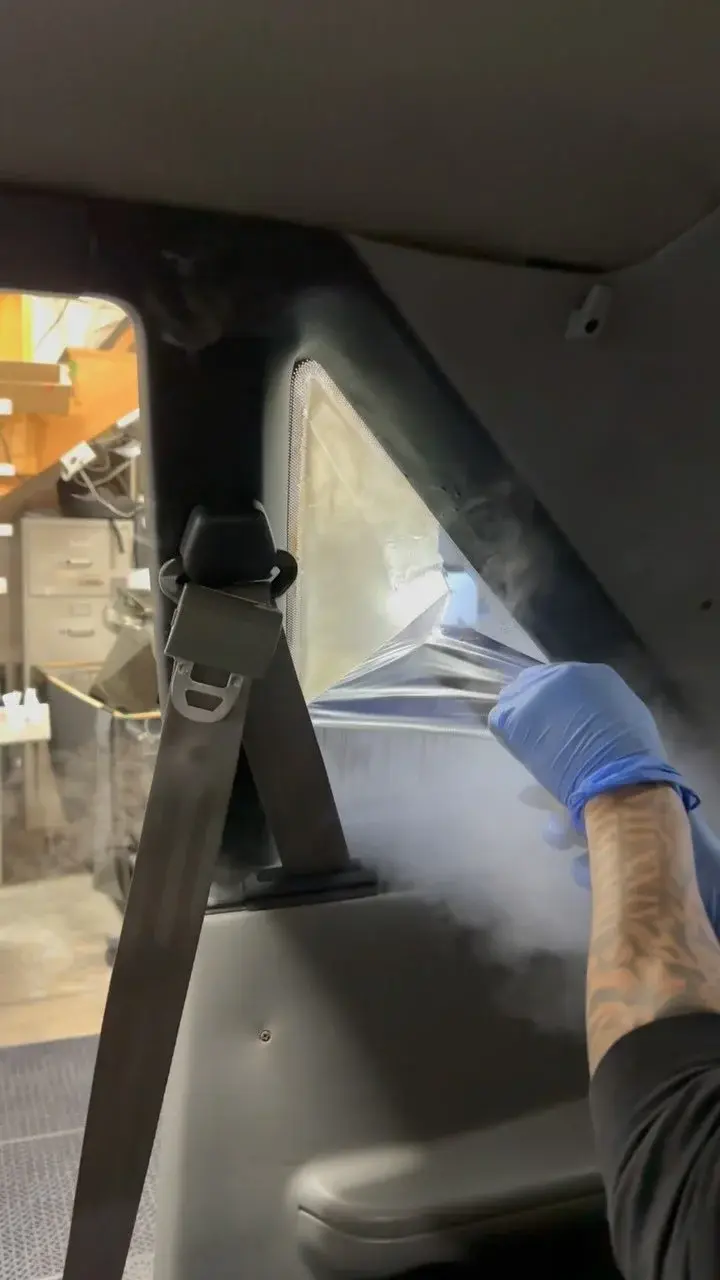
At the shop, removal for an inspection is done with steam, front two windows only unless you ask for more, and usually takes 1 to 3 hours. It is priced per window and discounted if the rear glass is re-tinted in the same visit; the details are on removing tint before an out-of-province inspection. Light film can be removed too. The shop takes calls and texts on 604 534 6433 between 9:00 and 17:00, every day except Sunday.