Which tint fails a BC out-of-province inspection?
Any film on side glass in front of the driver’s seat back fails, whatever its shade, and so does windshield film that hangs lower than 75 mm from the top edge. Back glass can be any darkness, provided there’s a mirror on each side of the car and the film isn’t reflective.
Those are the glass items in the 2025 Vehicle Inspection Manual, mandatory since September 2, 2025. They follow MVAR s. 7.05(8), which names no VLT percentage.
| Glass | Manual item | Rejected when | What we take off |
|---|---|---|---|
| Driver and front passenger windows | 13d | glass ahead of the driver’s seat back carries “any after-market tint (by film or any material or coating)” | All of the film and all of its glue |
| Windshield | 12e | after-market tint runs more than 75 mm below the top | A full windshield film, or a strip that hangs too low |
| Back glass | 14c | the car lacks outside mirrors on the left and right; the tint is “reflective type” or not allowed by ANSI/SAE Z26.1; or the driver’s normal vision is “materially impaired” | Only when one of those applies |
Two details catch owners out. “Forward of the driver’s seat back” takes in small fixed panes too, such as a vent window in the front door. And “by film or any material or coating” means clear film counts too.
Why a car that was legal at home fails in BC
Washington and Ontario allow some film beside the driver; BC allows none. Alberta bans it too, so an Alberta car with front tint was already outside Alberta’s own rule.
| Where the car was registered | Front side window rule there |
|---|---|
| Alberta | No film on the windshield or any window “beside or forward of the driver”, no strip allowance, $88 fine (AR 122/2009 s. 70) |
| Washington | Film allowed down to 24% combined light transmission (RCW 46.37.430) |
| Ontario | Vehicles built from January 1, 2017 fail Ontario’s safety inspection standard below 70% light transmittance beside the driver (MTO inspection standard) |
| British Columbia | No film forward of the driver’s seat back; windshield film only in the top 75 mm |
A Washington car with 35% film on the front doors can be legal at home and still fails here. An Alberta medical tint permit doesn’t carry over either; see whether BC has a medical exemption for tint.
How we take the tint off before your inspection
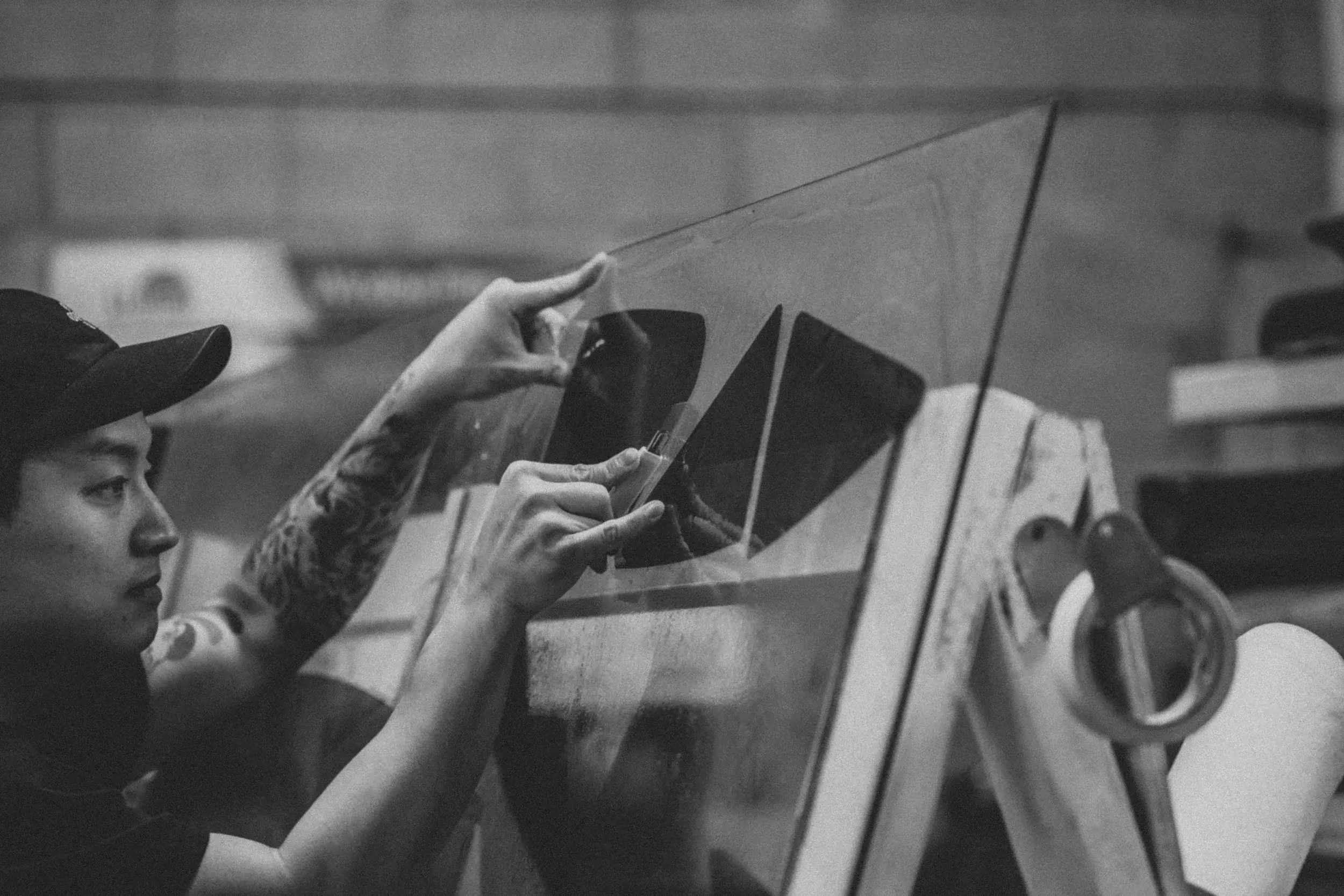
We strip only the glass the inspector will reject, using steam, and leave the rest of the car alone. For most out-of-province cars that means the two front doors and nothing else.
1. Settle which panes have to be bare
Per the manual: both front door windows, any vent glass ahead of the seat back, windshield film below 75 mm, and the back glass only if it is mirrored or a side mirror is missing.
2. Cover the door cards and seats
Removal is wet work, so trim panels and upholstery are covered before anything is lifted.
3. Lift the film with steam
Steam warms the old adhesive until the film lets go in large pieces. No razor goes near rear glass, because a blade is what cuts defroster lines.
4. Dissolve the leftover glue
Peeling the film leaves a tacky layer behind. We dissolve it completely, so the inspector looks through clean glass rather than a smeared haze.
5. Check the glass before you leave
Old film can hide chips and scratches. Anything we find, you see before the car goes back to you.
How long removal takes and what it costs
Most removals take 1 to 3 hours. Window count and the age of the glue set the time; decade-old film takes longer.
Removal is priced per window, so a front-two job for an inspection costs less than stripping the whole car, and re-tinting the rear at the same visit brings the removal price down. There is no published removal price list; every job is quoted. Tell us which windows carry film using the removal quote request and we’ll price those panes; phone or text 604 534 6433 if that’s quicker.
Do Alberta, Saskatchewan and Manitoba cars skip the inspection?
Some skip it, but none of them skip the tint rule. CVSE Circular 08-19 waives the inspection for qualifying private vehicles last registered to you in one of those three provinces, mostly late-model cars or ones with a recent passed provincial inspection.
In BC: an exempt car with front film is legal to register and illegal to drive. Police can write a $109 ticket or issue a Box 2 order that forces the removal anyway, as described on tint removal after a Notice & Order.
Full exemption conditions, ICBC’s document list and the lighting checks are in the out-of-province inspection guide for tint and lights.
What can go back on after the inspection?
Anything you like behind the driver, and nothing on the front doors. The rear glass can go as dark as 5% in LLumar ATC or IRX, or stay near-clear in AIR, each warranted for life, film and workmanship both.
| Rear-glass package (LLumar ATC) | Windows | From |
|---|---|---|
| Sedan or pickup | Two rear doors, any rear quarters, the back glass or slider | $240 |
| Sports coupe | Both rear quarters and the back glass | $220 |
| Full-size SUV or wagon | Rear doors, quarters, extended windows and hatch | $260 |
IRX ceramic and clear AIR are upgrades quoted per package; the current list is on window tint pricing. Some owners ask for film on the front doors again once the car is registered. It is not road-legal in BC: police can respond with a ticket or a Notice & Order, and the film fails the next inspection. We explain that risk before anyone decides.
Booking removal ahead of the inspection facility
Book the tint removal first and the inspection second, so the car arrives at the facility with bare front glass. On most cars a rear re-tint can happen in the same visit.
ICBC says inspection costs vary, so ask the facility for its price. Our shop is open between 9 and 5, Monday to Saturday.