Why doesn’t BC set a legal tint percentage?
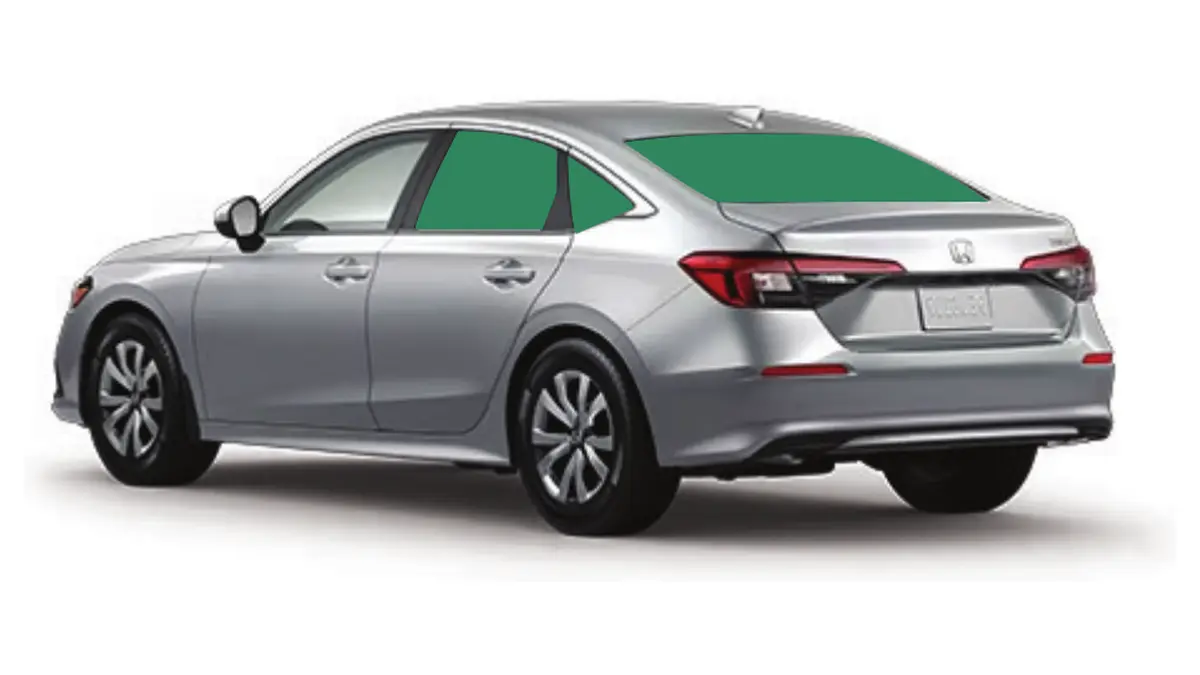
BC regulates where film goes, not how dark it is. MVAR s. 7.05(8) allows light-reducing material in three places: side windows “behind the driver”, the back glass of a car with outside mirrors on both sides, and the top 75 mm of the windshield. It attaches no light-transmission figure to any of them, and everywhere else the allowance is zero.
| Glass | Darkest film allowed in BC |
|---|---|
| Rear door windows and rear quarter windows | Any shade, 5% included |
| Back glass | Any shade, if the car has outside mirrors on both sides |
| Driver and front passenger windows | None |
| Windshield | Any shade in the top 75 mm, nothing below it |
So the question has two answers. Behind the driver, as dark as you like. Ahead of the driver, not at all, and the reason even clear film is caught is explained in the front window tint answer.
How do BC’s limits compare with Alberta, Washington and Ontario?
Washington and Ontario put a number on the front glass; BC and Alberta ban front film outright. A percentage that’s legal in one place can mean nothing in the next:
| Place | Front side windows | Side windows behind the driver | Where the rule is |
|---|---|---|---|
| BC | No film | Any darkness | MVAR s. 7.05(8) |
| Alberta | No film | Any darkness | AR 122/2009 s. 70 |
| Washington | 24% or more, glass and film combined | 24% on cars; darker allowed on trucks, SUVs and vans | RCW 46.37.430 |
| Ontario | 70% or more on vehicles built from 2017 | No percentage set | MTO inspection standard |
Washington’s RCW 46.37.430 counts factory glass and film together as “net film sunscreening”, so its 24% is a reading through both. Ontario’s 70% sits in the MTO inspection standard used for safety certificates, not in the Highway Traffic Act. Alberta’s section 70 works like BC’s, by location. Front film cut to a legal 35% in Bellingham becomes illegal film the moment the car is driven on a BC road.
What does the number on a tint film actually measure?
A film’s name carries a product code, not a measurement, and the two often differ. LLumar’s performance data sheet gives the measured figures, taken to NFRC methods on a single pane of 6 mm clear glass:
| Film | Measured visible light transmission |
|---|---|
| ATC 05 | 5% |
| ATC 15 | 18% |
| ATC 35 | 38% |
| ATC 50 | 60% |
| IRX 05 | 6% |
| IRX 35 | 39% |
| IRX 50 | 54% |
On a car, film sits on glass that already absorbs some light, so a meter held across both reads lower than the sheet. In Washington or Ontario that gap can decide a pass or a fail. In BC it barely matters for film: behind the driver any reading is legal, and ahead of the driver film fails whatever the meter shows.
Where does factory privacy glass fit in BC’s rules?
Factory tint is judged against the federal glass standard, not the film rule. Section 7.05(9) says tint built into manufactured glass “must meet the minimum light transmittancy requirements” of the Canadian Motor Vehicle Safety Standards. Federally, CMVSS 205 covers glazing and points to ANSI/SAE Z26.1-1996. The figure usually quoted for glass the driver needs to see through is 70%, but the ANSI document is paywalled, so treat 70% as commonly cited rather than as words in BC law.
Where a vehicle has dark factory privacy glass behind the driver, film can go over it in any shade, because the film rule sets no limit there. Ahead of the driver, the factory glass is legal as built and anything added to it is not.
Is mirror or reflective tint legal in BC?
The regulation sets no reflectivity limit, but BC’s inspection manual fails reflective tint on the windshield, the front side windows and the back glass. Items 12e, 13d and 14c of the 2025 Vehicle Inspection Manual each reject “any tint that is reflective type”, without giving a number. Washington, by contrast, caps total reflectance at 35%.
The films Brookswood Tint installs aren’t mirror films. LLumar’s sheet lists visible light reflection of 5 to 7% across the ATC and IRX shades and 9% for AIR 80 and AIR 90.
Does darker tint block more UV and heat?
Darker film doesn’t block more UV, and on heat the type of film counts for more than the shade. LLumar rates every automotive film on its sheet, from ATC 05 through AIR 90, at over 99% UV protection in the 300 to 380 nm band. Writing for the Skin Cancer Foundation, an International Window Film Association consultant made the same point: a darker tint guards against UV no better than “clear UV-protective film”.
| Film | Visible light transmitted | Total solar energy rejected |
|---|---|---|
| ATC 05 | 5% | 44% |
| ATC 50 | 60% | 28% |
| IRX 05 | 6% | 62% |
| IRX 50 | 54% | 50% |
IRX 50 lets through roughly ten times the light of ATC 05 and still rejects more of the sun’s total energy. If you’re going dark for comfort alone, the film line deserves as much thought as the shade.
How do you pick a shade for the windows you can tint?
Choose the look you want behind the driver; the law won’t stop you at any shade there. The shop carries both ATC and IRX in four shades (5, 15, 35 and 50%) and clear AIR in 70, 80 and 90%. In ATC, rear glass starts at $240 on a sedan or pickup, $220 on a sports coupe and $260 on full-size SUVs and wagons, and IRX or AIR is quoted per package.
For help choosing between 5, 15 and 35, read what tint percentage you should get. If heat matters most, look at ceramic window tint next to dyed film, and check the package list on tint pricing.