What has research found about glass, heat and EV range?
That cutting solar heat through the glass adds a little range in hot weather, and not much more. The clearest test comes from the US National Renewable Energy Laboratory (NREL), working with Eastman Chemical, the company behind LLumar.
The 2013 study swapped a car’s windshield for one with a solar-control interlayer. That brought the windshield’s total solar transmission down from 62% to 55%. The researchers parked test and control cars facing south in the Colorado sun, measured the temperature difference, then modelled what it meant for the air conditioning and the battery:
| Result | Figure |
|---|---|
| Cabin air temperature after soaking in the sun | 1 °C lower |
| Dashboard surface temperature | 3.5 °C lower |
| A/C power needed, at 35 °C and 60% humidity | 4.0% less |
| EV range with the A/C running | Up 0.7% to 1.5%, depending on the drive cycle |
| In distance | About 1.5 km on the city cycle, 1.0 km on the highway |
The authors say real-world results will differ, and present the numbers as an estimate of the magnitude. That magnitude is small: a hot-day gain you’d struggle to notice on the dash.
Why is the range effect so small?
Because air conditioning is only part of what the battery does, and solar heat through the glass is only part of what the A/C fights. In the study, taking 4% off the A/C load gave back around 1% of range.
The study’s conditions were also tough on purpose: 35 °C, humid, and parked facing the sun. Abbotsford’s climate normals for 1981 to 2010 average 8.7 days over 30 °C each year and an average July high of 24.0 °C. On most Fraser Valley summer days the A/C works less hard than in the test, so there’s less load to save.
The US government’s fueleconomy.gov does warn that the A/C’s effect on EVs “can be even larger on a percentage basis” than on gas cars. That’s the reason the topic comes up at all. It doesn’t turn a 4% A/C saving into a big range gain.
Does BC’s tint law change the answer?
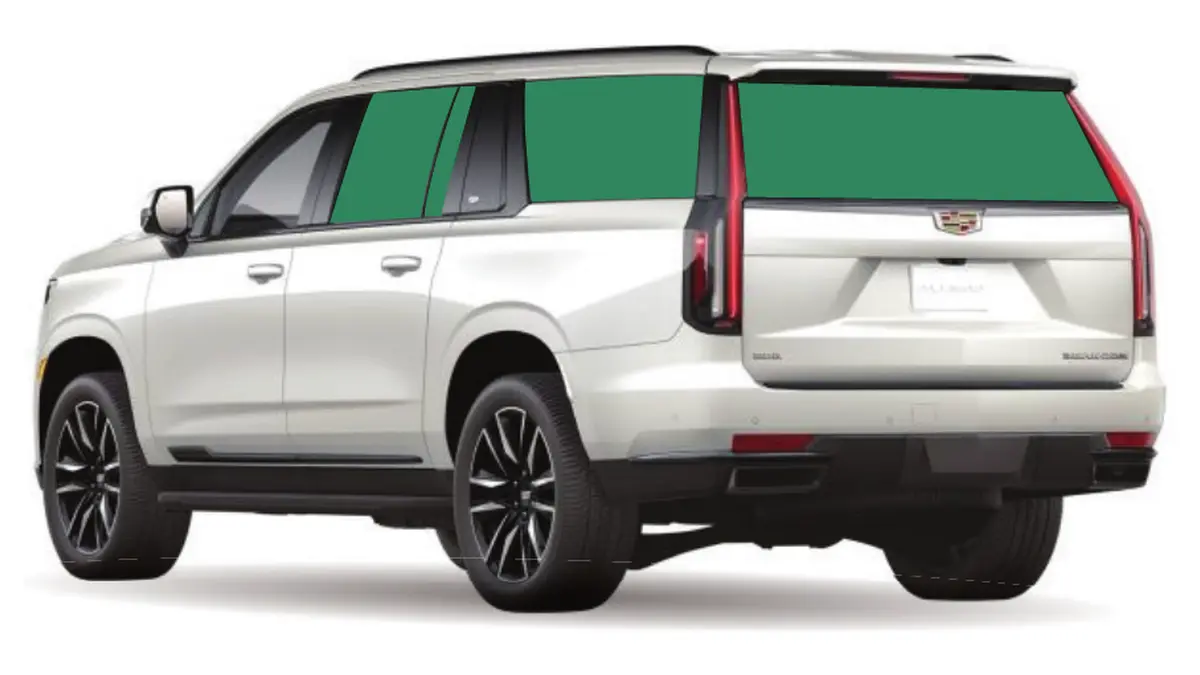
Yes, it shrinks it further. The NREL study changed the windshield, and its authors note that more than 40% of the heat entering a vehicle comes in through the windshield. In BC, the windshield is off-limits to film below its top 75 mm.
BC’s MVAR s. 7.05(8) confines legal film to the rear side glass, the back glass if mirrors are mounted on both sides, and a top band of the windshield no deeper than 75 mm; nothing may go on the front door glass. Owners can still have the shop fit a full windshield or front doors, but only after hearing that it breaks BC’s rule: a violation ticket of $109 is the usual penalty, and police can also order the film off and the car inspected. Legal tint on an EV therefore works on the rear glass, and whatever it saves, it saves there.
Does tint help EV range in winter?
Not in any useful way. Cold weather costs EVs a lot of range, and most of that loss goes to heating the cabin, which window film doesn’t supply.
On its cold-weather page, fueleconomy.gov, citing AAA testing, says EV range “can drop by 41%”, and that “about two-thirds of the extra energy consumed is used to heat the cabin”. The NREL paper gives the reasons glass matters little in winter: a low sun, fewer daylight hours and fewer sunny days. In an EV the battery heats the cabin, and the sun through the rear windows on a grey November afternoon won’t change that. Whether film keeps a car warmer in winter is answered on does window tint keep a car warmer in winter.
What does tint actually do for an EV?
It makes the car more comfortable to get into and ride in on sunny days, and it does the UV and privacy jobs it does on any car. That’s the case for tinting an EV, and it’s a good one without a range claim.
LLumar’s spec sheet measures what the film turns away, not what that does to range:
| Film | Solar energy turned away (TSER) | Infrared turned away (IRER) | UV |
|---|---|---|---|
| ATC, dyed | 28–44% | 22% | >99% |
| IRX, ceramic | 50–62% | 59–61% | >99% |
| AIR 80, clear ceramic | 43% | 60% | >99% |
Ceramic film’s heat numbers are the reason to consider it on an EV. The NREL result for windshield glass, a cooler dash and a slightly lighter A/C load, is the honest picture of what any heat-blocking glazing does. For local temperatures inside a closed car, see parked-car heat in Langley.
Booking tint for an electric car
EVs use the same body-based rear packages as everything else: from $220 for a coupe up to $260 when the vehicle is a full-size SUV or wagon, in ATC, with sedans and pickups at $240 and ceramic film priced per package. Glass roofs are quoted from the car, and the shop’s films contain no metal, so radio and GPS are unaffected.
The EV window tint page covers long rear glass and roofs, and the EV owner’s guide puts tint and PPF together. Text 604 534 6433 with your model, or use the online request for a tint quote.