How much does sunroof or panoramic roof tint cost?
Roof tint is quoted per vehicle; the shop has no posted roof price. A small tilting sunroof and a one-piece glass roof running from the windshield header to the hatch are very different jobs, so the shop prices the glass in front of it rather than an average.
What moves a roof quote:
- Glass area. A single panel over the front seats takes far less film and time than a roof that covers the whole cabin.
- Number of panes. Some roofs are two panes, one fixed and one that slides or tilts, and each is cut and fitted on its own.
- Curve. The more the glass bends in two directions, the more heat-forming it needs before the film lies flat.
- Film. LLumar ATC, IRX or AIR, with the ceramic films priced higher.
- Old film. Failed film on the roof comes off first, as a separate tint removal job.
The quote covers genuine LLumar film, the plotter pattern for your model, the hand fitting, and lifetime cover on film and labour. If you’re having the side and rear glass done too, ask for one figure for everything: the shop usually prices a whole-car job below the separate list prices, which start at $220 to $260 for rear glass on the window tint prices page.
Is sunroof glass laminated or tempered?
It depends on the car: roof glass is made both ways. Pilkington, one of the large automotive glass makers, says its sunroofs are “available in both tempered and laminated to suit design, safety, and performance needs.”
| Source | What it says about roof glass |
|---|---|
| Skin Cancer Foundation | Side, back and sunroof windows are “tempered glass, which does not block UVA rays effectively” |
| Polestar 2 owner’s manual | “The windscreen and panoramic roof have laminated glass,” always |
| AGC, Lexus RZ roof (2022) | A light-control film “encapsulated between layers of interlayer in laminated glass,” with a Low-E coating |
| Pilkington | Sunroofs made in tempered or laminated glass |
The difference shows up in UV. AGC, a glass maker, puts a laminated windshield’s UV cut at about 99% and tempered glass at around 90%. LLumar rates all of its listed films above 99% UV blocking from 300 to 380 nm, so film closes most of that gap on a tempered roof.
Construction also decides what the shop needs to know before it quotes. A roof with its own coating or a switchable layer, like the Lexus RZ glass that changes between dimmed and transparent, gets looked at first. Tell the shop your trim and whether the roof dims electronically.
How much heat comes through a glass roof?
More than through any side window at midday in summer, because a roof panel faces the high sun far more squarely. At Langley’s latitude, about 49° north, the noon sun at the June solstice stands roughly 64° above the horizon, so a near-flat roof panel takes it close to head-on.
The Fraser Valley gets plenty of that sun. Abbotsford’s climate normals (Environment and Climate Change Canada, 1981–2010) log 1,886.7 sunshine hours a year, July and August average highs of 24.0 °C and 24.4 °C, and 8.7 days each year over 30 °C. Even AGC, which makes roof glass, describes heat in summer and cold in winter as a problem panoramic roofs have had to solve.
Film puts a number on the fix. The figures below are LLumar’s, measured on 6 mm clear glass, so a tinted or coated roof will read differently.
| Film | Visible light through | Total solar energy rejected (TSER) | IR energy rejection (IRER) |
|---|---|---|---|
| ATC 35, dyed | 38% | 35% | 22% |
| IRX 35, ceramic | 39% | 54% | 60% |
| IRX 05, ceramic | 6% | 62% | 60% |
| AIR 80, near-clear ceramic | 77% | 43% | 60% |
If your roof has a sunshade, closing it keeps the sun off your head. Film lets you leave the shade open on a bright day without the same heat load, and it keeps working on roofs built without a shade, like the Lexus RZ glass AGC describes. IRX and AIR are set side by side, with prices, on ceramic window tint in Langley.
How is film fitted to large, curved roof glass?
It’s cut to the roof’s outline on the plotter, then shaped to the glass with heat and fitted by hand. On a big panoramic roof, the shaping is where the time goes.
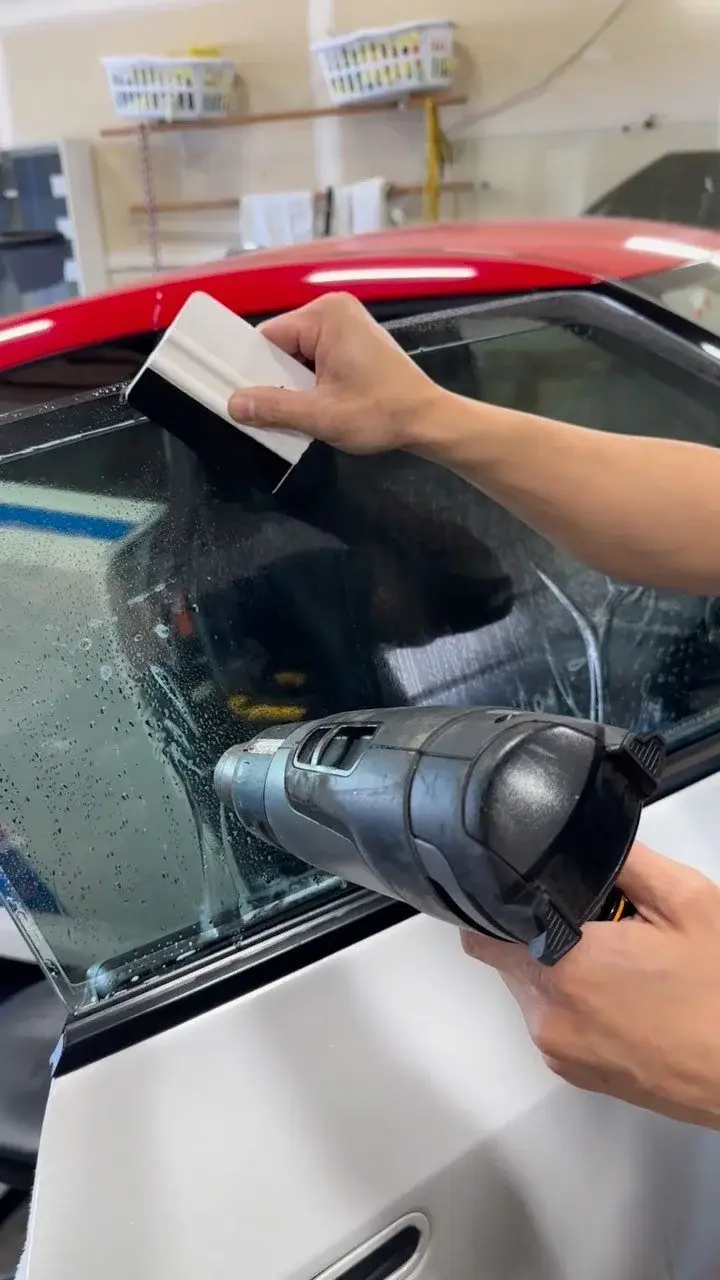
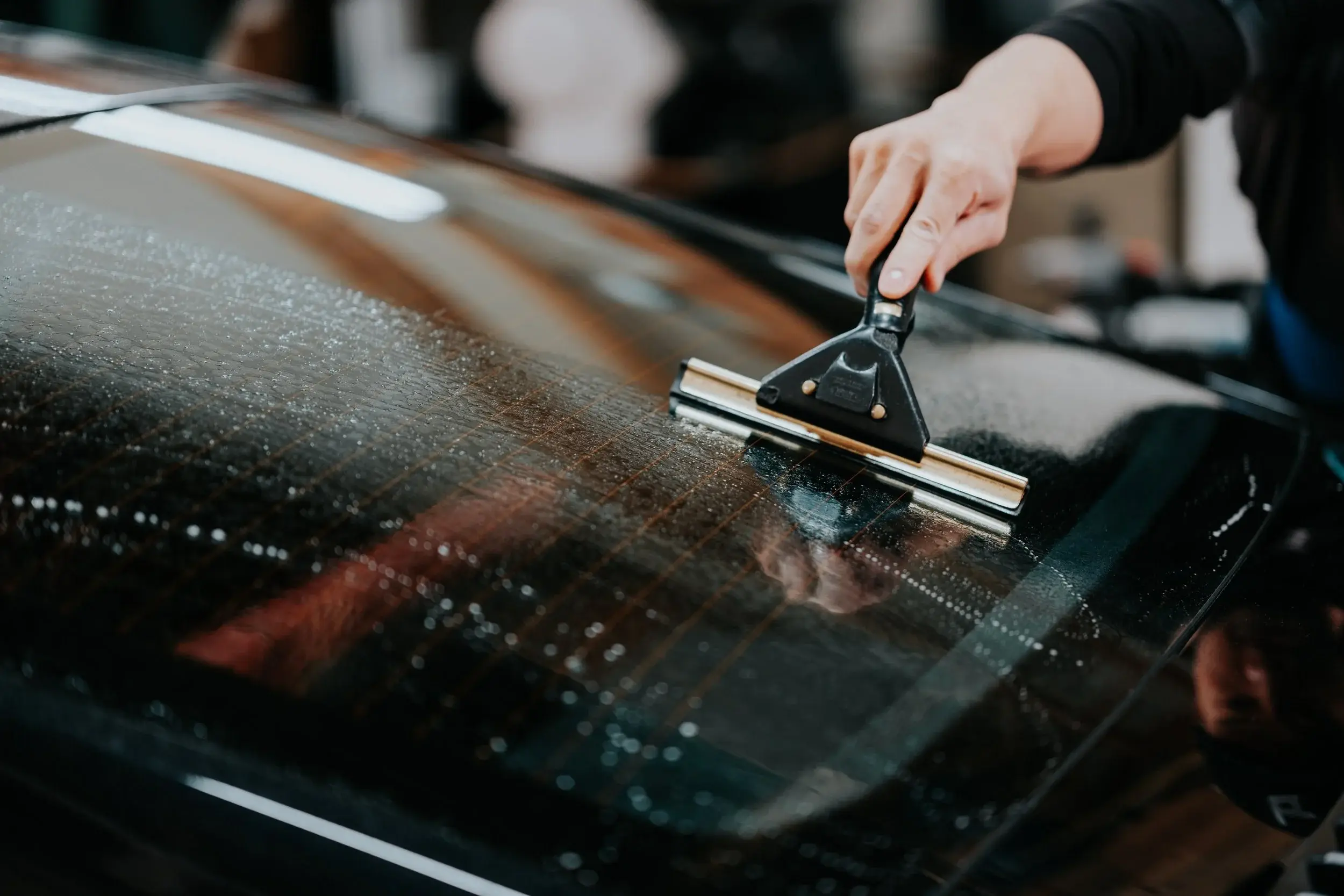
Flat film won’t lie on glass that curves in two directions without help. The installer shrinks it with a heat gun wherever it would otherwise bunch, working it until it follows the curve without creases at the edges, then squeegees it into place. Because the plotter does the cutting, no blade touches the glass or the trim around it. On a two-pane roof, the fixed panel and the moving one are separate pieces of glass, each cut and shrunk to its own shape.
After the install, treat an opening roof the way you would a door window: leave it shut for the three to five days the film needs to cure. A light haze in the first week is normal and clears as the moisture dries.
What does BC law say about tinting roof glass?
The regulation doesn’t mention roof glass by name, and this page doesn’t call roof film legal or illegal. Here is what the texts say, so you can read the wording yourself.
MVAR s. 7.05(8) bars light-reducing material on “the windshield or a window” of a vehicle driven on a highway, unless the material is on one of three places:
- the windshield, within 75 mm of its top edge
- a side window behind the driver
- the rear window, provided there’s an outside mirror on each side
Roof glass isn’t one of the three named exceptions, and the section doesn’t say whether a roof panel counts as “a window.” Item 29 of the Schedule to Division 7 words the standard more narrowly: no film on the windshield more than 75 mm below the top, and none “on a window other than a side window” behind the driver.
The 2025 Vehicle Inspection Manual, used at designated inspection facilities, has tint reject items for the windshield (12e), the side windows forward of the driver’s seat back (13d) and the rear window (14c). None of its glazing items mentions a sunroof or roof glass. Those three items also reject any reflective tint.
In BC: that leaves a question the texts don’t answer directly. The shop walks you through the wording before you decide, and the wider rules are in the BC window tint laws guide.
How do you get a roof tint quote in Langley?
Send the year, make, model and trim, since the trim often decides whether there’s a glass roof and what kind. Say whether the roof opens or dims, and which film you have in mind: AIR to keep the daylight, IRX to cut it.
The shop quotes the roof on its own or with the rest of the glass. Glass roofs are common on SUVs and crossovers, and the side and hatch glass on those is covered on the SUV window tint page. For the films in detail, see LLumar IRX and LLumar AIR. Request a roof price through the quote form for roof tint. If you’d rather talk it through, the number is 604 534 6433.