
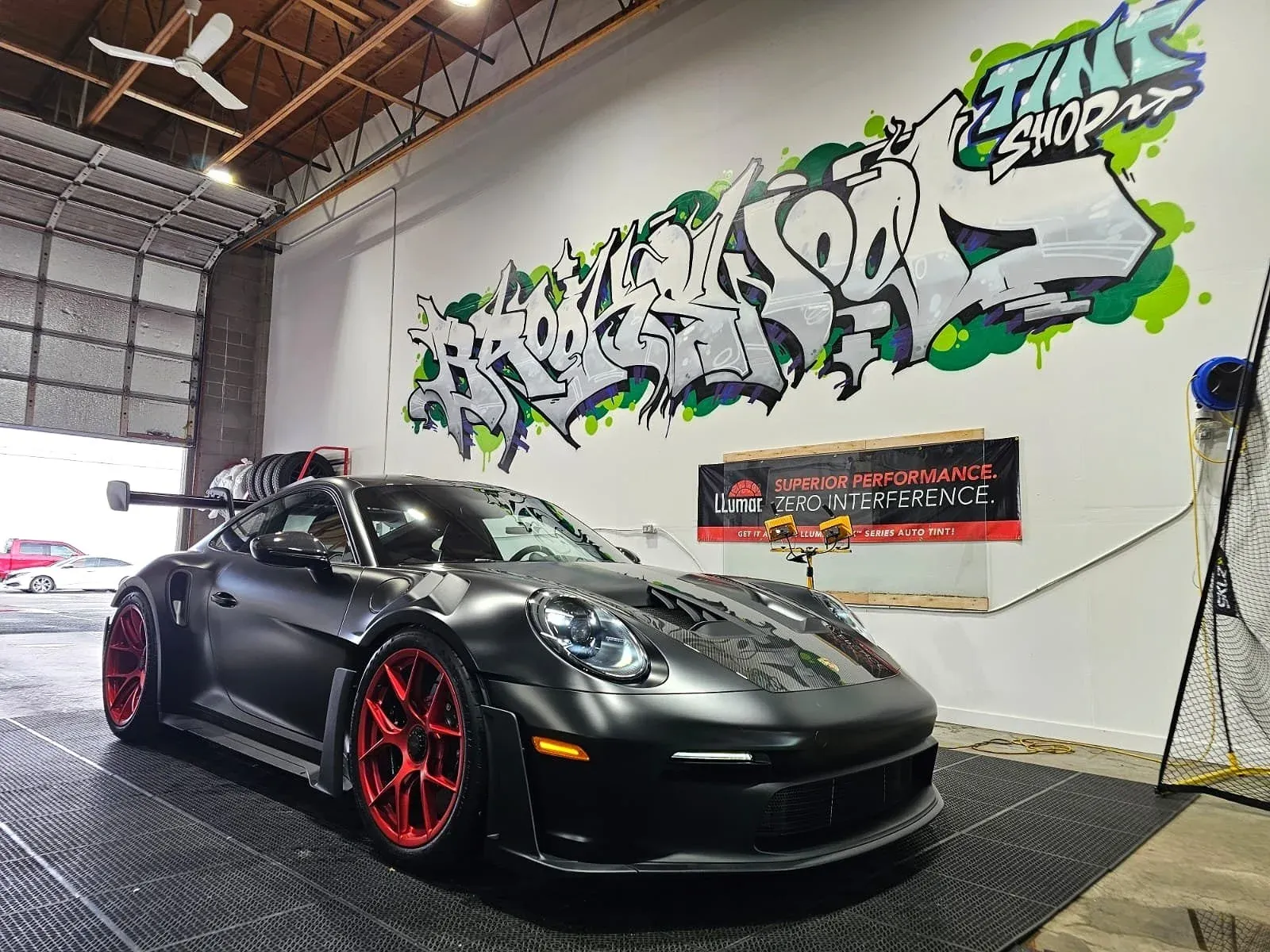

What does a window tint percentage measure?
Visible light transmission, usually shortened to VLT: the share of visible light that passes through, compared with the light falling on the window. A lower number means a darker window.
Building glass uses the same measure. The National Fenestration Rating Council, which rates windows and window film in the US, describes visible transmittance as a measure of how well a product lets daylight in, on a scale of 0 to 1; car film uses the same quantity written as a percentage. Washington State puts it in legal terms in RCW 46.37.430: “the ratio of the amount of total visible light, expressed in percentages,” that passes through a window to the amount falling on it. The meaning on your car is the same: 20% tint lets roughly a fifth of the daylight through.
How do film makers measure tint for a spec sheet?
In a lab, on a standard pane of glass, so every film is measured the same way. The result is the figure on the spec sheet, which is often not the number in the film’s name.
LLumar’s performance data sheet says its data were “captured using NFRC guidelines for window film solar performance measurement as measured on single pane, 1/4 inch (6mm), clear glass.” It adds that values come from “representative product samples” subject to “normal manufacturing variances”, and that actual performance varies with glass type. Some product codes match their measurement closely; others don’t:
| Film code | Measured VLT on LLumar’s sheet |
|---|---|
| ATC 20 | 25% |
| ATC 40 | 43% |
| IRX 15 | 20% |
| IRX 25 | 26% |
| CTX 50 | 55% |
| AIR 80 | 77% |
| AIR 90 | 84% |
So a film’s code and its measured darkness can sit several points apart: ATC 20 measures 25%, while IRX 15 measures 20%. When you compare quotes, compare measured VLT from the maker’s sheet, not the name on the box.
How does a handheld tint meter work?
It shines light through the glass and reports the share that gets through. Meters are built for law enforcement and tint shops alike, and they read the glass and any film on it as one.
EDTM, which makes the Tint-Chek line, describes its meters as measuring “Visible Light Transmission (Transmittance) of automotive glass and any glass/film up to 1/4” or 6.5mm thick.” Two designs cover different windows:
Slot meters for roll-down windows
The TC1800 has an opening you slide the glass into, so the window is lowered a little and the meter fits over its top edge. EDTM says it ships calibrated to a NIST-traceable standard and uses techniques to cancel ambient light such as “stray headlights and cloud cover.”
Two-piece meters for fixed glass
Windshields, back glass and fixed quarter windows can’t be slid into a slot. The TC3800 splits into an instrument unit and a reflector unit with magnets that line the two halves up through the glass, which lets it test windshield, rear-window and side-window tint.
Why does a meter read lower than the film’s percentage?
Because the meter is measuring the glass as well. Car glass absorbs some light before any film is added, and the two transmissions multiply.
A simple way to estimate it: multiply the two transmissions. If a window’s glass passes 80% of light and the film passes 38%, the pair passes about 0.80 × 0.38, roughly 30%. Washington writes the same idea into law: its limit applies to “net film screening”, which counts the colour the glass maker put in plus any film added afterward. On factory privacy glass, which starts much darker, the combined number drops further; that case is worked through on tinting over factory tint.
Where does a measured tint percentage actually matter?
In places that set a percentage, and not in BC. British Columbia regulates tint by window, not by reading.
| Place | What the rule turns on |
|---|---|
| British Columbia | Which window: no film on front side windows or the windshield below its top 75 mm; any darkness behind the driver |
| Washington State | 24% or more net light transmission on side and rear windows |
| Ontario | 70% minimum in the provincial inspection standard for 2017 and newer vehicles |
| Alberta | No film beside or ahead of the driver, whatever its percentage |
BC’s regulation, MVAR s. 7.05(8), permits film of any shade behind the driver, on the rear window of a car with mirrors on both sides, and in the windshield’s top 75 mm. The 2025 Vehicle Inspection Manual rejects “any after-market tint” on a side window forward of the driver’s seat back (item 13d), so even a near-clear film with a high VLT fails there. The shop fits front-door film when asked, and explains first that it isn’t road-legal in BC at any reading. Washington’s rule is compared with BC’s on BC vs Washington tint laws.
Using tint percentages to choose your film
Read the measured VLT on the maker’s sheet, think about the glass it’s going on, and choose for the rear windows, since that’s where BC lets the number vary. A lower VLT means more privacy and glare control; heat rejection is a separate figure.
LLumar ATC and IRX come in 5, 15, 35 and 50% at Brookswood Tint, with AIR as a near-clear option. On the price list, ATC on a sports coupe’s three rear windows starts at $220, and every other body style is listed alongside it. For help choosing a shade, see what tint percentage to get; the short definitions live under VLT and tint meter in the glossary. Ask for a price through the window tint quote form.