How do BC and Washington tint rules compare on each window?
Washington sets a percentage for the side and rear glass; BC sets none and rules by position instead. Here is how BC’s MVAR s. 7.05(8) and Washington’s RCW 46.37.430 treat each piece of glass:
| Glass or issue | British Columbia | Washington State |
|---|---|---|
| Windshield | Film only within 75 mm of the top edge | Darker film in the top 6 inches, kept above the AS-1 line; clear UV film allowed on the whole windshield |
| Front side windows | No film | 24% light transmission or more, glass and film combined |
| Rear side windows on cars | Any darkness | 24% or more, combined |
| Rear side windows on trucks and multipurpose passenger vehicles | Any darkness | Below 24% allowed, if reflectance is 35% or less |
| Back glass | Any darkness when both outside mirrors are fitted | Same limit as the side glass, with both mirrors showing 200 feet behind |
| Reflective film | No figure in s. 7.05; “reflective type” tint fails the 2025 inspection manual | Total reflectance of 35% or less; mirror finishes banned |
| Film colour and layers | No colour or layer rule in s. 7.05 | Red, gold, yellow and black material banned; one sheet per window |
| Inspections | Cars from outside BC must pass a designated-facility inspection before registration | State Patrol inspections are VIN checks on rebuilt, homemade or stolen vehicles |
Washington’s State Patrol describes its inspections as checks made “in an effort to deter auto theft”, and its page says nothing about tint.
What does Washington’s 24% measure, and which shades clear it?
It’s a reading through the glass and the film together. RCW 46.37.430 defines “net film screening” as the manufacturer’s tint in the glass plus any film added after the vehicle was built, so factory privacy glass counts against the 24%.
LLumar’s performance data sheet rates each shade to NFRC methods, measured through one 6 mm sheet of clear glass. Against Washington’s line they fall like this:
| LLumar shade | Measured VLT on clear test glass | Against Washington’s 24% |
|---|---|---|
| ATC 05 | 5% | Below it before the car’s own glass is counted |
| IRX 05 | 6% | Below it |
| ATC 15 | 18% | Below it |
| IRX 15 | 20% | Below it |
| ATC 35 | 38% | Above it on test glass; the car’s glass sets the final reading |
| IRX 35 | 39% | Above it on test glass |
| ATC 50 | 60% | Above it on test glass |
The 5% and 15% shades the shop sells in ATC and IRX sit under Washington’s floor for a car on their own. The 35% and 50% shades start above it, but a meter on a real door reads lower than the sheet, because automotive glass holds back some light of its own.
Can a BC car get a tint ticket in Washington?
Yes, on the statute’s wording. Subsection (7) says running non-compliant film on Washington’s public highways is a “traffic infraction” for “any person”, and the section has no exception for vehicles registered elsewhere. Washington’s court rule IRLJ 6.2 lists US$48 as the base penalty for an equipment infraction not listed separately, “not including statutory assessments”.
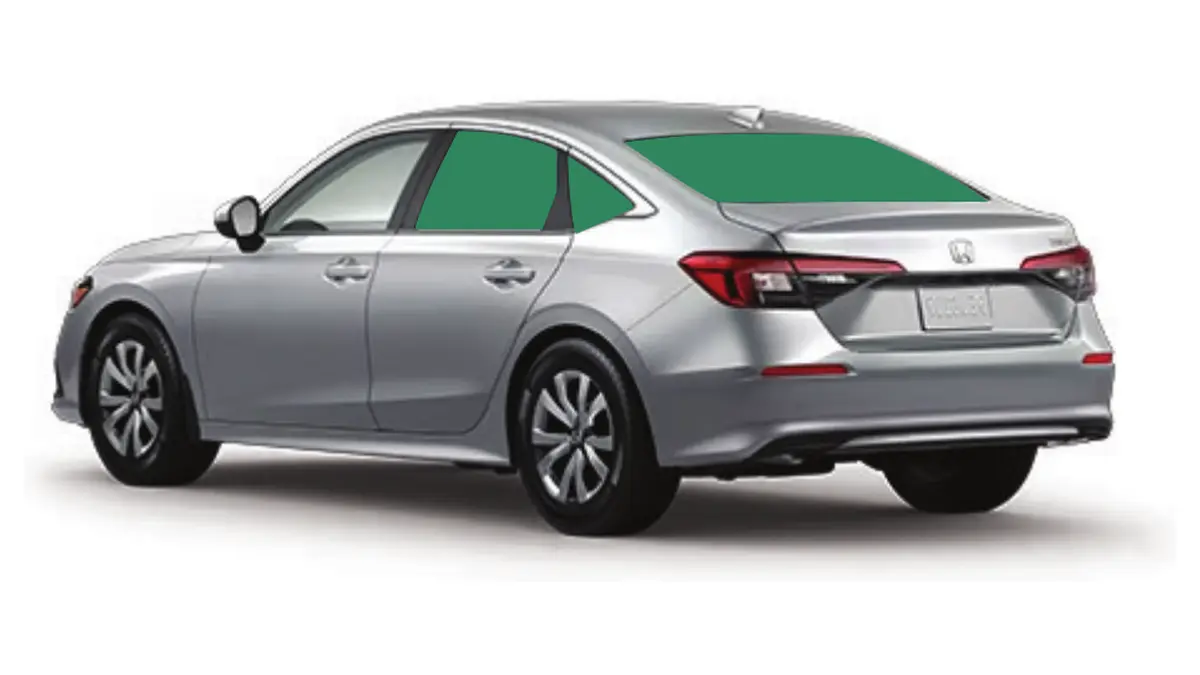
The mismatch runs mostly one way. Rear film that BC never measures, such as 5% or 15% on a sedan’s back doors and rear window, is darker than Washington allows on a passenger car. A pickup, or an SUV or van that its manufacturer identifies as a “multipurpose passenger vehicle”, is treated differently: subsection (5)(b) lets that class go below 24% on any window to the rear of the driver, as long as reflectance is 35% or less and both outside mirrors are fitted. Front door film is a problem on both sides of the line: banned outright in BC, and legal in Washington only at 24% or more combined.
Is a Washington car with legal front tint legal in BC?
No. Section 7.05(8) applies to any person who drives or operates a vehicle on a BC highway, and it has no exception for out-of-province plates. The one carve-out in Division 7 for vehicles registered outside BC, in s. 7.01(4), is limited to cars built in 1940 or earlier and doesn’t touch s. 7.05. So 35% film on a Washington car’s front doors, legal at home, is illegal on Highway 1.
The windshield shows the gap most clearly. Washington allows clear UV film over the whole windshield under subsection (5)(e). BC’s 2025 Vehicle Inspection Manual fails a windshield under item 12e when after-market tint extends past the 75 mm band at the top, clear film included.
A Washington car moving here clears the Canada Border Services Agency, then needs a pass at a designated inspection facility before ICBC registers it (MVAR 25.24 and 25.25), and item 13d fails film ahead of the driver’s seat back. The removal job is on removing tint ahead of a BC out-of-province inspection.
How do Washington’s medical exemption and installer sticker work?
Washington lets a physician’s note allow darker film; BC has no medical route at all. Subsection (5)(d) permits “a greater degree of light reduction” on “all windows and the top six inches of windshields” of a vehicle driven by, or carrying, a person with “a written verification from a licensed physician” that they must be protected from sunlight. The statute names no permit, fee or state approval step. That letter carries no weight in BC, whose tint section and inspection manual offer no medical exception; the legal alternatives are listed in the BC medical tint exemption answer.
Washington also tracks who did the work. Under subsection (5)(c), a business tinting for profit within the restricted areas must supply a sticker for the driver’s door post, beside the manufacturer’s identification tag, showing its business name and state tax number. The sticker certifies that the work meets the light transmission, reflectance and placement standards. BC’s regulation has no sticker scheme, so the invoice is your record of the film and shade.
LLumar lists visible light reflection of 5 to 9% for the shop’s ATC, IRX and AIR shades; Washington caps total reflectance, a different measure, at 35%.
Tinting a BC car that crosses into Washington
Start from BC’s rule, since that’s where the car is registered: nothing on the front doors, any shade behind. On a sedan or coupe that crosses often, 35% or 50% behind the driver keeps the film itself above Washington’s line, while a pickup or a multipurpose passenger vehicle can stay dark in both places. The BC side, shade by shade, is in how dark tint can be in BC.
In LLumar ATC, rear sets start at $240 for sedans and pickups, $220 for sports coupes and $260 for full-size SUVs and wagons. IRX ceramic and clear AIR are quoted as upgrades for each package, with lifetime cover on the film and the work. Every package is listed on window tint pricing; to book, use the tint quote request or phone 604 534 6433 from Monday to Saturday.