
Who makes LLumar and SunTek window tint?
The same company. Both brands belong to Eastman Performance Films, LLC, whose name sits at the foot of each brand’s website and spec sheet, and Eastman’s own brand list includes “LLumar window and paint protection film” and “SunTek window film” side by side.
That shared parentage shows in the paperwork. SunTek’s automotive specifications sheet (04/24) and LLumar’s performance data sheet (03/26) define IRER and SIRR in the same words and measure on the same nominal quarter-inch clear glass. That’s rare: most brand comparisons, such as LLumar vs 3M, have to correct for different test glass first. Here you can put the numbers next to each other as they are.
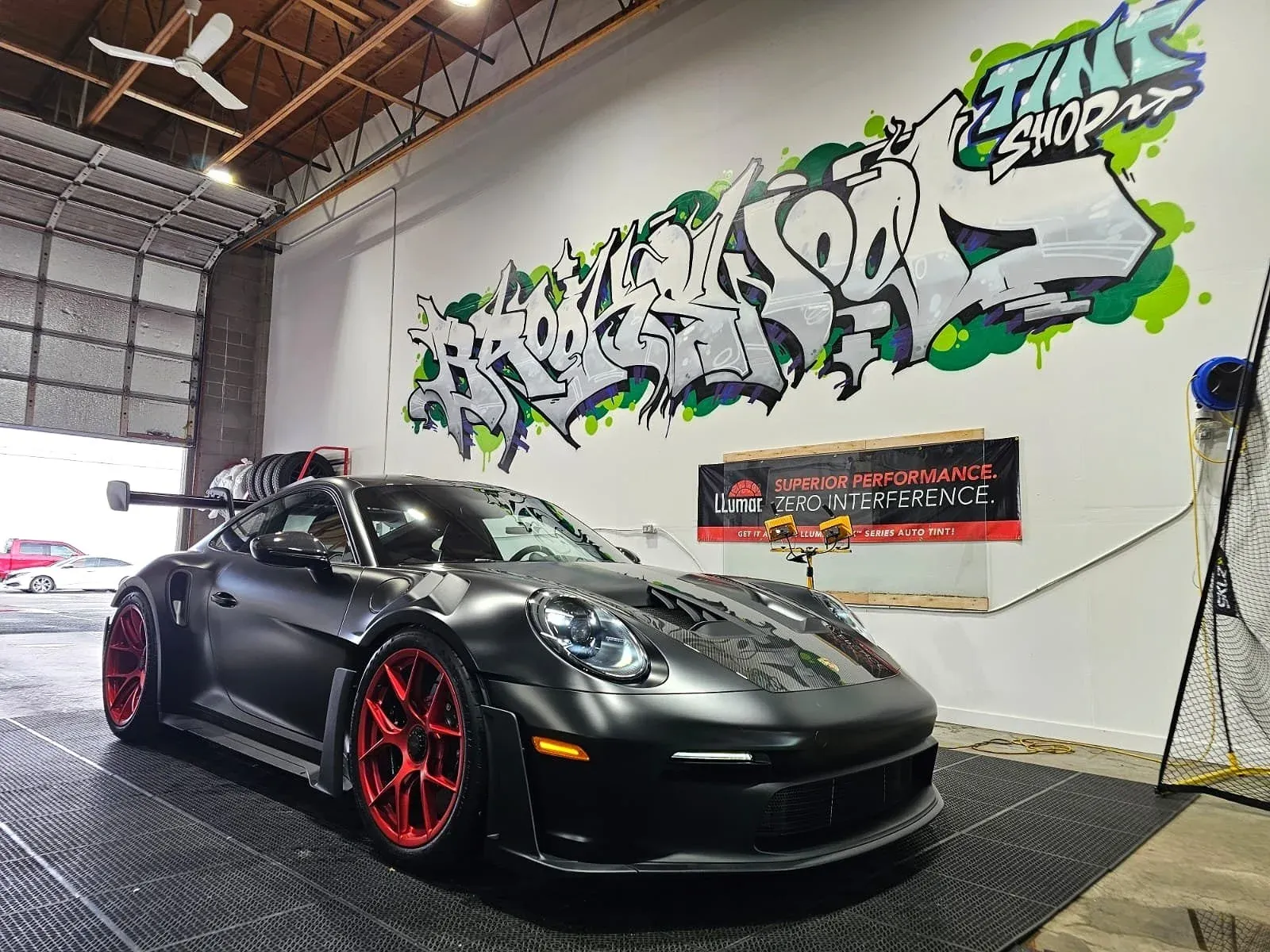
What differs is the line-up, the product names and the dealer network. SunTek says its automotive tint is made in Martinsville, Virginia, and is sold through SunTek dealers; LLumar is sold through LLumar dealers such as Brookswood Tint.
How do the LLumar and SunTek lines match up?
Each film type the shop sells has a SunTek counterpart, and SunTek adds a carbon tier and a premium ceramic that LLumar’s current sheet doesn’t have.
| Film type | LLumar | SunTek |
|---|---|---|
| Dyed charcoal | ATC (on the shop’s menu) | Standard Pro, Standard |
| Carbon | None on the current sheet | Carbon, CXP |
| Metallized | ATR | HP (High Performance) |
| Ceramic | IRX (on the shop’s menu), CTX | CIR |
| Premium ceramic | No separate tier | Evolve, with “HeatResist” nanoparticles |
| Clear ceramic | AIR 80 and 90 (on the shop’s menu) | CoolSight 90 |
SunTek’s carbon films are compared with ceramic on ceramic vs carbon window tint, so this page sticks to the three film types the shop installs.
How does LLumar ATC compare with SunTek Standard Pro?
They’re near twins. Matched by measured light, Standard Pro and ATC sit within one point of each other on total solar energy rejected (TSER) at every shade.
| Measured darkness | LLumar ATC (VLT / TSER) | SunTek Standard Pro (VLT / TSER) |
|---|---|---|
| About 5% | ATC 05: 5% / 44% | STD PRO 5: 4% / 44% |
| About 18–19% | ATC 15: 18% / 40% | STD PRO 20: 19% / 39% |
| About 38–39% | ATC 35: 38% / 35% | STD PRO 40: 39% / 34% |
| About 57–60% | ATC 50: 60% / 28% | STD PRO 50: 57% / 28% |
Two small differences show up. LLumar rates every ATC shade above 99% UV rejection, where SunTek rates most Standard Pro shades above 97% and only its 5 above 99%. And SunTek’s warranty splits its dyed films: Standard Pro has a lifetime limited warranty that includes change in colour, while Standard carries a “Manufacturer’s 3-year limited warranty”, according to SunTek’s dyed charcoal page. If a SunTek quote says “Standard”, ask which one.
How does LLumar IRX compare with SunTek CIR and Evolve?
CIR and IRX are close to a tie, and Evolve is SunTek’s step above both. At similar measured darkness, CIR lands within a point of IRX on TSER, while Evolve adds 2 to 4 points of TSER and 3 to 5 points of infrared energy rejection (IRER).
| Measured darkness | LLumar IRX (VLT / TSER / IRER) | SunTek CIR (VLT / TSER / IRER) | SunTek Evolve (VLT / TSER / IRER) |
|---|---|---|---|
| About 5% | IRX 05: 6% / 62% / 60% | CIR 5: 5% / 62% / 58% | Evolve 5: 5% / 65% / 65% |
| About 20–22% | IRX 15: 20% / 59% / 61% | CIR 20: 22% / 58% / 59% | Evolve 20: 21% / 61% / 64% |
| About 33% | IRX 30: 33% / 56% / 60% | CIR 30: 33% / 55% / 59% | Evolve 30: 32% / 58% / 64% |
| About 48–54% | IRX 50: 54% / 50% / 60% | CIR 50: 52% / 50% / 59% | Evolve 50: 48% / 54% / 65% |
IRX 30 appears on LLumar’s data sheet, though the shop’s menu goes from 15 straight to 35; IRX 35 measures 39% VLT with 54% TSER, against Evolve 35 at 38% and 57%. Evolve’s headline, “up to 94% IR rejection”, is its selective IR rejection (SIRR), the bigger number, as SunTek’s Evolve page footnotes; IRX’s SIRR is 85 to 88% on the same basis. SunTek describes its ceramics as non-metal, LLumar lists easy electronic connectivity for IRX, and all three lines are rated above 99% UV in these shades.
How does LLumar AIR compare with SunTek CoolSight?
At the 90 shade they’re the same on paper. AIR 90 and CoolSight 90 share every published figure: 84% light let through, 30% TSER, 40% IRER, 57% SIRR, 5% glare reduction and 9% reflection.
SunTek has no CoolSight 80. Its nearest light film is CIR 80 Black, which measures 78% VLT, 42% TSER and 58% IRER with UV above 97%, against AIR 80 at 77%, 43%, 60% and above 99%.
Clear film and BC’s front-glass rule
SunTek’s clear tint page markets CoolSight 90 for windshields “in areas where regulations allow it” and suggests matching film on the front glass of trucks and SUVs. BC isn’t one of those areas. MVAR s. 7.05(8) rules out light-reducing film on BC’s front side windows and anywhere under the windshield’s top 75 mm, clear film included, and the 2025 inspection manual rejects it under items 13d and 12e. The same applies to LLumar AIR. The shop will fit front or windshield film if a customer asks, but explains first that driving with it is illegal in BC and can mean a ticket (Mission RCMP puts it at $109 typically) or a Notice & Order, which means stripping the film and booking an inspection.
How do LLumar and SunTek warranties compare?
Both brands back their main tint lines with a manufacturer’s lifetime limited warranty, and each leaves the fine print to its dealers. SunTek spells out more of what’s covered on each product page.
| LLumar ATC, IRX, AIR | SunTek | |
|---|---|---|
| Term | Lifetime limited on all tint | Lifetime limited on Evolve, CIR, CoolSight and Standard Pro; 3 years on Standard |
| Defects named | Discolouration, in LLumar’s FAQ | Evolve and CIR: “change in color, peeling, cracking, adhesive failure, and delamination” |
| Condition | Restrictions apply; “see dealer for warranty details” | Restrictions apply; “see a dealer for details” |
| Who handles a claim | A LLumar dealer | A SunTek dealer |
LLumar’s wording is from its tint FAQ; SunTek’s from its product pages, including CIR. At Brookswood Tint, the labour is covered for life by the shop, alongside LLumar’s cover on the film.
LLumar or SunTek: which should you choose?
With one maker and one test method behind both, the brand matters less than the line, the shade and the installer. Compare film type to film type at the same measured VLT.
When LLumar makes more sense
- You’d rather buy from a LLumar dealer, where the film is LLumar’s to warrant and the fitting is ours.
- IRX meets your heat target; the lightest shade on the menu, IRX 50, still rejects 50% TSER.
- You want a light ceramic at 80, where AIR 80 has no CoolSight equivalent.
When SunTek makes more sense
- You’ve found an authorized SunTek installer you trust.
- You want the most heat rejection of any ceramic film on either sheet at a given darkness, which is Evolve.
- You want a carbon film, which LLumar’s current sheet doesn’t list.
Our take on the sister brands
Our bays only see LLumar film, so factor that in; the numbers here all come from Eastman’s published sheets. Our honest summary: the dyed and clear films are equals, IRX and CIR are equals, and Evolve is ahead by a few points. If Evolve is the film you want, get it from a SunTek dealer so its warranty applies.
How do you compare a SunTek quote with a LLumar one?
Ask for the SunTek line and shade by name, then send it to us and we’ll quote the LLumar film that measures closest. ATC behind the driver begins at $220 for sports coupes, $240 for sedans and pickups, and $260 on the full-size SUVs and wagons; the window tint price list explains how IRX and AIR are added per package.
Most cars go home on their drop-off day, and the side windows stay up until the film has cured, three to five days later. Details on each film are on LLumar ATC, LLumar IRX and LLumar AIR, and the quote form is here for window tint.