
How do LLumar and 3M window film lines line up?
Each brand sells a colour-stable entry film, a nano-ceramic film and a light, high-performance film, though the technology inside each tier differs. The table pairs the three LLumar films on the shop’s menu with the three 3M series that 3M’s vehicle-owner warranty card groups under its “never fade to purple” promise.
| Tier | LLumar, as installed here | 3M |
|---|---|---|
| Colour-stable entry film | ATC, “Color-Stable Dyed Window Tint”, in 5, 15, 35 and 50 | Color Stable, built on “nano-carbon polyester”, in CS 5, 20, 35 and 50 |
| Nano-ceramic | IRX, “advanced nanoceramic IR-blocking technology”, in 5, 15, 35 and 50 | Ceramic IR, “absorptive nano-ceramic technology”, in IR 5 to IR 70 |
| Light, high-performance | AIR, a clear ceramic, sold here as 70, 80 or 90 | Crystalline, “multilayer optical film and ceramic nano-technology” in 200 layers, sold as CR BLK 15 to 80 |
LLumar’s descriptions come from its performance data sheet; 3M’s come from its Color Stable, Ceramic IR and Crystalline brochures. 3M calls Color Stable and Crystalline “non-metallized” and Ceramic IR “metal-free”, with no interference with phones, GPS or satellite radio; LLumar lists “easy electronic connectivity” for IRX. The 3M card also covers Obsidian, FX-PM and FX-HP films that these brochures don’t describe, so ask any 3M dealer which series is on your quote.
Why don’t 3M’s heat numbers match LLumar’s?
Because 3M reports its film’s performance on tinted glass and LLumar measures on clear glass, so 3M’s figures include work the glass does by itself. A 3M brochure and a LLumar sheet are two different rulers.
LLumar’s sheet (LL0116NAEN, 03/26) tests on single-pane clear glass a quarter-inch (6 mm) thick, following NFRC guidelines. All three 3M brochures say their numbers are “the estimated performance of film applied to ¼” (6mm) thick, 73% VLT automotive green glass”, and add: “Data is for reference only.”
How big is the head start? 3M’s 2021 Crystalline technical bulletin, a Spanish-language edition, prints the bare glass on both bases:
| Glass with no film, 6.3 mm | Light passed (VLT) | Solar energy rejected (TSER) | UV stopped |
|---|---|---|---|
| Clear glass | 89% | 19% | 34% |
| Green “Auto-75” glass | 73% | 42% | 67% |
On 3M’s own numbers, then, green glass starts 23 points ahead on total solar energy rejected (TSER) before any film goes on. The light figure shifts too: a 3M shade’s VLT already includes the green glass taking out a quarter of the daylight.
The infrared figures don’t describe the same thing
3M’s headline infrared number, IRR, is taken over a narrow 900 to 1,000 nm band, and 3M describes it as a measurement “of film with liner alone (i.e. no glass)”. LLumar’s larger infrared number, SIRR, spans 780 to 2,500 nm. Both brands also publish IRER across 780 to 2,500 nm, which is the closer match, though still on different glass. The terms are explained on TSER and IR rejection.
How do LLumar and 3M compare on the same clear glass?
Closely. On the only 3M document we found with clear-glass data, an earlier version of Crystalline matches AIR 80, edges AIR 90 by 4 points, and runs 4 to 6 points of TSER ahead of IRX at middle shades.
| Darkness | 3M Crystalline CR, clear glass (VLT / TSER / IRER) | LLumar, clear glass (VLT / TSER / IRER) |
|---|---|---|
| About 20% | CR20: 21% / 63% / 67% | IRX 15: 20% / 59% / 61% |
| About 39% | CR40: 39% / 60% / 71% | IRX 35: 39% / 54% / 60% |
| About 50–54% | CR50: 50% / 56% / 70% | IRX 50: 54% / 50% / 60% |
| About 77% | CR80: 77% / 44% / 60% | AIR 80: 77% / 43% / 60% |
| About 84–86% | CR90: 86% / 34% / 48% | AIR 90: 84% / 30% / 40% |
Three cautions before you treat that as a ranking. The bulletin covers the CR films from 2021, while the version sold in North America now is CR BLK, whose 2024 brochure gives only green-glass numbers. CR50 is a little darker than IRX 50, which helps its TSER. And 3M tested to ANSI/NFRC 200 on clear glass passing 89% of light, a similar set-up to LLumar’s but not one you can assume is identical.
What do 3M’s own brochures list for each series?
Read 3M’s tables against each other, not against LLumar’s sheet: every figure below is film on 73% green glass.
| 3M series and shade | VLT | TSER | IRER | UV rejected |
|---|---|---|---|---|
| Color Stable CS 20 | 15% | 60% | 61% | 99.0% |
| Color Stable CS 35 | 32% | 55% | 58% | 98.0% |
| Ceramic IR 35 | 37% | 58% | 67% | 99.8% |
| Ceramic IR 50 | 50% | 54% | 66% | 99.8% |
| Crystalline CR BLK 35 | 33% | 60% | 67% | 99.9% |
| Crystalline CR BLK 70 | 64% | 51% | 65% | 99.9% |
Inside 3M’s range, Crystalline leads Ceramic IR by up to two points at similar shades, and Color Stable trails both on infrared energy rejection. A nano-carbon film showing 55% TSER would rival ceramic film on a clear-glass sheet; on 3M’s basis, part of that number belongs to the green glass. The same goes for UV, since the bare green glass already stops 67% of it.
How do the LLumar and 3M warranties compare?
Both run for the long term and both start with the installer. 3M prints its terms on a card; LLumar publishes a short statement and sends you to the dealer for the details.
| LLumar ATC, IRX, AIR | 3M Crystalline, Ceramic IR, Color Stable | |
|---|---|---|
| Term | “manufacturer’s lifetime limited warranty” | “as long as you own your vehicle” |
| Defects named | Discolouration, in LLumar’s FAQ | Cracking, crazing, blistering, bubbling, delaminating, fading to purple |
| Remedy | Covered discolouration means new tint “at no additional cost” | Replacement film, with “reapplication labor free of charge” |
| Next owner | Ask the installing dealer | “not transferable” |
| Paperwork | “see dealer for warranty details” | The card plus the original invoice |
| Where it applies | LLumar’s dealer network | “only valid in the United States and Canada” |
LLumar’s wording is from its tint FAQ; 3M’s is from its vehicle-owner warranty card. On a LLumar install here, our own lifetime cover for the labour is added, as the warranty page explains.
What 3M’s card says about illegal film
3M states it has no duty to judge whether an install is legal, and that the owner holds 3M harmless for “an illegal application of the product.” In BC that bites at the front of the car. The only places MVAR s. 7.05(8) allows film are side glass behind the driver, back glass on a car with outside mirrors both left and right, and the windshield’s uppermost 75 mm, so front-door film from either brand isn’t road-legal. The shop fits it on request, after explaining that it can bring a ticket (Mission RCMP gives $109 as typical) or a Notice & Order that means removal and a full inspection.
LLumar or 3M: which should you choose?
Neither brand wins once you correct for the glass. Pick the installer first, then compare film lines on matching measured shades.
When LLumar is the better fit
- You’d like film and labour both backed for life: LLumar’s warranty on the film, ours on the fitting.
- You want specs on a clear-glass basis, the same one SunTek uses, so you can line up LLumar vs SunTek directly.
- You want a near-clear film: AIR 80 measures 77% VLT with 60% IRER.
When 3M is the better fit
- You’ve found an authorized 3M dealer you trust.
- You want Crystalline, which on 3M’s clear-glass bulletin out-rejects IRX at middle shades.
- You like a printed warranty card that names each defect.
Our position on LLumar and 3M
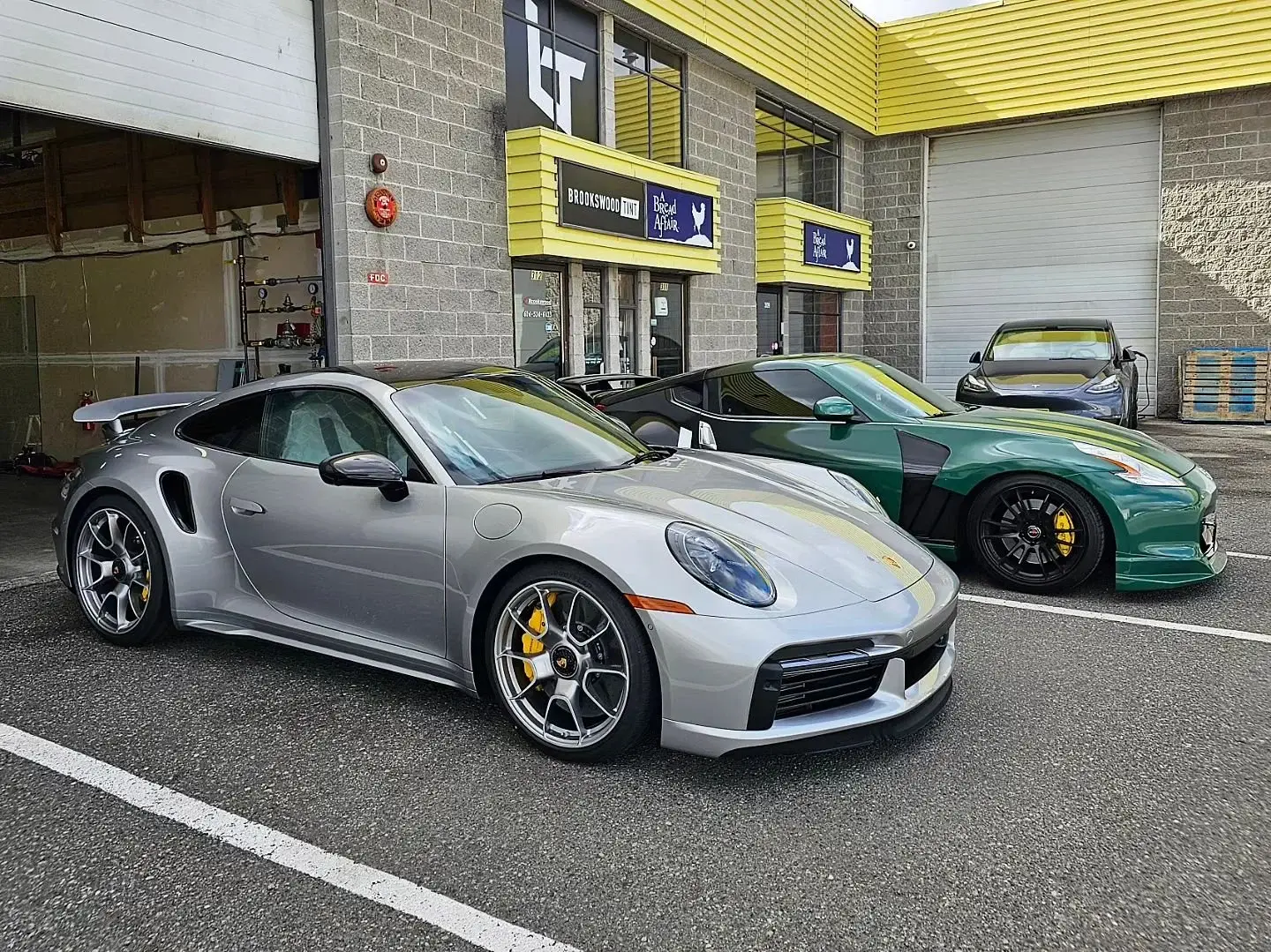
LLumar is the only window film we fit, which is worth remembering as you read; the figures, though, are each maker’s own. The 911 Turbo S in this page’s photo wears LLumar CTX 15%, a ceramic line the shop has installed but no longer lists. For our day-to-day ceramic, see LLumar IRX nano ceramic film; for the clear option, LLumar AIR.
How do you price LLumar against a 3M quote?
Tell us the 3M series and shade you were quoted, and we’ll price the closest LLumar film on the same windows. Our ATC menu runs like this: a sports coupe’s two rear quarters and back glass, $220 and up; a sedan or pickup’s five rear windows, $240 and up; a full-size SUV or wagon’s seven, $260 and up. IRX and AIR are extra, priced package by package (price list).
Expect a same-day job on most cars; a complete sedan or SUV tends to spend two to four hours in the bay, and every piece is plotter-cut for your exact model. Send the details by text (604 534 6433) or through the tint quote form.