

Which BC laws stop a dealer selling a car with illegal tint?
Four layers of rules, one for every seller and three aimed at dealers. Section 222 of the Motor Vehicle Act applies to anyone: nobody may sell a vehicle, or offer, expose or display one for sale, if it doesn’t comply with the Act and its regulations. Film on the front side windows breaks MVAR s. 7.05(8), so a car carrying it is caught.
Dealers then face MVAR s. 8.01, which reaches further back than the sale itself. Nobody “engaged in the business of selling motor vehicles” may “keep for sale, or sell or offer for sale” a new or used vehicle unless it’s equipped as the regulations require. On a dealer’s lot, the car is supposed to be compliant before it’s offered, not fixed after the deposit.
| Rule | Who it binds | What it says about a car with front film |
|---|---|---|
| MVA s. 222 | Any seller | Can’t be sold, offered, displayed or delivered for use |
| MVAR s. 8.01 | Businesses selling vehicles | Can’t be kept for sale, offered or sold |
| Motor Dealer Act Regulation s. 21(2)(e) | Motor dealers, used vehicles | The purchase agreement must state the car complies with the Motor Vehicle Act |
| Motor Dealer Act Regulation ss. 21(2)(f), 22 and 27(b) | Motor dealers | A car not suitable for transportation must be declared in writing and labelled |
What must a used-car purchase agreement say?
It has to say the car complies, or say that it isn’t fit for the road. The Motor Dealer Act Regulation lists what a dealer’s written agreement for a used vehicle must contain, beyond the price and the VIN. Four items matter here:
- Section 21(2)(c): any jurisdiction outside BC where the dealer knows the car was registered before.
- Section 21(2)(d): an itemized list of any repairs to be done, with the extra cost if there is one.
- Section 21(2)(e): “a statement that the motor vehicle complies with the requirements of the Motor Vehicle Act”.
- Section 21(2)(f): where the car isn’t suitable for transportation, a statement saying so.
A dealer who signs the compliance statement on a car with front film has put something untrue in writing. “Windshield and windows” appear in the Vehicle Sales Authority’s list of standards for a car sold to be driven, and the regulator says leaving an unsuitable car undeclared “may be misrepresentation”.
Can a dealer sell it as not suitable for transportation?
That route exists, but it isn’t a way to sell a car for daily driving. Section 22 of the regulation requires every purchase order and agreement for a vehicle “not intended for transportation” to say it’s not suitable for transportation and is sold “for parts only or purposes other than transportation”. Section 27(b) requires a used vehicle on display in that state to carry the words “Not Suitable for Transportation”.
For a car whose only defect is a pair of filmed front windows, that label would be an odd choice. Front-only removal is a short job, so stripping the film before the car is offered is the simpler fix. Section 28 exempts cars in a storage area, and inventory not yet prepared for sale, from the labelling rule.
Can a dealer add front tint to a new car you’re buying?
Not as part of a car delivered for the road. A new-vehicle agreement has to list extra equipment the dealer adds, with its price, under s. 21(1)(g) of the Motor Dealer Act Regulation, and s. 222 bars delivering a car that breaks the regulations to a buyer. Clear film is no exception: LLumar’s performance data shows AIR 90 letting through 84% of visible light, so it still reduces light on a front door.
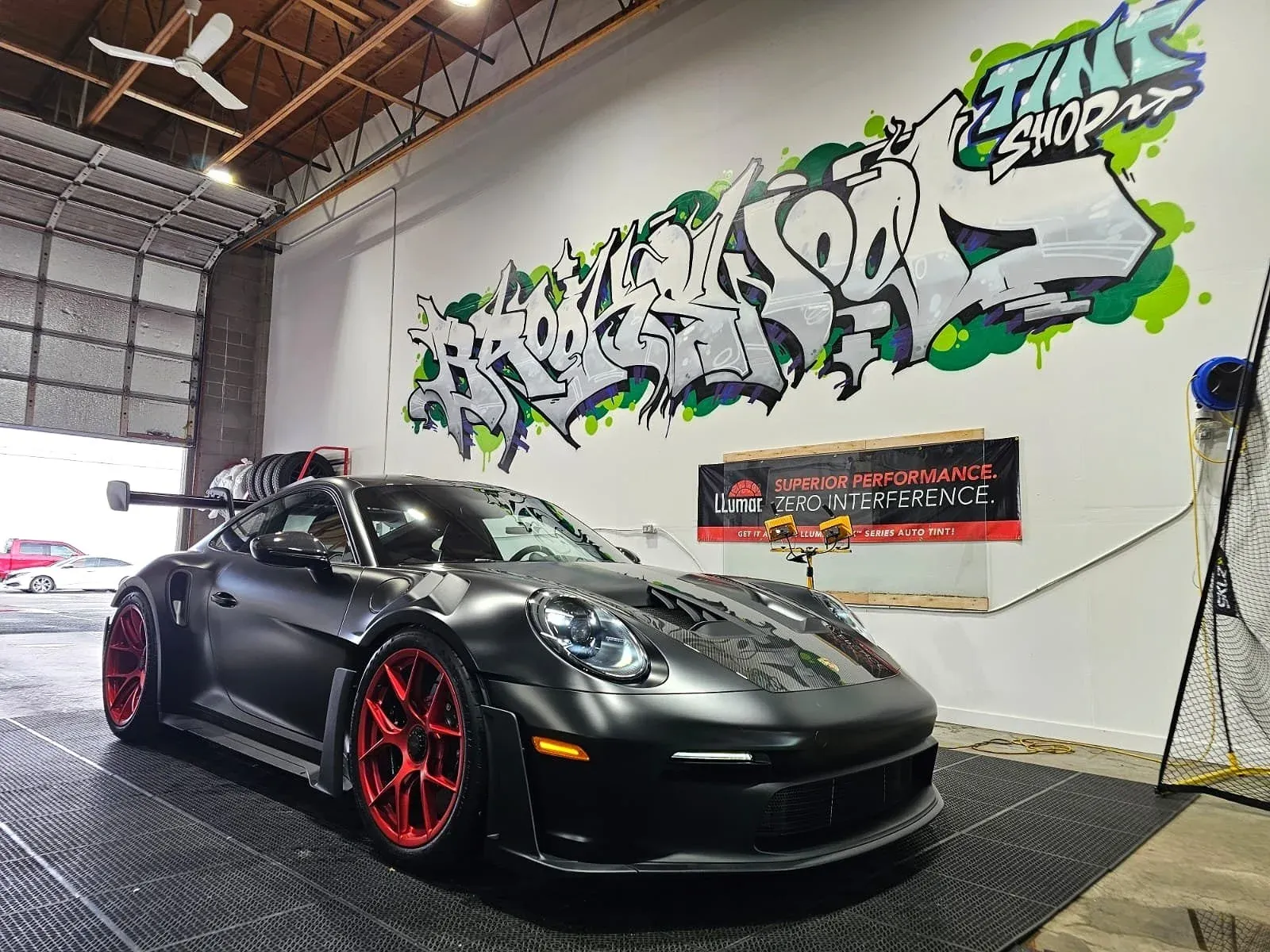
Dealer add-ons that stay legal are film in any shade on the rear side glass and, with both outside mirrors fitted, the back window, a windshield strip no deeper than 75 mm, and paint protection film. Brookswood Tint’s dealership services work to that line, with a shade profile for each model’s rear glass.
What should you check before signing for a car with tint?
Look at the front side windows yourself, and read the agreement before you sign it. Film on the driver’s or front passenger’s window, including near-clear film, fails item 13d in the province’s 2025 inspection manual, which rejects aftermarket tint on side panes in front of the driver’s seat back.
- Ask what the dark glass is. Factory privacy glass behind the driver is fine; film ahead of the seat back is not.
- Get removal in writing. If front film is on the car, ask for its removal in the itemized repairs under s. 21(2)(d).
- Read the compliance line. The agreement should carry the s. 21(2)(e) statement, or a not-suitable statement under (f).
- Check the history. A car registered outside BC may still need a BC inspection before ICBC registers it, and the s. 21(2)(c) line tells you where it came from.
Already driven off with front film? Start with the steps after a used-car purchase with front tint.
Getting front film removed before delivery
Front-only removal is one of the shop’s standard inspection jobs: steam lifts the film from the two front windows, the adhesive is dissolved, and the glass comes back clean, usually in 1 to 3 hours. Rear film in good condition can stay. Removal is priced per window and discounted if the car is re-tinted in the same visit.
Asked to film a car’s front doors, the shop says plainly first that it isn’t road-legal in BC, and that a $109 ticket, a Notice & Order and a failed inspection can all follow. More on the service is at window tint removal, or book through the removal request or by phone at 604 534 6433.