Is EV paint actually softer than gas-car paint?
Not by any measure we could find. Carmakers don’t publish paint hardness figures by model, and nothing from a carmaker, paint maker or regulator that we found sorts paint by what powers the car. Paint goes onto the bare body shell in the plant’s paint shop, long before a battery or an engine is fitted.
The US Environmental Protection Agency’s air rule for car and light truck assembly plants, 40 CFR part 63, subpart IIII, defines each coating step a body goes through. Its definitions cover “automobiles” and “light-duty trucks” by body type and weight, with no separate category for electric vehicles.
How is a car’s factory paint built?
In layers, each with its own job. The EPA’s definitions give the sequence a body moves through at the plant:
| Layer | What the rule says it is | What it does for you |
|---|---|---|
| Electrodeposition primer (e-coat) | A waterborne primer applied by dipping the body in a tank with an electrical charge | Corrosion protection, right into recessed areas |
| Primer-surfacer (guide coat) | An intermediate coat on the e-coat and under the topcoat | Adhesion, protection and appearance for the whole finish |
| Topcoat | “A monocoat color or basecoat/clearcoat system” | Colour, gloss and the protective outer skin |
| Anti-chip coating | A coating “designed to reduce stone chipping damage”; the lower-body version goes on rocker panels, valence panels and the lower parts of doors and fenders | Extra resistance where stones hit most |
On a basecoat/clearcoat car, the clear coat is the layer that takes swirl marks, wash scratches and the first impact of a stone. How hard and how thick that clear layer is, and how it was cured, is what people are really asking about when they ask whether paint is soft.
What makes one car’s paint mark more easily than another’s?
Four things, and none of them is the battery. Each one varies between brands, models and individual cars.
- The clear coat itself. Its chemistry and thickness are the maker’s and the plant’s choice, so they can differ from brand to brand.
- Colour. Dark colours make fine scratches easy to see. In the shop’s own words, sun on a dark car shows every swirl mark.
- Repairs. The EPA rule notes that “final repair” coatings on finished vehicles cure at a lower temperature than the factory topcoat. Fresh paint also needs time before film: LLumar’s PPF FAQ puts the common outgassing wait at 30 days, and its warranty doesn’t cover issues with aftermarket or repaired paint.
- Washing. In the shop’s experience, swirl marks almost always come from washing: dirty mitts, brush car washes and gritty drying towels.
Why does a new EV sometimes look marked already?
Usually because of what happened before delivery, not because of the paint. The shop’s view is that dealer prep and transport often leave a new car with more swirls than a well-kept ten-year-old one, and that applies to any new car.
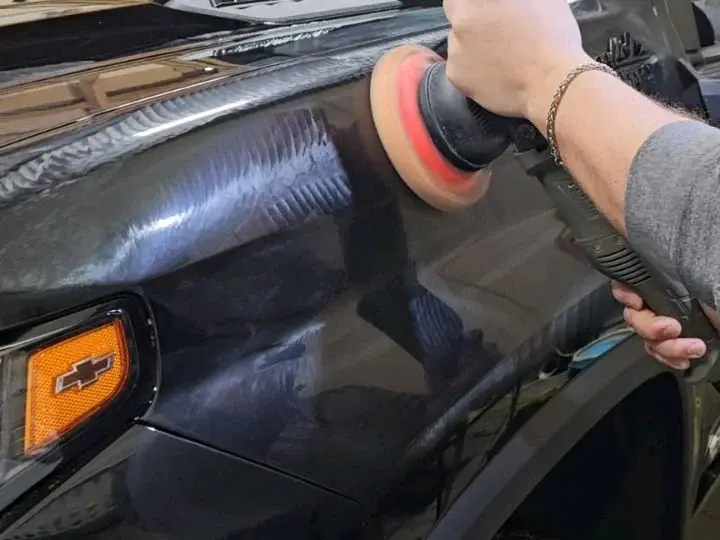
On a dark colour those marks show plainly. That’s a visibility problem as much as a hardness one, and a single-stage enhancement polish takes it out, with the paint measured first so only what’s needed is removed.
Do electric cars chip more easily?
The stone decides that, not the drivetrain. A chip is a small rock hitting paint at speed, and TranBC’s figures show the impact energy almost doubling when speed rises from 80 to 110 km/h. Pieces of winter abrasive on BC’s main highways are capped at 9.5 mm, and they’re thrown the same way at an EV or a gas car.
What changes chip damage is where you drive, how fast, and how much of the front end is protected. A factory may add anti-chip coating where stones hit most, but the topcoat is still the surface a stone meets first.
How do you find out how tough your own car’s paint is?
Measure it and look at it. A paint depth gauge shows how much paint there is and whether any panel has been refinished, and a strong light shows how much marring the clear coat already carries.
Brookswood Tint measures paint thickness before any correction, so you’ll know what you’re working with before anything is polished. The correction levels run from a one-day enhancement polish to two-stage correction over one to two days, and multi-stage restoration of three days or more quoted after inspection; they’re on paint correction.
Protecting an EV’s paint in Langley
Treat it like any car you want to keep looking new: correct it if it needs it, film the front before the chips start, and wash it gently. LLumar Platinum PPF starts at $850 for the Partial Front and $1,550 for the Full Front, and a ceramic coating is quoted per vehicle.
EV-specific details are on PPF for electric vehicles and in the EV owner’s guide to tint and PPF, and glass and heat are covered on EV window tint. Ask for a PPF quote with your year, make, model and what you’d like protected, or text the details to 604 534 6433.