Where does clear coat sit in a car’s paint?
At the top of a stack of thin layers. A Ford paint researcher’s overview, hosted by NIST, gives the typical body paint system on steel:
| From the metal up | Typical build | Role in the stack |
|---|---|---|
| Phosphate | 5 µm | Corrosion resistance on the bare metal |
| Electrocoat (e-coat) | 20 µm | Main corrosion barrier |
| Primer | 25 µm | Smooth base that shields the e-coat and helps the colour stick |
| Basecoat | 10 to 20 µm | The colour, plus any metallic flake |
| Clearcoat | 45 µm | Gloss, and a UV shield for the colour |
Plastic bumpers and trim swap the lower layers for a 25 µm conductive primer, with the same basecoat and 45 µm clearcoat on top. There are exceptions: the same overview says some commercial vehicles use a single-layer monocoat for solid colours, and some colours, mostly reds, use a tinted clear.
What is clear coat made of, and how much is there?
Ford’s overview says all clearcoats are based on acrylic copolymers for durability, crosslinked by one of several chemistries. On steel body panels the topcoat cures at 140 °C and ends up hard; on plastic trim it cures at 80 °C and stays softer and more flexible.
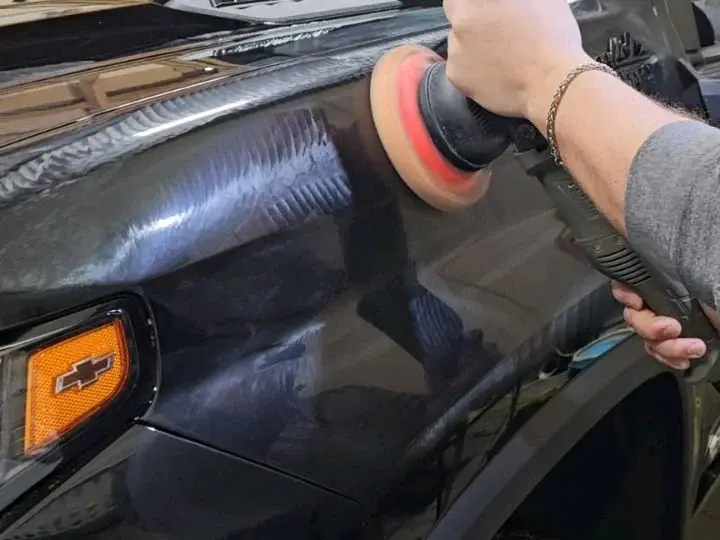
Thickness varies by maker and measurement. Chrysler’s collision bulletin 31-001-13 puts the clearcoat on most vehicles at 1.5 mils, about 38 µm, and caps removal at 0.2 mil when polishing and 0.5 mil when wet sanding and polishing. Measured against a layer that thin, every pass with a polisher counts.
Why clear coat matters for correction, PPF and coatings
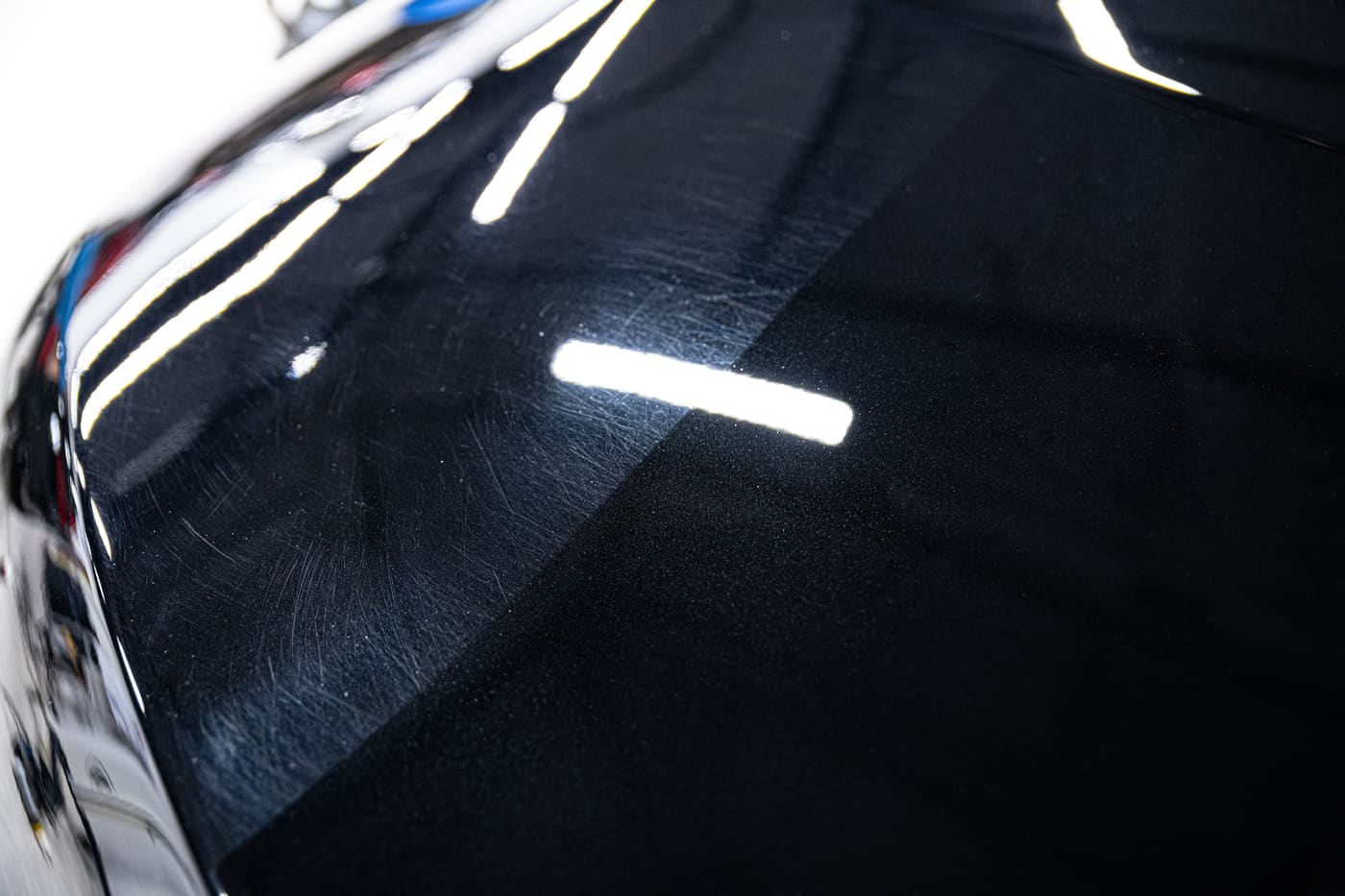
Most of what the shop works on happens in or on this layer. Swirls and light scratches sit in the clear, which is why polishing removes them; texture such as orange peel is the shape of the clear itself. Brookswood Tint reads paint thickness before correcting, and says correction takes off only a few microns of clear to level the surface. How much clear coat correction removes runs the numbers.
Paint protection film and coatings go on top of it. PPF carries a clear layer of its own: 3M’s installation guidelines describe the surface of its film as clear-coated, for protection against environmental and mechanical stress, and on self-healing film that layer is the self-healing top coat.
To get the clear measured and a stage picked, book through paint correction. Timing runs from about a day for the single-stage enhancement polish up to three days or more for a multi-stage restoration, which is only priced after inspection.