How much sun does tint keep off a dog in the back seat?
A good share of it, on the windows around the dog. LLumar’s performance data sheet rates every film by how much of the sun’s total energy it turns back, measured on clear glass.
| Film the shop sells | Light let through | Total solar energy rejected | Infrared energy rejected |
|---|---|---|---|
| ATC 15, dyed | 18% | 40% | 22% |
| AIR 80, clear ceramic | 77% | 43% | 60% |
| ATC 05, dyed | 5% | 44% | 22% |
| IRX 15, ceramic | 20% | 59% | 61% |
| IRX 05, ceramic | 6% | 62% | 60% |
On a summer drive, that’s sunlight that would otherwise land on the dog, the seat it’s lying on and the cargo floor. The sheet’s figures are taken on a single pane of 6 mm clear glass, so the result on your car shifts with its own glass. The windshield and front doors still let the sun in untouched, which is why a dog in the back of a tinted car is shaded rather than in a cool box.
Does tint make it safe to leave a dog in a parked car?
No. Film cuts some of the sun’s energy coming through the glass it covers; it doesn’t stop a closed, parked car from becoming dangerous.
ICBC and the BC SPCA put it plainly in their 2025 pet safety campaign: “Vehicles can heat up quickly with warm temperatures”, and even a car parked in the shade with its windows cracked can get hot enough to cause heatstroke or death. A tinted car is still a closed box in the sun.
BC law backs that up. Under the Prevention of Cruelty to Animals Act, an animal is in distress if it is “not protected from excessive heat or cold” (s. 1(2)(a.2)), and a person responsible for an animal “must not cause or permit the animal to be, or to continue to be, in distress” (s. 9.1(2)). Section 14 lets an authorized agent enter a vehicle without a warrant to relieve an animal in critical distress. How quickly a car heats up on a Langley summer day is covered on how hot a parked car gets in Langley.
Which windows can you tint around a dog in BC?
All of the ones near the dog. ICBC’s campaign says “Pets are safest when secured in the back seat or cargo area of your vehicle”, and that’s the part of the car BC lets you tint in any shade.
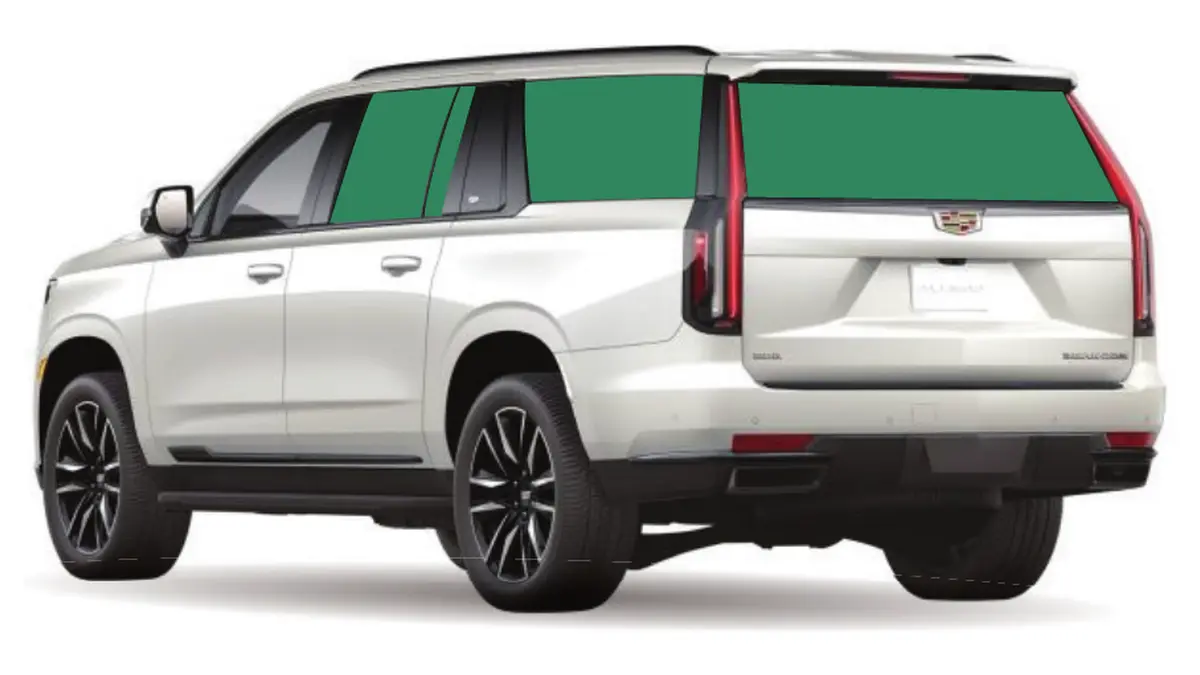
MVAR s. 7.05(8) lets film go on any side window to the rear of the driver, and on the back window provided the car has mirrors outside on the left and right. For a dog owner that covers:
- Back-seat dogs: the rear door windows and any quarter glass beside them.
- Crated dogs in an SUV or wagon: the extended windows along the cargo area and the hatch glass.
- Sedans: the rear doors, quarter glass if the car has it, and the back window.
Front doors and the windshield below its top 75 mm are a different matter: film there isn’t road-legal in BC, at any shade. The shop fits it if asked, after explaining the ticket and Notice & Order risk, but it does nothing for a dog in the back. ICBC also warns that a dog riding with its head out of an open window risks eye injuries from wind and flying debris, so an open window isn’t much of a cooling plan either.
Which film suits a car that carries a dog?
The one that blocks the most heat at the darkness you’re comfortable with. In BC that’s a choice made purely for the rear glass, so you can pick for heat rather than law.
IRX ceramic for the most heat blocked
IRX rejects 50 to 62% of total solar energy depending on shade, against 28 to 44% for dyed ATC. If the dog spends summer afternoons in the back, that gap is the reason to price the upgrade. The full case is on whether ceramic window tint is worth it.
AIR over factory privacy glass
Many SUVs already have dark privacy glass in the back. LLumar’s page for its clear AIR film names factory privacy glass as a place for it, glass it says “offers style and privacy but lacks good heat control.” AIR 80 still turns back 60% of infrared energy, yet passes 77% of visible light, so the back of the car looks much as it did.
ATC when the budget leads
ATC carries the same shades, blocks over 99% of UV and is the film in every starting price. It shades the dog; it just turns back less of the heat than ceramic.
Will a dog damage window tint, and how do you look after it?
It can be marked, so it’s worth some care: the film is on the inside, which makes it the surface a nose, a tongue or a paw actually touches. LLumar describes its tint as scratch-resistant; claws scrabbling at a door window are still worth discouraging.
Clean dog marks off with a soft microfibre cloth and an ammonia-free cleaner, and never use a blade or scraper on the inside of the glass. ICBC suggests disabling the power windows so a pet can’t open one by accident. That’s doubly useful in the first 3 to 5 days after tinting, when the windows have to stay up while the film cures.
Booking tint for a car that carries a dog
Tell the shop what you drive and where the dog rides. Rear-glass packages in LLumar ATC start at $260 for a full-size SUV or wagon (seven windows, hatch included), $240 for a sedan or pickup and $220 for a sports coupe; IRX and AIR are quoted as upgrades. Most cars go home the same day; a full sedan or SUV is usually a two-to-four-hour job.
The SUV package is laid out on SUV window tint, and every price is on the window tint price list. For keeping the whole car cooler through July and August, see keeping your car cool in a BC summer. Request a quote on the window tint form, or send a text to 604 534 6433.