Where should you park to keep a car cool?
In shade, every time you have the choice. It costs nothing, and it has some of the clearest numbers behind it of any summer habit.
When Vanos and colleagues parked pairs of identical vehicles in Tempe, Arizona, one in full sun and one in full shade, the shaded ones averaged 39.5 °C cabin air against 47.6 °C for the ones in sun, and their dashboards averaged 47.8 °C against 68.9 °C. Langley is milder than Arizona, but the sun does the same thing to a dash here. A parkade, a carport or the shadow side of a building all count; think about where the shade will be when you come back, not when you arrive. How hot a closed car gets in Langley is broken down in parked-car heat in Langley.
Is a windshield sunshade legal in BC?
Yes, while the car is parked. Take it down before you drive.
MVAR s. 7.05(8) bars anyone from driving or operating a vehicle on a highway while anything that cuts light sits on the windshield or a window, whether “affixed to or placed on” the glass, outside the allowed places. A folding shade across a parked car’s windshield breaks nothing; the same shade left up while driving would. Cling shades on the front door glass work the same way: fine for a parked car, off before you pull out.
The shade earns its spot because film can do very little at the windshield. Only the top 75 mm of it may carry film, so a removable shade is the legal way to keep the sun off the dash while you’re away.
What’s the quickest way to cool a car that’s been sitting in the sun?
Let the hot air out before asking the air conditioning to work on it. Mazda’s owner’s manual says that if a vehicle has been parked in direct sunlight in hot weather, “open the windows to let warm air escape, then run the air-conditioning system”, and recommends recirculate mode when you want to shut off outside air “for quick cooling of the interior”.
- Open the doors or windows for a moment to dump the hottest air.
- Start the air conditioning once the worst of the heat has escaped.
- Close the windows and switch to recirculate for the quickest cooling.
- If your car can start its climate control remotely, run it a few minutes before you walk out.
The same manual has two pre-summer tips: have the air conditioner checked before the weather gets hot, since a lack of refrigerant can make it less efficient, and run it for about 10 minutes at least once a month to keep its internal parts lubricated.
Which windows can you tint for heat in BC?
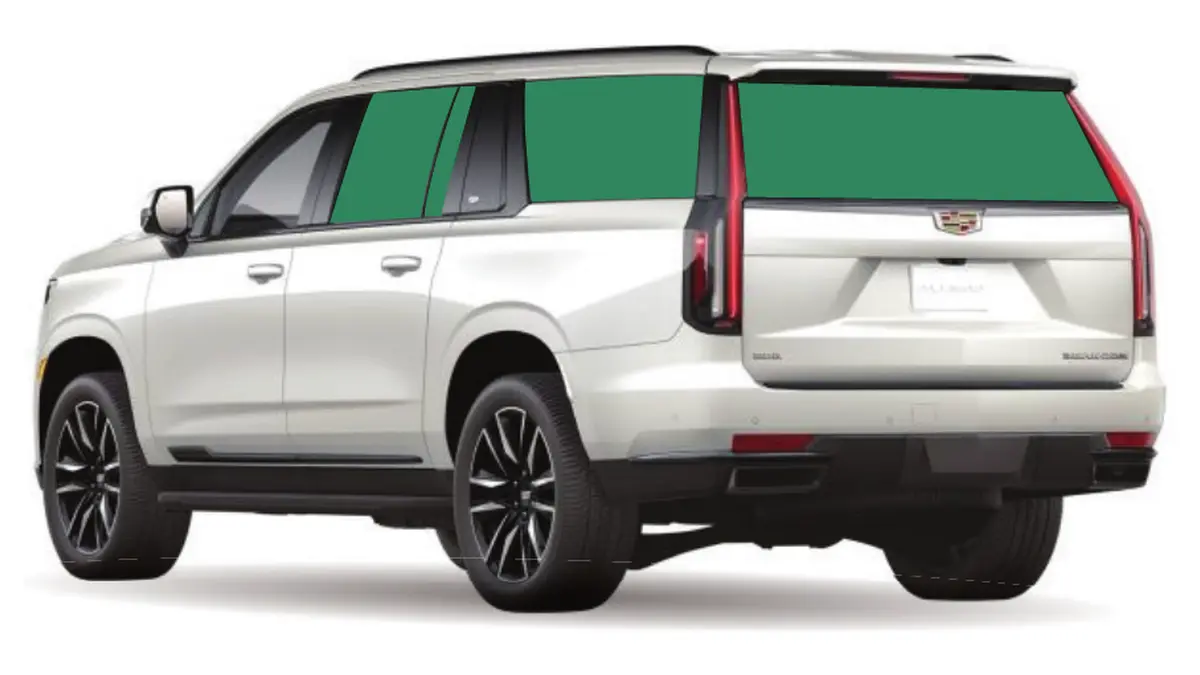
Everything behind the driver, and a strip across the top of the windshield. The rule doesn’t change with the season:
| Glass | Film allowed in BC? |
|---|---|
| Rear side windows | Yes, any darkness |
| Back window | Yes, when both outside mirrors are fitted |
| Top 75 mm of the windshield | Yes |
| Windshield below that strip | No |
| Front side windows | No, not even clear film |
| Sunroof | Not named in the regulation; see sunroof tint |
Some drivers want film on the front doors or windshield to cool the front seats, and the shop installs it on request. That film breaks BC’s rule however light it is, and the shop tells customers so up front. Mission RCMP lists a tint ticket at $109 as the typical fine. On top of a ticket, an officer may issue a Notice & Order: the film comes off and the car goes for inspection. The details are in BC’s front window rule.
How much heat does ceramic film block compared with dyed?
Nearly three times the infrared energy, shade for shade, and about 20 points more of the sun’s total energy. LLumar’s performance data sheet measures every film on clear 6 mm glass, so read the numbers as a comparison between films rather than a promise for your car:
| Film | Light let through | Total solar energy rejected | Infrared energy rejected | Pick it when |
|---|---|---|---|---|
| ATC 35 (dyed) | 38% | 35% | 22% | The look matters more than heat |
| IRX 35 (ceramic) | 39% | 54% | 60% | Same look, far more heat kept out |
| AIR 80 (clear ceramic) | 77% | 43% | 60% | The rear glass is already factory-dark |
Darker isn’t the only route to cooler. AIR 80 lets in twice the light of IRX 35 and matches its infrared rejection, which makes it an option for SUVs and pickups whose rear glass is already privacy-tinted. The full ranking by heat rejection is on which window film rejects the most heat, and the ceramic options side by side on ceramic window tint.
What should you never count on to keep a car cool?
A cracked window, a short errand, or the film. None of them makes a parked car safe for a person or a pet. Health Canada’s heat guidance rules out leaving anyone in your care, or any animal, in a parked car, and points out that a mild day doesn’t mean a safe cabin. If you travel with a dog, this answer on tint and dogs covers what film changes and what it can’t.
Booking heat-rejecting tint before summer
Book in spring so the film has cured before the first hot week; the timing is laid out on when to tint your windows in BC. Plan on two to four hours in the shop for a complete sedan or SUV, with the car back in your driveway that evening in most cases.
Behind-the-driver packages in dyed ATC start here:
| Vehicle | Rear glass, from |
|---|---|
| Sports coupe | $220 |
| Sedan or pickup | $240 |
| Full-size SUV or wagon | $260 |
Ceramic IRX and clear AIR are priced as upgrades on each package, so ask for both numbers. Every package is on window tint prices, or request a tint quote with your year, make and model.