How much glare does each window film cut?
Between 5% and 94% on LLumar’s sheet, depending almost entirely on how dark the film is. A shade that lets in less light cuts more glare, and that’s close to the whole story.
LLumar’s performance data sheet lists a glare reduction figure beside each film’s visible light transmission (VLT), and footnotes it as a calculated number that “may differ between similar products due to averaging and rounding”:
| Film | Daylight let through (VLT) | Glare reduction |
|---|---|---|
| ATC 05 | 5% | 94% |
| IRX 05 | 6% | 94% |
| ATC 15 | 18% | 79% |
| IRX 15 | 20% | 78% |
| ATC 35 | 38% | 57% |
| IRX 35 | 39% | 56% |
| ATC 50 | 60% | 32% |
| IRX 50 | 54% | 39% |
| AIR 80 | 77% | 13% |
| AIR 90 | 84% | 5% |
Read the pairs. At each shade, dyed ATC and ceramic IRX land within a few points of each other, and wherever IRX has the higher number, it’s because that IRX shade is a little darker. Glare reduction on a car window is dimming, and dimming comes from the shade.
LLumar’s own pitch on its benefits page is that tint tempers the sun “like a pair of top-quality sunglasses”. The comparison is fair as far as it goes: a lens and a film both just pass less light.
Which glare can tint fix in BC?
Glare that comes in from the side or from behind. Under MVAR s. 7.05(8), film may cover any side window rearward of the driver, the back window when the car carries an outside mirror on the left and the right, and a windshield band that stops within 75 mm of its top edge.
| Source of glare | Glass it comes through | Can film help in BC? |
|---|---|---|
| Low sun beside you on a rear-seat passenger | Rear side windows | Yes, any shade |
| Sun or headlights behind you, seen in the inside mirror | Back glass | Yes, with mirrors on both sides |
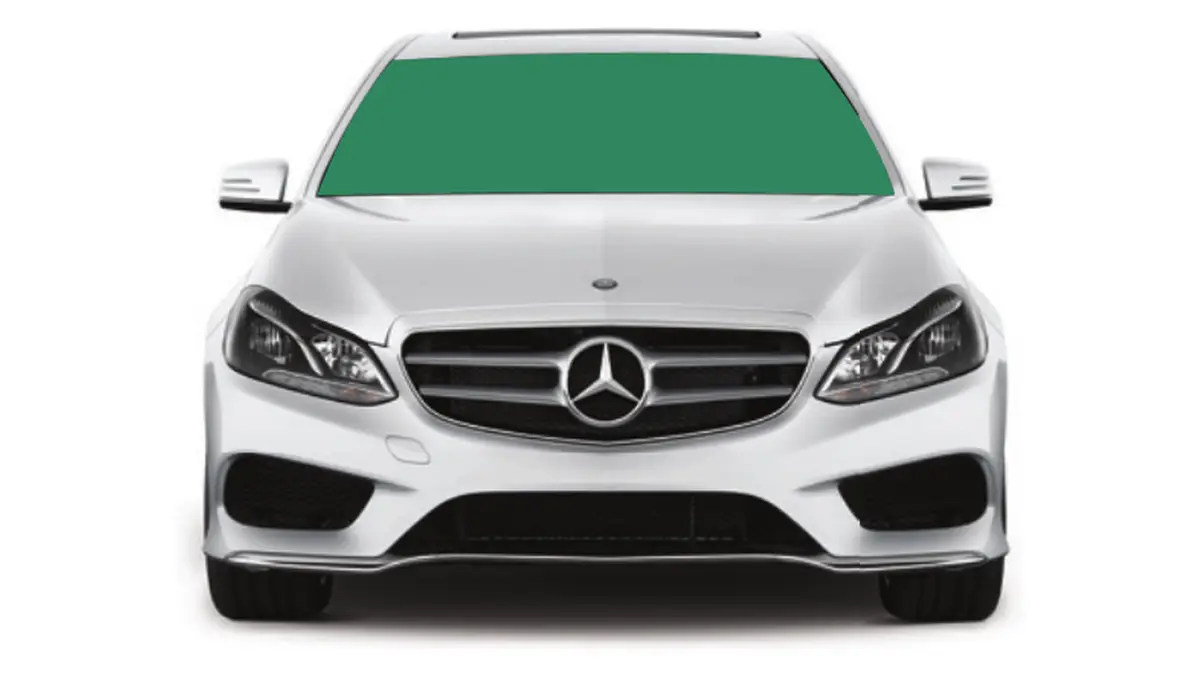
| Sun high over the windshield | Top of the windshield | Yes, in a band within 75 mm of the top |
| Low sun ahead, glare off a wet road | Windshield below the band | No |
| Sun through the driver’s side window | Front side window | No, not even clear film |
Customers can still ask the shop for a full windshield or front-door film, and the shop tells them straight that it breaks BC’s rule. The likely results are a ticket, usually $109, or a police order to peel it off and have the car inspected, and that conversation happens before any film is cut.
The windshield band
A strip across the top, kept within 75 mm, is the legal way to shade the windshield. BC’s 2025 Vehicle Inspection Manual fails windshield tint that runs lower than that under item 12e, and items 12e, 13d and 14c also reject any tint of the “reflective type”. More on how that strip is fitted is under the windshield sun strip entry.
A shade band from the factory
Some windshields leave the factory with a tinted band already in the glass. The US glazing standard, FMVSS 205, sets where the lower boundary of such a band may sit (S5.3), so if your windshield has one, it’s built in rather than added.
How does window tint compare with sunglasses?
The darker shades sit right in sunglass territory. The sunglass standard, BS EN ISO 12312-1, sorts lenses into five categories by how much light they let through, as listed by the College of Optometrists:
| Sunglass category | Light let through | LLumar films with similar VLT |
|---|---|---|
| 0, clear or very light | Over 80% | AIR 90 (84%) |
| 1, light tint | Over 43% to 80% | AIR 80, ATC 50, IRX 50 |
| 2, medium tint | Over 18% to 43% | ATC 20, ATC 35, IRX 35 |
| 3, dark tint | Over 8% to 18% | ATC 15 (18%) |
| 4, very dark tint | Over 3% to 8% | ATC 05, IRX 05 |
The College’s guidance says lenses for driving should be in categories 0 to 3, and that lenses passing under 75% aren’t suitable for road use at twilight or at night. Those rules are written for glasses on your face, not for film on glass behind you, but they show what a 5% rear window really is: category 4 darkness. Wear sunglasses while looking back through it and the two multiply, since each lets through only its share of what reaches it.
Does clear or ceramic film reduce glare?
Clear film barely does: AIR 80 is rated at 13% and AIR 90 at 5%. Ceramic film reduces glare as much as dyed film of the same darkness, and no more.
That’s useful to know when you’re choosing. If glare is the reason you’re tinting, the decision is about shade. Ceramic IRX earns its price on heat, with an infrared energy rejection (IRER) of 59–61% where ATC’s is 22%, not on glare. AIR is the pick when you want the glass to look untouched while it handles heat and UV, and it does little for glare by design.
Does tint cut headlight glare at night?
Only by dimming everything behind you equally. A dark back window makes the headlights in your mirror dimmer, and makes the dark road around them dimmer too.
That trade is why the right rear shade depends on how often you reverse or merge after dark. The research on tint and seeing at night, and how it plays out with BC’s clear front glass, is gathered in the night-driving answer.
Choosing a shade for glare and booking it
Start from where the glare bothers you. For passengers baking in side sun, a 15% to 35% shade on the rear doors cuts glare by roughly 56% to 79%. For the back glass, weigh glare against night visibility, and if you mostly want heat control without darkness, AIR or IRX 50 makes more sense than a glare-driven shade.
Pricing for the rear set in dyed ATC: coupes $220, sedans and pickups $240, full-size SUVs and wagons $260. Ceramic upgrades are quoted separately for each package. The shade guide shows each darkness on a car, and rear-only window tint breaks the packages down window by window. Ask for a price on the tint quote page, or ring 604 534 6433.