What actually fades a car’s interior?
Mostly visible light, then UV, with heat speeding things along. It’s easy to blame UV for all of it; the people who protect museum collections for a living say otherwise.
The Canadian Conservation Institute, a federal agency, puts it bluntly: light “fades (or ‘bleaches’) colours”, and “UV usually contributes less than half of the fading and often only one tenth”. Its guidance is written for museum objects, not car seats, but leather, fabric and dyed plastics are similar materials. CCI splits the damage three ways:
| What reaches the surface | What CCI says it does |
|---|---|
| Visible light | Fades or bleaches colours |
| Ultraviolet | Causes “yellowing, chalking, weakening, and/or disintegration” |
| Infrared | Heats the surface, a form of temperature that’s too high |
Damage also follows the dose, which is light intensity multiplied by time, so a car that sits outside all day collects far more than one parked in a garage. And faded colour doesn’t come back: CCI calls it “utterly irreversible”.
LLumar’s benefits page says the glass in most vehicles won’t fully block UV, and that long exposure “contributes to fading of upholstery and warping or cracking of other interior finishes.”
How much of the fading can window film block?
Nearly all of the UV, part of the visible light and part of the heat. How much visible light depends on the shade you pick; the UV figure doesn’t.
LLumar’s performance data sheet rates the UV blocking of every film at over 99%, for wavelengths of 300 to 380 nm. VLT, visible light transmission, tells you how much daylight still gets in, and TSER, total solar energy rejected, is the heat figure:
| LLumar film | Daylight let in (VLT) | Daylight held back | Solar energy rejected (TSER) | UV blocked |
|---|---|---|---|---|
| ATC 05 | 5% | 95% | 44% | >99% |
| ATC 15 | 18% | 82% | 40% | >99% |
| ATC 35 | 38% | 62% | 35% | >99% |
| IRX 35 | 39% | 61% | 54% | >99% |
| IRX 50 | 54% | 46% | 50% | >99% |
| AIR 80 | 77% | 23% | 43% | >99% |
The sheet measures each film on one pane of 6 mm clear glass, so treat these as close guides, not readings off your windows.
UV: solved by any film
Once film is on, the UV part of the problem is almost entirely gone from that window, whatever the shade.
Visible light: set by the shade
This is the part that’s easy to miss. If CCI is right that visible light does most of the fading, a near-clear film leaves most of the fading in place, and a darker one removes more of it.
Heat: set by the film type
Ceramic IRX turns away more solar energy than dyed ATC at a similar shade: 54% against 35% at the 35 level. That keeps surfaces cooler on a parked car, which CCI’s infrared warning suggests is worth having.
Why does shade matter for fading but not for UV?
Because fading runs on dose, and a darker film lowers the dose of visible light hitting the seats. UV is a yes or no question that every LLumar film answers the same way.
CCI says the rate of light damage is proportional to intensity. Put ATC 35 on a rear door and the daylight reaching the seat behind it drops to roughly 38% of what came through that glass before, so the fading that light causes should slow by about the same proportion. AIR 80 lets 77% through, which is why clear film is a fine choice for skin protection and a weak one for a cream leather back seat. That arithmetic is an estimate built on CCI’s rule, not a measured fade test on car upholstery; we know of no such test for these films.
Which parts of the cabin can tint protect in BC?
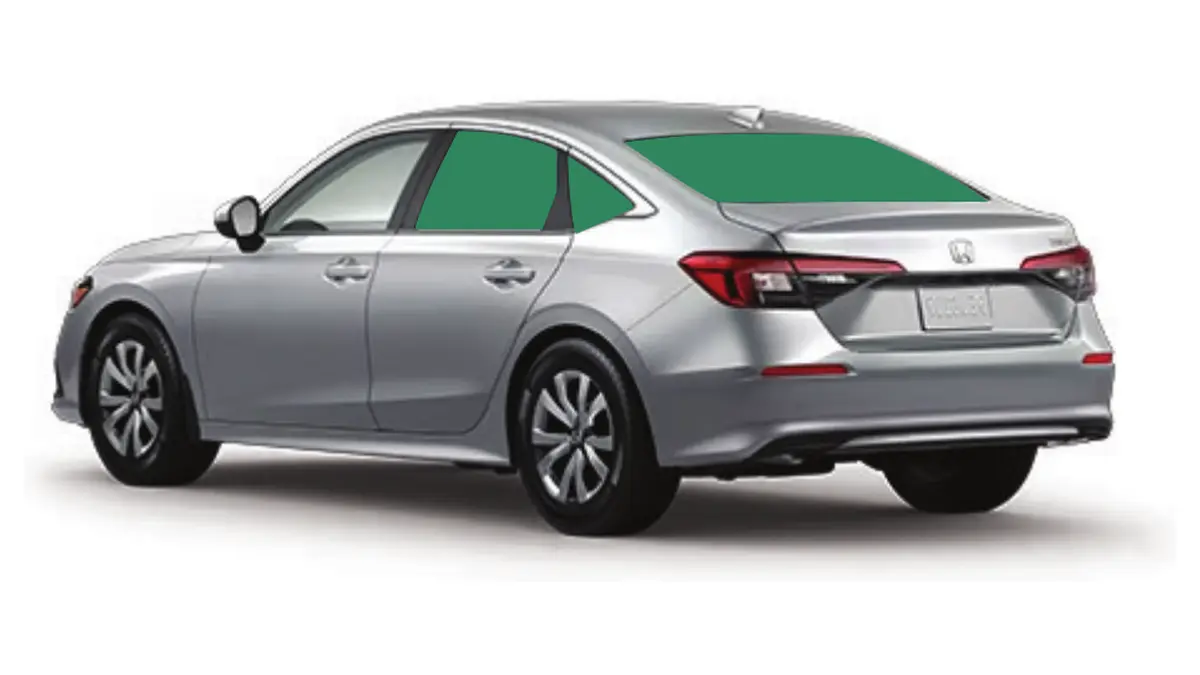
Only the parts the sun reaches through glass behind the driver. BC’s MVAR s. 7.05(8) permits film on rear side glass at any shade, on back glass given an exterior mirror on the driver’s and passenger’s sides, and in a top windshield band of at most 75 mm.
| Area of the cabin | Glass the sun comes through | Can that glass take film in BC? |
|---|---|---|
| Rear seats and door panels | Rear side windows | Yes, any shade |
| Rear deck, headrests, cargo floor | Back glass and quarter windows | Yes; mirrors on both sides are required for the back glass |
| Dashboard | Windshield | Top 75 mm only |
| Front seats and door trim | Windshield, front side windows | No film below that strip, clear film included |
For the dashboard, UV is already handled: a laminated windshield blocks almost all UVA, 99.25% on average across 34 vehicles in a 2025 study. What fades a dash is the visible light and heat coming through that glass, and a folding sunshade on a parked car is the legal fix. Brookswood Tint will film a full windshield or the front doors if asked, but neither is road-legal here; the usual consequence is a $109 ticket or an order to peel the film off and book an inspection, and the shop goes over that with you first.
Does your factory glass already block UV?
Some does, and you can’t tell by looking. The same 2025 study found driver’s windows averaged 88.78% UVA blocked, with wide swings between cars, so plenty of side glass lets some UVA through.
Glassmakers can do better. AGC sells what it calls “all-around 99% UV Cut” glazing, using the UV absorption of its privacy glass for the rear doors and back window. If your car has glass like that, film adds little on UV and its fade benefit comes from the shade and the heat rejection instead. Either way, the film’s UV rating is published on the sheet, while your glass’s is harder to find. For what that means for skin, see whether window tint blocks UV rays.
Tinting to protect an interior: what to book
Pick a shade for the light you want to keep out, then decide whether heat matters. For a pale or valuable rear interior, a mid to dark ATC shade does most of the work; IRX adds the heat rejection for a car that lives outside.
A rear set in LLumar ATC costs from $220 for a sports coupe’s three panes, sedans and pickups (five panes) from $240, and full-size SUVs or wagons (seven panes) from $260, with IRX or AIR priced on top. Shade by shade, what tint percentage to get shows how each looks, and families should see UV protection for the back seat. To book, fill in the window tint quote request or message 604 534 6433 by text.