What light transmission does factory privacy glass have?
Anywhere from about 4.5% to 45%, going by the glassmakers’ own ranges. The figure that matters is VLT, short for visible light transmission: the portion of daylight a pane passes; a lower number means darker glass, and no single value covers every car.
| Who says it | Glass | Light let through |
|---|---|---|
| AGC, glassmaker | Privacy glass, chosen per car line | 4.5% to 40% (ISO 9050) |
| Pilkington, glassmaker | Deep-tint Sundym, 3 to 5 mm thick | 26% to 45% |
| Pilkington | Galaxsee dark grey glass | “Low light transmission”, no figure published |
| Hyundai, carmaker | Privacy glass in general | “Typically less than 20%” |
| AGC | Ordinary clear vision glass, for comparison | Higher than 70% |
AGC’s wording is that light transmission “can be selected according to the car line & application”. In other words the carmaker orders the darkness it wants. Pilkington says Galaxsee was first developed for the North American market and is “increasingly the choice for dark tail SUV and MPVs”, as well as for sunroofs.
Why is one car’s privacy glass darker than another’s?
Because darkness depends on the glass recipe, its thickness and how it’s built, and each carmaker picks its own. Pilkington’s single Sundym range spans 26% to 45% across 3 to 5 mm of glass.
The tint and the thickness
AGC says its dark tint comes from “altering the chemical composition of the glass” and that its figures depend on “the glass tint and thickness”. Thicker glass of the same recipe passes less light.
Grey or green
AGC offers grey and green tints “in a variety of privacy ranges and thicknesses”. Pilkington describes Sundym as a green and blue range made to blend with the green-tinted front door glass.
Laminated privacy glass
Where privacy glass is laminated, the shade can sit in the plastic layer. Hyundai’s bulletin says a dark interlayer is used in place of the usual clear one, and notes that on the 2023 Palisade that dark acoustic layer can look slightly hazy in direct sun.
How does privacy glass compare with window film shades?
The makers’ published figures span roughly the 5% to 40% film shades. Putting the makers’ numbers beside LLumar’s measured VLT, from its performance data sheet, gives a feel for it:
| Factory glass figure | LLumar film with similar measured VLT |
|---|---|
| AGC’s darkest, 4.5% | ATC 05 (5%) |
| Hyundai’s “under 20%” | ATC 15 (18%) |
| Pilkington Sundym’s darkest, 26% | ATC 20 (25%), IRX 25 (26%) |
| AGC’s lightest, 40% | ATC 35 (38%), ATC 40 (43%) |
| Pilkington Sundym’s lightest, 45% | ATC 40 (43%) |
Keep in mind that LLumar measures film on clear 6 mm glass, and that film names aren’t measurements: ATC 20 measures 25%. Glass and film also look different from outside even at the same VLT, because the colour is in the glass rather than in a charcoal film.
Why are the front door windows so much lighter?
Because they’re held to a visibility standard and the glass behind them mostly isn’t. In the US, Hyundai’s bulletin says front door glass must transmit 70% or more, with no specific level for rear doors.
The US glazing standard, FMVSS 205, says glazing in multipurpose passenger vehicles, the US class that covers many SUVs and vans, must meet the requirements for trucks (S5.1.1). In Canada, glass that leaves the factory tinted must meet CMVSS 205 under MVAR s. 7.05(9); that standard incorporates ANSI/SAE Z26.1-1996, the paywalled source of the commonly cited 70% figure for the glass a driver looks through. BC’s 2025 Vehicle Inspection Manual limits glass marked AS-3 to side windows behind the driver (item 13c). Pilkington’s own description fits the pattern: its dark rear glass is benchmarked against the “optimised green glass used in the front of the vehicle”.
Does privacy glass block heat and UV as well?
It cuts a good share of both, mostly by absorbing. Pilkington says Galaxsee lowers the heat reaching the cabin by about 65% compared with its green front glass, and absorbs more than 95% of UV.
Those are the glassmaker’s figures for one product, measured its own way, so they can’t be lined up exactly against film numbers. Film brings published infrared and UV ratings of its own; the heat comparison between the two is in film against factory privacy glass.
How do you find out how dark your own glass is?
Have it metered. A tint meter reading on each row of windows gives your car’s real number, which no brochure range can.
Meter every row you care about, because one vehicle can mix glass types: Hyundai’s Palisade bulletin describes solar glass up front and privacy glass behind. Once you know the number, multiply it by the film’s VLT to estimate the result, and use tinting over factory tint to pick a shade that won’t leave the back too dark at night.
Adding film to privacy glass: what it costs
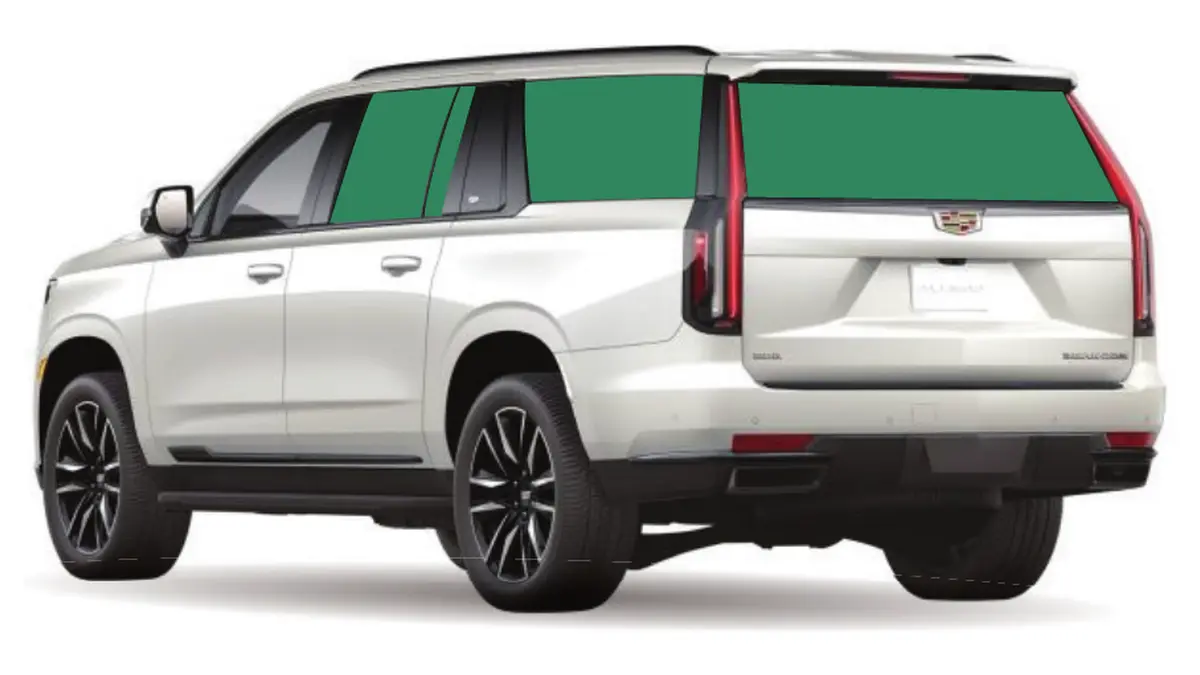
Film over privacy glass costs $260 in ATC for all seven rear panes on a full-size SUV or wagon; a sedan or pickup’s rear set is $240 and a coupe’s is $220, and IRX or AIR ceramic adds to that. Clear AIR suits glass that’s already as dark as you want, when heat is the goal.
When you request a price online or by text to 604 534 6433, ask for the glass to be metered. The seven-window job is described in detail under tinting an SUV.