How does factory privacy glass compare with window film?
Privacy glass gets its darkness from the glass; film adds a layer you choose. On the published numbers, privacy glass already does a lot for light and UV, and film is the way to add infrared control, a lighter or darker look, or tint on glass that has none.
| Factory privacy glass | LLumar window film | |
|---|---|---|
| How it’s darkened | Glass chemistry altered (AGC); dark PVB interlayer if laminated (Hyundai) | Film on the inside face of the glass, plotter-cut for your model |
| Where it goes | Side windows, rear window, roof (AGC) | Any glass; road-legal in BC behind the driver |
| Visible light let through | 4.5–40% (AGC); “typically less than 20%” (Hyundai) | ATC 5–60%, IRX 6–54%, AIR 77–84% |
| Total solar energy | 29–45% transmitted (AGC) | ATC 28–44%, IRX 50–62%, AIR 30–43% rejected |
| UV | 0.2–7% transmitted (AGC) | Over 99% blocked, 300–380 nm |
| Infrared | No separate figure published by AGC | IRER: ATC 22%, IRX 59–61%, AIR 40–60% |
| How it’s tested | ISO 9050, glass alone | NFRC methods, film on 6 mm clear glass |
| Changing it later | Replace the glass | Steam the film off and re-tint |
| Cost | Part of the vehicle or trim | Full-size SUV rear glass from $260 in ATC |
Glass figures are from AGC’s privacy glass page and Hyundai’s 2023 bulletin; film figures are from LLumar’s performance data sheet (03/26). Because AGC and LLumar test to different standards, read the two columns side by side, not as a contest decided to the point.
How is factory privacy glass made, and where is it fitted?
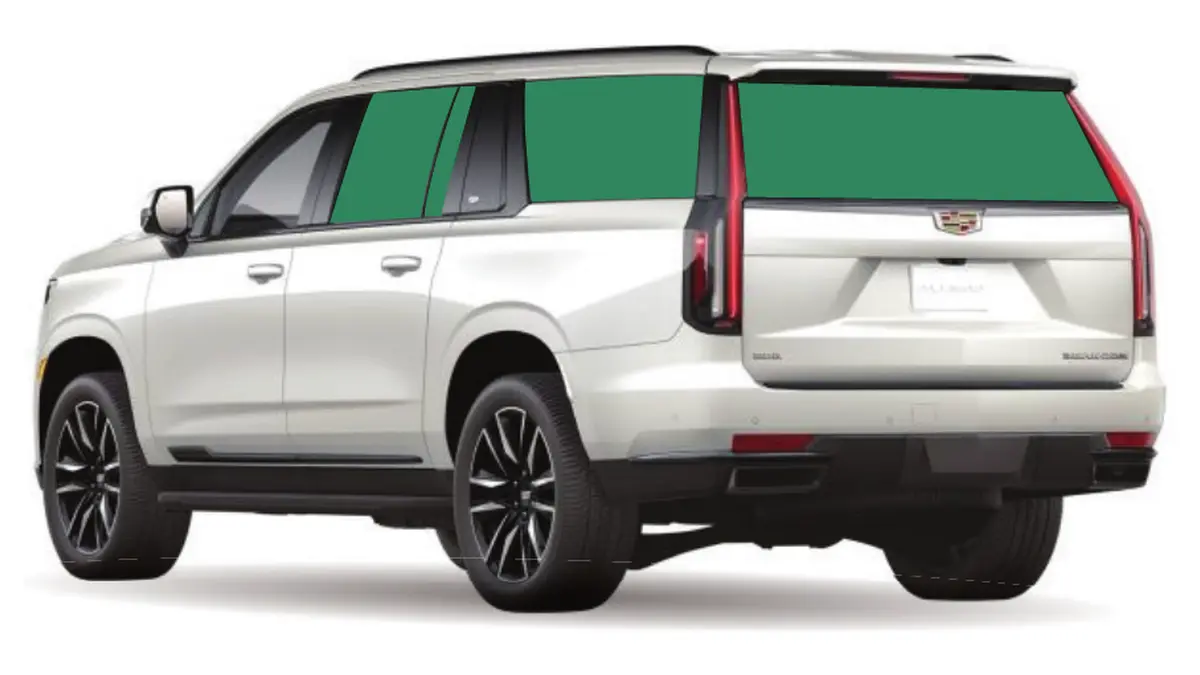
The darkness is part of the glass. AGC says “the dark tint is obtained by altering the chemical composition of the glass, giving lower light transmission”, and lists side windows, rear windows and roofs as where it goes. Hyundai’s bulletin adds that when privacy glass is laminated, “a dark PVB film is used instead of clear PVB film” between the layers.
Privacy glass stops at the front doors for a legal reason. The same Hyundai bulletin says front door glass must have a visible light transmittance of 70% or more under US federal standards, which “do not require a specific level” for rear door windows. In BC, MVAR s. 7.05(9) holds factory-tinted glass to the Canadian safety standard, CMVSS 205, which adopts ANSI/SAE Z26.1-1996. The often-quoted 70% minimum for the driver’s vision glass traces to that ANSI document, which is paywalled, so the figure is commonly cited, not quoted from BC’s regulation.
Hyundai also separates privacy glass from “solar glass”, which it describes as glass made “to reduce ambient temperatures in the cabin by reflecting infrared light”. On the 2023 Palisade, the front row gets solar glass and “the rear door windows may have privacy glass instead of solar glass”.
Does privacy glass keep heat out as well as window film?
It keeps out a real share of the sun’s energy, largely by being dark. AGC publishes no infrared figure for it, and glass and film are measured to different standards. Film is where you get a stated infrared number.
What the glassmaker says
AGC says its dark glass “absorbs part of the incoming sunlight” and that “total energy transmission can be limited up to 29-45% (ISO 9050), depending on the glass tint and thickness, vs. 59–70% for classical vision glass”. By AGC’s own figures, then, its dark glass lets through 29–45% of the sun’s total energy where ordinary clear glass lets through 59–70%. The page gives no separate infrared figure.
What the film maker says
LLumar’s AIR page describes factory privacy glass as glass “which offers style and privacy but lacks good heat control”. That’s a film maker talking about a product its film is sold to improve, so weigh it accordingly. LLumar does publish infrared numbers for its films: IRX holds 59–61% infrared energy rejection (IRER) in every shade, and AIR 80 rejects 60% while letting 77% of daylight through.
What that means for your car
The two work differently. AGC describes its dark glass as absorbing part of the sunlight; LLumar’s sheet puts IRX’s infrared performance down to its “nanoceramic IR-blocking technology”. Adding AIR 80 to privacy glass adds a film rated at 60% IRER on clear glass with almost no change in darkness, which is the job LLumar pitches it for.
Does privacy glass block UV as well as window film?
It blocks most of it, and film tops it up. AGC says “UV transmission can be limited up to 0.2-7% (ISO 9050), depending on the glass tint and thickness, vs 20-38% for classical vision glass”. On LLumar’s side, every automotive film on the 03/26 sheet carries a UV rating above 99% for 300–380 nm.
The bigger UV gap is on clear side glass with no privacy tint at all. The Skin Cancer Foundation says the tempered glass used for side, back and sunroof windows doesn’t stop UVA well, and that window film can cut out more than 99% of both UVA and UVB. Research has associated UV through side glass with more sun damage to the skin on the driver’s side, and whether window tint helps prevent skin cancer looks at that evidence. The full UV picture is on does window tint block UV rays.
What happens when you put film over privacy glass?
The two layers stack: light passes through the glass, then the film, so the finished window is darker than either, and multiplying the two percentages gives a rough figure. That’s why the choice of film changes on privacy glass. Near-clear AIR 80, at 77% on LLumar’s test glass, keeps the factory look while adding its infrared rejection, and even a mid shade like IRX 35 takes 20% glass down to about 8%, so a small step in film makes a big step in the finished window. Tinting over factory tint covers the job itself, and the vehicle pages for SUV window tint and truck window tint show the packages.
What does BC law say about privacy glass and window film?
The two are covered by different rules. Factory tint in the glass must meet the federal standard under s. 7.05(9); added film falls under s. 7.05(8), which permits any shade on the windows behind the driver’s seat, on a back window backed up by two outside mirrors, and in a band no more than 75 mm deep across the top of the windshield. Everywhere else, nothing.
That’s why you can add 5% film over an SUV’s privacy glass legally, yet can’t add even clear film to its front doors. The 2025 Vehicle Inspection Manual’s item 13d rejects aftermarket tint of any kind, film or coating, on the front side windows, meaning those forward of the driver’s seat back. Brookswood Tint will tint front doors if you ask, and first explains the risk. A tint ticket is typically $109, per Mission RCMP. Police can also issue a Notice & Order: the film comes off, the car goes through an inspection, and the fine for missing the 30-day window is $598. BC’s darkness rules are set out in full on their own page.
Window tint or factory privacy glass: which should you choose?
If your vehicle has privacy glass and you like how it looks, you may not need film at all, and the main reason to add some is heat. If it has clear glass behind the driver, film is the only way to get the privacy look.
Privacy glass on its own is enough if
- The darkness already suits you.
- Heat in the back seats isn’t a complaint.
- You want nothing on the glass that could ever need replacing.
Adding film makes sense if
- The back of the vehicle still gets hot: AIR 80 adds heat control with little visible change (LLumar rates it at 60% IRER on clear glass).
- You want the rear glass darker: even a 50 or 35 makes a big difference over privacy glass.
- Your vehicle has clear glass behind the driver and you want the privacy look.
Where we stand
We don’t think privacy glass needs fixing if you’re happy with it. If you do add film over it, our suggestion is a light one: AIR if heat is the only issue, a 35 or 50 IRX if you also want it darker. Comparing those two films is the subject of LLumar IRX vs LLumar AIR, and the film on its own is on LLumar AIR clear ceramic.
What does film over privacy glass cost, and how is it booked?
A full-size SUV or wagon’s seven rear windows start at $260 in LLumar ATC, and a pickup’s rear glass at $240; IRX and AIR are per-package upgrades on the tint price list.
Tell the shop the year, make, model and trim, since glass can differ by trim, as Hyundai’s Palisade bulletin shows, and say whether you want the glass darker, cooler or both. Most vehicles are done the same day, and a full SUV typically takes two to four hours. Book through the quote form, or send a text to 604 534 6433.