
Why is factory privacy glass treated differently from film?
Because BC’s tint law is written about material added to glass, and privacy glass has nothing added. MVAR s. 7.05(8) restricts material that cuts light when it is “affixed to or placed on” a windshield or window. Factory privacy glass gets its shade during manufacture, so there’s nothing affixed for that subsection to catch.
The next subsection deals with it instead. Section 7.05(9) says that where a vehicle has manufactured glass, “tinting contained within the glass” must meet the minimum light transmittance set by the Canadian Motor Vehicle Safety Standards. In short: film is judged by where it sits, and factory tint is judged by the federal glass standard.
| Factory privacy glass | Window film | |
|---|---|---|
| BC rule | s. 7.05(9) | s. 7.05(8) |
| Test | Meets the federal glazing standard | Sits only on permitted glass |
| Front side windows | AS-3 glass fails inspection there, item 13c | Not allowed at any shade |
| Glass behind the driver | Legal as built | Any shade; back window needs both outside mirrors |
Which federal standard does privacy glass have to meet?
CMVSS 205, the federal glazing standard, which adopts the American standard ANSI/SAE Z26.1-1996. Under section 205 of the Motor Vehicle Safety Regulations, each piece of glazing in a vehicle has to meet that 1996 standard and be “legibly and permanently marked” with the marking the standard requires, plus a code mark that the federal Minister assigns to the glass maker.
The light-transmittance figure itself sits inside Z26.1, which is sold rather than published free. Seventy percent is the figure most often given for glass in the driver’s line of sight; treat it as commonly cited, not as wording in BC law.
BC’s own Motor Vehicle Act backs the federal standard at the point of sale. Section 223 bars a dealer from selling a new vehicle unless it and its components comply with the federal safety standards and carry the National Safety Mark. So a new vehicle sold by a BC dealer comes with glass built to the federal standard, privacy glass included.
How does a BC inspection check factory-tinted glass?
By reading the AS marking on each pane, not by metering it. Item 13c of the 2025 Vehicle Inspection Manual rejects a side window not marked AS-1, AS-2, AS-3, AS-10 or AS-11, and adds a note: “AS-3 is only acceptable for side windows to the rear of the driver location.”
The tint items work separately. Items 12e, 13d and 14c target “after-market tint”, film or coatings applied later, which factory privacy glass isn’t. So a car with dark factory rear glass and nothing added passes the tint items, and its rear panes pass item 13c as long as they carry an accepted marking.
| Inspection item | What it looks at | Factory privacy glass behind the driver |
|---|---|---|
| 13c, side window material | The AS marking | Passes with an accepted mark, AS-3 included |
| 13d, side window tinting | Aftermarket tint ahead of the seat back | Not applicable |
| 14c, rear window tinting | Aftermarket tint on the back glass | Not applicable unless film is added |
| 12e, windshield tinting | Aftermarket tint below the top 75 mm | Not applicable |
Can factory privacy glass get you a tint ticket?
Not on its own. The tint ticket in BC is written under s. 7.05(8), which needs material placed on the glass. Mission RCMP frames BC’s limits as rules on where “tinting film” can be applied, and privacy glass carries no film.
Where questions come up is on cars that have both, or on a used car whose history you don’t know. If you can’t tell whether a dark rear window is glass or film, the signs are on telling factory tint from film. If the front door glass on a car you’re buying looks dark, check it before you pay: film there is illegal on a BC road, and an AS-3 pane there fails inspection.
Is it legal to put film over factory privacy glass?
Yes, behind the driver, at any shade. BC sets no limit on how dark the combined glass and film can be there, so 5% film over privacy glass is legal on the rear doors and quarter windows. On the back window, the film needs outside mirrors on both sides of the car, as explained in the side mirror rule for back-window tint.
How dark the factory glass starts out varies by model, and the numbers are covered in how dark factory privacy glass is. That matters for the look and for night visibility, not for legality in BC.
What about replacement glass and imported vehicles?
Replacement panes have to follow the same marking rules, and dark glass belongs behind the driver only. Section 7.05(4) requires safety glass whenever a door or window pane is replaced. A clear pane with an accepted marking, fitted where privacy glass used to be, is fine; a dark AS-3 pane fitted in a front door fails item 13c even though no film is involved.
A vehicle coming from another province or the US goes through the same item list at its BC inspection, so factory privacy glass behind the driver isn’t a reason for it to fail. Front film on the same car is, under item 13d.
Adding film to a vehicle with privacy glass
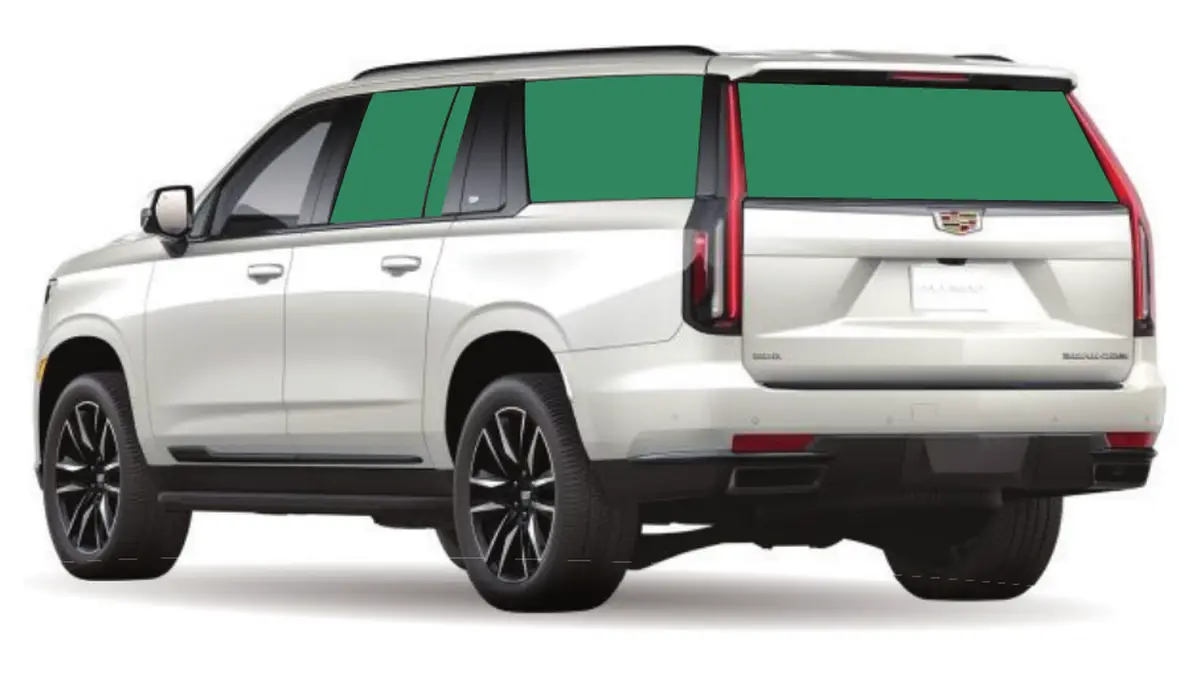
Choose the film for what the factory glass doesn’t do. Privacy glass already looks dark. Clear LLumar AIR adds heat and UV rejection with little extra darkness, with AIR 80 letting 77% of visible light through on clear test glass, while dyed or ceramic shades darken it further. On a full-size SUV or wagon, all seven panes behind the front doors start at $260 in LLumar ATC, and IRX or AIR is priced per package; SUV window tint lists the panes.
Film on the front doors isn’t road-legal in BC at any shade, clear included, and the shop explains the $109 ticket and the inspection order that can follow before anyone books it. Ask for a price through the tint quote request or call 604 534 6433.