
How long is a typical window tint appointment?
Plan on a few hours, not a whole day. Tinting all the side and back glass of a sedan or SUV is typically a 2-to-4-hour job at Brookswood Tint, and most cars leave the same day whichever package they’re booked for.
The figure moves with the car and the work on it. Here is how the shop’s own timings line up:
| The job | Time in the shop |
|---|---|
| Every window on a sedan or SUV | Typically 2–4 hours |
| Most cars, any tint package | Same day |
| Old film stripped before the new film goes on | Removal takes 1–3 hours, then the tint; same day on most cars |
| Complex rear glass, or a van with a lot of glass | Longer; the shop gives a time when you book |
| After you drive away | Windows stay up 3–5 days while the film cures |
The last row isn’t shop time, but it’s part of the answer: the car comes home the same afternoon, and its door glass waits most of a week.
What happens to the car during those hours?
Each window gets its own cut, shape and fit, and that work, not the film itself, is what the hours pay for. Three stages fill the appointment.
Cutting the film on the plotter
The shop cuts each piece on a computerized plotter, from a pattern for the exact year, make and model. The film reaches the car already shaped, so no knife is needed against the glass or the trim around it.
Shaping film to curved glass
Film comes off the roll flat, and a back window isn’t. On curved glass the film is heat-shrunk until it follows the shape of the pane, then fitted by hand. The more curve a window has, the longer this step runs.
Fitting each piece inside the glass
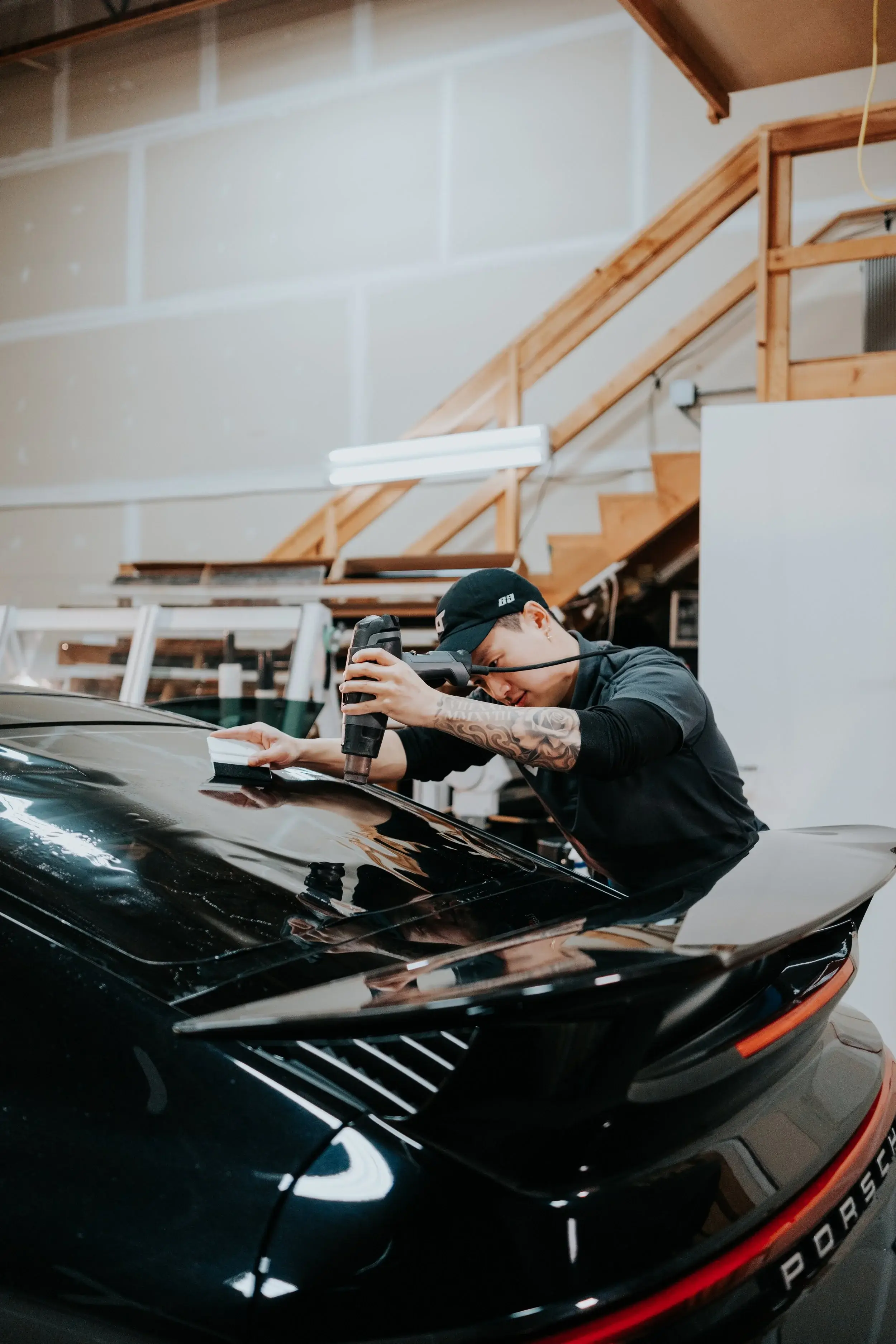
Car tint normally goes on the glass from inside the car, as LLumar’s FAQ says, and that’s how the shop fits it. Each piece goes on wet, is slid into place and has the water squeegeed out, window by window.
What makes a tint job take longer than usual?
Three things, by the shop’s own account: rear glass that is hard to shape, film already on the car that must be stripped, and vans. Each one adds work before or during the fit.
Rear glass that is hard to shape
Panoramic roofs, one-piece rear glass like a Tesla’s, and curved hatch windows all need more heat-shaping and handwork after the plotter cut. Big roof glass is covered on the sunroof tint page, and EV glass on window tint for electric vehicles.
Old tint that has to come off first
If the car already wears film, that film is stripped before anything new goes on. Removal on its own takes 1 to 3 hours, depending on how many windows there are and how firmly the old glue holds; film that has baked onto the glass for a decade sits at the slow end. The rear glass is done with steam rather than a blade so the defroster grid survives. How that works is explained on window tint removal, and the removal is discounted when the car is re-tinted in the same visit.
Vans and other big glass
Vans such as the Sprinter, Transit and ProMaster carry the largest glass on the road. The shop keeps plotter patterns for them and has the bay height to work on them indoors, but more glass still means more time. Fleet owners can block-book vehicles; the details are on fleet window tinting.
Which windows does a whole-car tint cover, and are they all legal?
On the shop’s price list, a car’s side and back glass comes in two parts: the rear glass package and the front doors. The rear packages cover 3 windows on a sports coupe, 5 on a sedan or pickup and 7 on a full-size SUV or wagon; the front doors add 2 more.
In BC: under MVAR s. 7.05(8), film is allowed on the windshield’s top 75 mm, on side glass to the rear of the driver, and on the rear window when there’s a mirror outside on both the left and right. Film on the front door glass is not road-legal at any shade, clear included. The shop fits front doors when asked and explains the ticket and Notice & Order risk before anyone decides.
The full rule lives on the BC front-window answer. If you book the rear glass on its own, you’re booking the part of the car BC allows.
How long until the car is back to normal after tinting?
You can drive it home straight away; the windows are what wait. Keep every tinted door window closed for 3 to 5 days, and don’t worry about a faint haze or a few little pockets of water while the first week passes.
Both are moisture leaving the space between film and glass, and both fade without help. The reasons behind the wait, and what to do if a window goes down by accident, are on how long after tint you can roll the windows down. If the haze is what’s bothering you, why new window tint looks hazy explains what is normal and what isn’t.
Can other work be done in the same visit?
Yes, but each service brings its own time, and the longest one sets the pickup day. Tint on its own is a same-day job on most cars; paint protection film usually keeps the car for a day or more.
| Added service | Time the shop publishes |
|---|---|
| Tint removal before the new film | 1–3 hours |
| Paint protection film, partial front | About a day |
| Paint protection film, full front or Track Package | One to two days |
| Ceramic coating | 1–3 days in the shop |
Whether it makes sense to combine them is its own question, answered on booking tint, PPF and a ceramic coating together.
How to book a tint appointment that fits your week
Send the year, make and model, say which windows you want done, and mention any old film already on the glass. The shop confirms the price and how long the car will be in before you book.
ATC rear glass is priced by body style: $220 is the sports coupe package and $260 the full-size SUV or wagon, with IRX and AIR ceramic quoted on top; every package is on the window tint price list. Pick a day that leaves the next week free for closed windows, then book through the window tint enquiry form, or send a text or call to 604 534 6433.