
What is the haze in freshly installed tint?
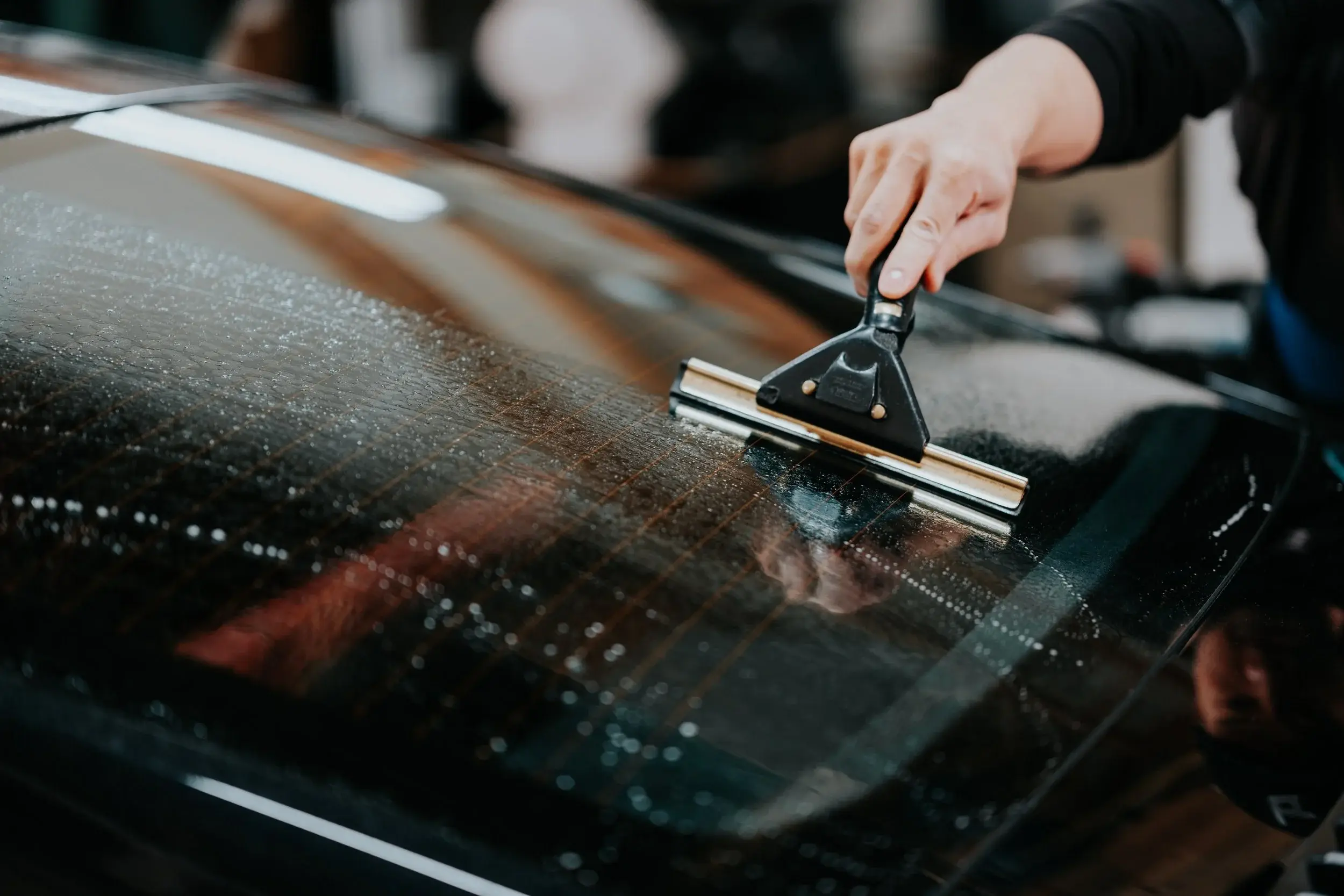
It’s water. Window film is fitted wet, and once the installer has squeegeed out all the water a squeegee can reach, a fine layer is left behind. That leftover moisture is what makes new film look milky or slightly blurred.
Car film sits on the cabin side of the glass, which LLumar’s FAQ describes as the usual practice. Until the last of the water evaporates, the adhesive isn’t fully in contact with the glass, so the film can look uneven in places.
Curing haze has a recognisable look:
- It’s soft and even, like a faint fog across part or all of the window, rather than a sharp mark.
- It may gather into small pockets, soft blisters of water that sit under the film.
- It changes. Day by day the fog thins and the pockets shrink.
That last point is the test. Curing haze moves toward clear; a problem stays as it is.
How long does curing haze take to clear?
Most of it goes within the first week, which is the window the shop treats as normal. In a cold, cloudy, damp stretch it lingers longer, because the water under the film evaporates more slowly when the glass is cold and the air is already wet.
The Fraser Valley’s autumn and early winter are exactly that kind of weather. At Abbotsford Airport, the closest station to Langley with sunshine records, the 1981–2010 federal climate normals trace the drying weather fading month by month:
| Abbotsford A, 1981–2010 normals | October | November | December |
|---|---|---|---|
| Days with any bright sunshine | 24.0 | 17.7 | 16.6 |
| Days with 0.2 mm or more of precipitation | 15.8 | 20.8 | 19.8 |
| Relative humidity at 3 pm | 66% | 74% | 74% |
| Relative humidity at 6 am | 88% | 87% | 83% |
| Mean daily high | 15.0 °C | 9.3 °C | 5.9 °C |
From October to November the days that see any sun drop from 24 to under 18, the wet days climb past 20, and even mid-afternoon air holds 74% humidity. Tint fitted in those months still clears; give it longer than a week before deciding something is wrong. Whether it’s worth tinting at that time of year at all is covered on can you tint car windows in winter.
When is hazy tint a problem rather than curing?
When it doesn’t change, or when it arrives in film that cured long ago. This table sorts the usual causes by what you see:
| What you see | Most likely cause | What to do |
|---|---|---|
| Soft, even fog that thins each day, first week | Moisture still curing | Leave it alone |
| Small soft pockets that shrink | Water under the film | Leave it alone; don’t press them |
| A cloudy smear that stays after the cure, on glass that had old film taken off | Old adhesive left on the glass under the new film | Call the installer |
| Tiny fixed specks or bumps that never shrink | Dust or grit trapped when the film went on | Call the installer |
| Cloudiness, bubbles or a purple cast in film that’s years old | The film or its glue is failing | Removal and new film |
| A faint fog in dark rear glass in direct sun, film or no film | The glass itself | Nothing; it’s a property of the glass |
Old adhesive on the glass
Peeling old tint off usually leaves glue behind, and anything left on the glass shows through new film as a cloudy patch. That’s why the shop dissolves the old adhesive completely before re-tinting, and why a window stripped at home and then tinted can look hazy for good. If you plan to take old film off yourself, window tint removal explains what a full strip involves.
Dust or grit under the film
The shop treats tint as work for a controlled space, since dust, wind and cold all spoil an install. A speck caught between film and glass stays where it is. Unlike water, it never dries out, so it’s the one fault the calendar won’t fix.
Old film that is failing
Haze, bubbles or a purple tint in film that has been on the car for years means the film or its glue has reached the end of its life. That isn’t curing at all; it’s covered on bubbling tint removal.
Haze that’s in the glass, not the film
Some factory glass can look hazy all by itself. Hyundai’s service bulletin for the 2023 Palisade warns that on some trims the acoustic laminated privacy glass can look a little foggy in strong sun, puts it down to the dark layer inside the glass, and calls it normal. If your glass does that before tinting, point it out at drop-off so the film isn’t blamed for it.
What should you do while new tint clears?
Very little. Leave the door windows shut for 3 to 5 days, keep your hands off the inner face of the glass, and give it time.
- Leave the pockets alone. Time and warmer, drier air clear them; fingers and cards don’t.
- Hold off cleaning the inner face of the glass until the cure is done.
- When you do clean it, use microfibre and a cleaner without ammonia, and keep scrapers off the film.
The full routine for the first weeks and beyond is in the window tint aftercare guide, and the reasons the windows have to stay closed are on when tinted windows can go back down.
When should you call the shop about hazy tint?
Once the first week is over and the haze hasn’t changed, or straight away if you can see fixed specks or a lifting edge. Text a photo to 604 534 6433, ideally in the light where the haze shows worst.
The film is covered by LLumar’s lifetime limited warranty and the install by the shop’s lifetime workmanship warranty, so a fault from the install comes back to the people who fitted it; the warranty page has the terms. If you’re judging film fitted somewhere else, how to spot a bad tint job lists what to look for.
Booking tint that clears without surprises
Choose your timing with the weather in mind: tint fitted in the dark months needs more patience, not different care. The shop fits film indoors, cuts it on a plotter for your exact model, and dissolves any old adhesive before new film goes on.
ATC rear glass for a sedan or pickup begins at $240, and the tint price list has every package. Tell the shop the vehicle and the windows you’d like done through the tint enquiry form.