
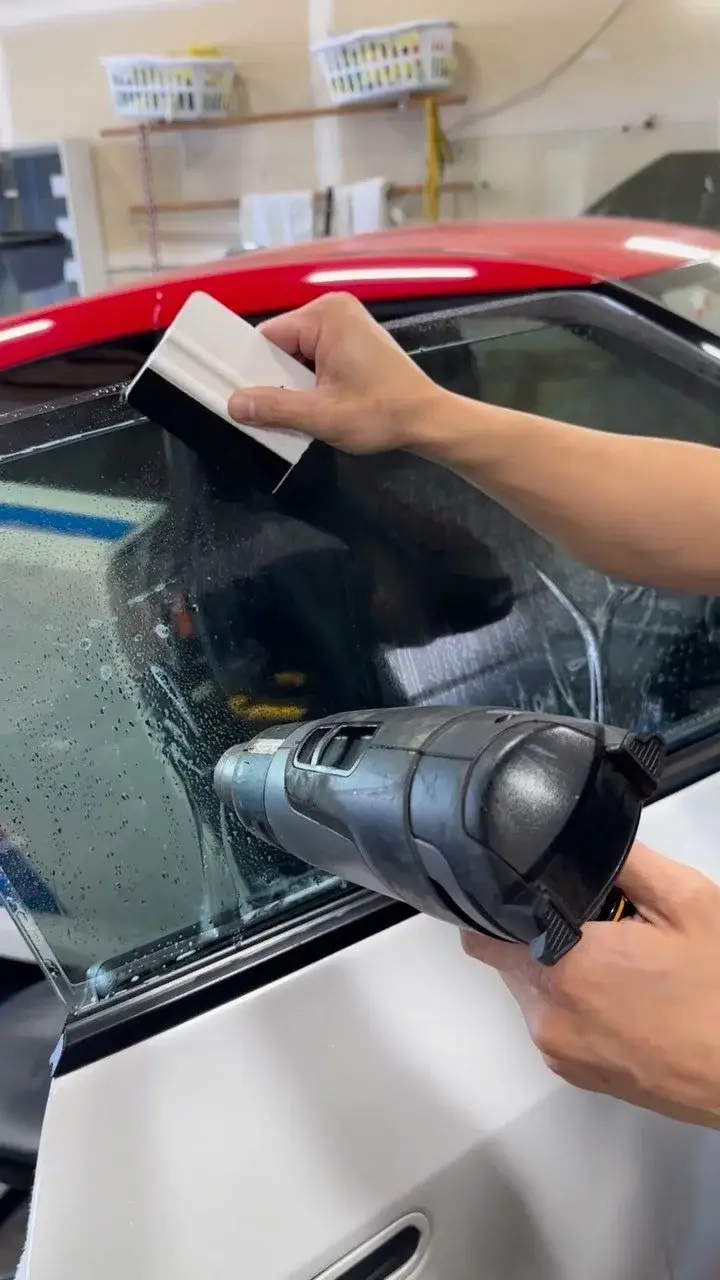
Why does tint stop short of the top edge of a door window?
The film is kept off the seal. Door glass travels up into a rubber channel in the door frame whenever it closes, and a film edge sitting right at the top of the glass would be pushed by that rubber every trip.
Car tint goes on the inside surface of the glass, as LLumar’s tint FAQ notes, so the top edge of the film faces the inner lip of that channel. The window film industry association’s inspection guideline explains why edges are kept clear. The International Window Film Association’s visual inspection guideline says an edge gap lets the installation water be squeegeed out and “ensures that film edges are not raised up by contact with the frame margin”, adding that such contact “could lead to peeling of the film.”
That guideline is written for building windows, where the glass never moves. A car door window is the harder case: its top edge meets the seal again and again, every time you use the switch.
How is the top edge cut during a tint install?
With the window lowered slightly, so the true top of the glass is exposed. Film makers’ own instructions set the top edge with the glass partly lowered.
Avery Dennison’s application bulletin for automotive window film tells installers to lower a roll-down window a few centimetres, line the film up with the top of the glass and trim off the excess. When the film goes on the inside, the top edge is aligned first, the window is closed, and only then is the lower part positioned.
At Brookswood Tint the trimming happens before the car is touched. Each piece is cut on a computerized plotter from a pattern for the exact year, make and model, so no blade runs along the glass or the rubber. The installer then heat-shrinks the piece to the curve of the window and fits it by hand. How that compares with trimming on the car is covered in plotter-cut vs hand-cut window tint.
How wide should the gap at the top be?
Narrow and consistent. The IWFA guideline puts normal edge gaps at 1/32 to 1/16 of an inch, roughly 1 to 1.5 mm, and recommends keeping them at or under 1/16 of an inch on darker films “to minimize the light line around the edge.”
That last phrase is the gap you’re noticing. Next to film that passes only 5% of visible light, as LLumar’s ATC 05 does on its spec sheet, even a sliver of bare glass shows as a bright line. On a lighter shade the same strip is much harder to spot.
| What you see along the top edge | Normal? |
|---|---|
| A fine, straight line, visible only with the window part-way down | Yes |
| The same width from the front corner to the back corner | Yes |
| A band several millimetres wide | No, wider than the industry norm |
| Wide at one end, almost touching at the other | No, the piece was misplaced or misjudged |
| Film lifting, curling or frayed at the top | No, an edge fault, or the window went down during the cure |
A wandering edge is one of the signs listed in how to spot a bad tint job, along with grit under the film and bubbles that outlast the first week.
Why can’t the film just run right to the edge?
Because the seal would win. Film that reached into the channel would meet the rubber on every trip of the glass, and the IWFA’s warning about edges raised by frame contact applies with more force to a moving window than to a fixed one.
Fixed glass is different. Quarter windows and back glass don’t move, so there’s no channel to rub against, and their edges usually meet the black printed border around the pane, which hides the line. That border, and the dots that fade out of it, are explained in what the black dots around car windows are.
If any visible edge at all bothers you, factory privacy glass is the comparison worth knowing: its shade is part of the glass, so lowering the window shows no line. Film over that glass still has a margin of its own.
Does the gap matter for tint legality in BC?
No. The width of the margin has no legal meaning; which window carries the film does.
Under MVAR s. 7.05(8), film is allowed on side windows behind the driver, on the back window when there’s an outside mirror on each side of the car, and only in the top 75 mm of the windshield. Front door windows can’t legally take any film, clear film included. So on a BC car tinted to the rules, the gap you see is on the rear doors. The shop does fit front-door film when a customer asks, after explaining that it breaks the BC rule and can lead to a $109 ticket or a Notice & Order. The full rule is on whether you can tint front windows in BC.
What to do about a top edge that doesn’t look right
Give new film its first week, then judge it. Keep the tinted windows up for 3 to 5 days so the top edge can bond before it meets the seal; how long after tint you can roll the windows down explains the wait.
If the line is still wide or uneven after that, a better edge means new film on that window, not a touch-up. On a Brookswood Tint install that’s a workmanship question, and the shop’s lifetime warranty covers workmanship as well as the LLumar film. On film from somewhere else, the shop steams the old film off, dissolves the adhesive and re-tints; tint removal is priced per window and costs less when the car is re-tinted in the same visit. In LLumar ATC, a sedan’s rear glass starts at $240, a sports coupe’s at $220 and a full-size SUV’s at $260. Text 604 534 6433, or use the window tint quote form with the year, make and model.