

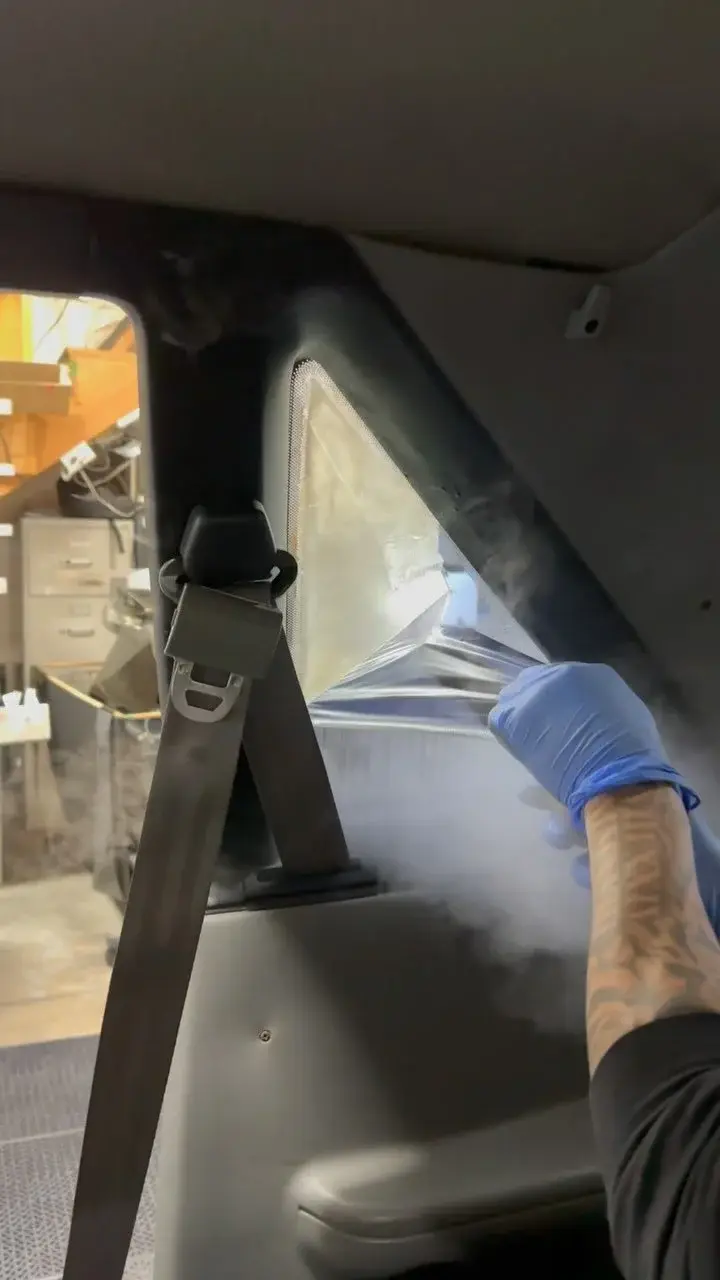
What is the black border with dots made of?
It’s ceramic enamel printed onto the glass and fused to it by heat, not paint or a sticker. Glassmakers call it the frit, the obscuration band or simply the black band.
AGP, which makes automotive windshields, describes it in a 2017 US patent as an “obscuration band of black enamel frit” that is “commonly called the ‘black band’.” Companies that make these enamels sell them to glass producers for exactly this use: Vibrantz lists its glass enamels for front and rear windows, back-lights and quarter-lights, and names “good opacity for obscuration” as one of their properties. Once fired, the enamel is part of the glass surface. You can’t peel it, and you shouldn’t try to scrape it.
Why do bonded car windows need a black band?
To hide and protect the adhesive. Bonded glass, the windshield above all, is held in the body by a bead of polyurethane, and that bead needs shelter from sunlight.
AGP’s patent traces the polyurethane to crash safety: the industry switched to adhesive mounting “to improve occupant retention in crashes”, and the adhesive “needs to be protected from ultra-violet light.” It gives the band two jobs: “to obscure the view of the polyurethane and to protect the polyurethane by blocking the UV.” Vibrantz makes the same point from the enamel side, listing “protection for adhesives against UV degradation” and noting that UV absorbed from sunlight “can result in cracking or degradation” of the materials holding windows in place. The band also covers wiring. Vibrantz says its enamels let carmakers “hide antenna and heat and sensor connections”, which is where the ends of a rear defroster grid usually disappear, into the black edge of the back glass.
Why does the band end in dots instead of a straight edge?
Because black enamel heats faster than clear glass, and a sharp boundary between the two causes distortion. The dots turn that boundary into a gradual fade.
The frit is screen- or inkjet-printed onto flat glass, which is then heated and bent to shape, and the enamel fuses to the glass surface during bending. AGP’s patent explains that “the painted area tends to run hotter than the adjacent clear areas”, and that the steep temperature change at the inner edge of the band leaves optical distortion there, known in the industry as the “burn” line. The usual remedy is a dot fade: starting at the solid edge, “rows of increasingly smaller dots are painted on the glass”, which the patent compares to “the same principle as used in grayscale printing.” Spreading the change in temperature over a wider strip reduces the distortion and helps hide what remains. The softer look of a fade, compared with a hard black line, comes with it.
Which windows on a car have the black dots?
The ones glued into the body. Moving glass usually doesn’t need them.
| Window | Band and dots? | Why |
|---|---|---|
| Windshield | Yes, around the edge | Bonded with urethane; also hides the mirror mount and camera area |
| Back glass | Yes, around the edge | Bonded; hides the adhesive and the defroster connections |
| Fixed rear quarter glass | Usually | Enamel makers list quarter-lights alongside back glass |
| Roll-down door glass | Usually not | Slides in channels instead of being glued |
The patch of dots behind the rear-view mirror belongs to the same system. On a car with a forward camera, AGP’s patent notes that the band’s edge region is “a critical viewing area for windshield mounted cameras”, which is one reason film has no place there. The camera question has its own answer on tinting a windshield with an ADAS camera.
How does window tint deal with the dots?
Film makers teach installers to cut back-glass film so it covers the dotted fade and finishes on the solid black, where its edge disappears against the enamel.
Avery Dennison’s application bulletin for automotive film has installers size rear-window film to finish “2-3 mm over the solid part of the dot-matrix print.” The same bulletin singles out the dot-matrix print, along with the heating wires, as places to “take particular care” when film is removed.
At Brookswood Tint, film is cut on a computerized plotter to the exact year, make and model, then heat-shrunk to the curve of the back glass and fitted by hand. When old film has to come off, the shop uses steam rather than blades on rear glass, so the defroster grid and the printed edge come through intact; rear window tint removal covers that job. The defroster lines themselves are a separate question, answered on tinting over rear defroster lines.
Door glass is a different story. With no band to hide behind, its film edge stops a little short of the top of the glass, which is the line explained on why tinted windows have a gap at the top.
Do the black dots change what you can tint in BC?
No. The band and dots are part of the factory glass, and BC’s tint rule is about material added to the glass afterwards.
Under MVAR s. 7.05(8), added film is allowed on the side glass to the rear of the driver, on the back glass if outside mirrors are fitted left and right, and on the windshield “not more than 75 mm below the top of the windshield.” The 75 mm is measured from the top of the windshield, whatever the black band is doing. Front door glass can’t legally take film of any shade, clear included. The shop will fit front-door or full-windshield film if asked, after explaining that it isn’t road-legal in BC and that a $109 ticket or a Notice & Order can follow.
Getting back glass with a dot border tinted in Langley
Book the rear glass package for your body style and the back window is included, dots and all. The rear packages run from $220 on a sports coupe (three windows) through $240 on a sedan or pickup (five) to $260 on a full-size SUV or wagon (seven), in LLumar ATC; ceramic IRX and clear AIR are quoted as upgrades. Most cars are done the same day.
The back windows tint page shows what each package covers. Send your car’s year, make and model on the window tint quote form, or phone or text 604 534 6433. If you want the term for the black band in one line, the frit glossary entry has it.