

What is frit, and how does it get onto the glass?
It’s a ceramic enamel, printed on flat glass and then fired. AGP, a windshield maker, explains in a 2017 patent that the frit goes on “using a silk screen or ink jet printer prior to heating and bending”, and that the enamel is “fired” during that heating. Once fired, it can’t be peeled or washed off.
The trade has several names for the same thing. Glassmakers say frit, black band or obscuration band; Avery Dennison’s window film installation bulletin calls it the “dot-matrix print”. Enamel supplier Vibrantz sells its versions to glass producers as “specialty black bands”, for windshields, back-lights, quarter-lights and sunroofs.
What does the frit do?
Two jobs: cover and shield the adhesive, and hide hardware. AGP’s patent gives the band two duties, keeping the polyurethane bead out of sight and blocking the UV that would degrade it. Vibrantz adds that the enamel lets carmakers conceal antenna, heater and sensor connections, which is why a rear defroster grid seems to end at the black edge.
The dots are a manufacturing fix. The printed black area runs hotter than the clear glass beside it during heating, and AGP describes the resulting optical distortion at the band’s inner edge as the “burn” line; rows of ever-smaller dots soften that edge the way greyscale printing does. The longer story, window by window, is on the black dots around car windows.
What the frit means for window tint in BC
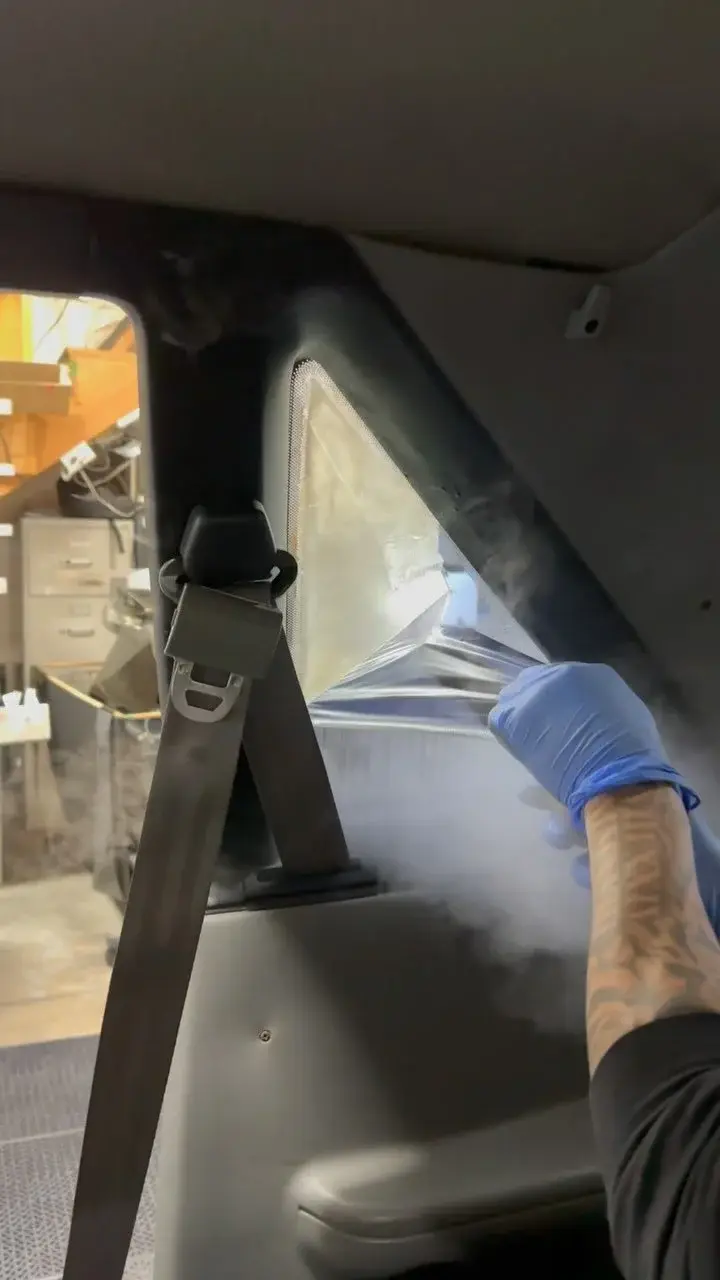
It decides where film on bonded glass ends. Avery Dennison’s bulletin tells installers to trim back-glass film so it laps 2 to 3 mm onto the solid black, and to go carefully around the dots and heating wires when old film is stripped. Brookswood Tint cuts each piece on a computerized plotter to match the car’s year, make and model, shrinks it to the glass with heat and settles the edge by hand. Old film is lifted from rear glass with steam, never a blade, as set out on rear window tint removal.
The frit is part of the factory glass, so BC’s tint rule doesn’t reach it; the windshield check in the 2025 Vehicle Inspection Manual, item 12e, is written about “after-market tint”. AGP’s patent also flags the band’s edge as an area that windshield-mounted cameras depend on to see the road ahead, which is why tinting a windshield with an ADAS camera needs its own answer. Back glass, dots included, comes in every rear package on back window tint.