Which roads lead from Abbotsford to the Langley Bypass?
Two roads do nearly all of the work: Highway 1 west, or Fraser Highway west through Aldergrove. Abbotsford City Hall, at 32315 South Fraser Way, is about 24.5 km east-southeast of the shop in a straight line, so either way you are crossing most of the Township of Langley.
By Highway 1
From City Hall, Clearbrook Road leads to the Highway 1 westbound on-ramp. Leave at the 232 Street exit, and follow Highway 10 south and west, first as 232 Street and then as Glover Road, into Langley City. Glover Road meets the Langley Bypass, and the shop is a short way along it.
By Fraser Highway
Head west on Old Yale Road and Maclure Road, which runs on as Fraser Highway, and stay on Fraser Highway through Aldergrove and on into Langley City, where it crosses paths with the Langley Bypass; turn onto the Bypass there. This way keeps you off the freeway. Drivers from the Mission side of the river have a page of their own.
What is changing on Highway 1 between Abbotsford and Langley?
The province is widening it in phases, so expect construction for years. The Fraser Valley Highway 1 program shows two Langley-side phases under construction, 216th to 264th Street (10 km) and 264th Street to Mt. Lehman Road (13 km), with the next 8 km, from Mt. Lehman Road to Highway 11, in procurement and detailed design.
At the Abbotsford end, major construction on the Highway 11 interchange began in spring 2026 and is expected to finish in 2031. The province warns of construction speed zones, lane shifts and overnight closures, with a 50 km/h limit on Highway 11. In the same release, Abbotsford mayor Ross Siemens said the city “sees more than 80,000 vehicles travel through our community on highways every day.”
In slow, shifting lanes it is easy to end up close behind the vehicle ahead, and following distance is what decides whether a thrown stone reaches your paint. Protecting your car from Highway 1 rock chips sets out the following distances and the film that work together.
How does the City of Abbotsford handle snow and ice?
The City treats about 918 km of paved roads in three priority tiers, starting with roughly 350 km of busy arterials and collectors that include transit routes, school zones and the main climbs into hillside neighbourhoods. Its snow and ice page describes the season’s preparation and the order of work:
| Stage | What crews do |
|---|---|
| Before winter | Stock sand and salt in four storage sheds spread across the city; inspect the anti-icing tanks |
| Before a storm | Spray liquid sodium chloride so ice can’t bond to cold asphalt |
| During and after snow | Spread a sand and salt mix, pre-wetted with brine, from tandem trucks |
| Once snow builds up | Plow with belly and front plows while still spreading sand and salt |
Highway 1, Highway 11 and Mt. Lehman Road south of the freeway to the airport belong to the province, not the City; Abbotsford names Emil Anderson Construction as the ministry’s contractor there. Staff watch weather cameras and pavement sensors at key locations, which residents can view too.
What does the weather at Abbotsford Airport mean for a car?
Rain is only part of what Abbotsford’s weather records show. Environment and Climate Change Canada’s 1981–2010 normals for Abbotsford A, about 3.7 km from City Hall, record:
| Normal, per year | Abbotsford A |
|---|---|
| Days with fog, ice fog or freezing fog | 26.6 |
| Days with freezing rain or drizzle | 1.6 |
| Snowfall | 55 cm |
| Days with a high above 20 °C | About 100 |
| Days with a humidex of 30 or more | 22.6 |
The summer numbers are the argument for ceramic tint behind the driver; the winter ones are the argument for film on the front panels, because ice means abrasive on the road. On fog-heavy routes, it is worth thinking about how dark tint behaves at night and in low light before choosing the darkest shade.
Which film suits an Abbotsford driver?
For a car that commutes on Highway 1, start with paint protection film; for a car that bakes on summer days, add tint. Customers come to the shop from Abbotsford, and the right mix depends on how the car is driven.
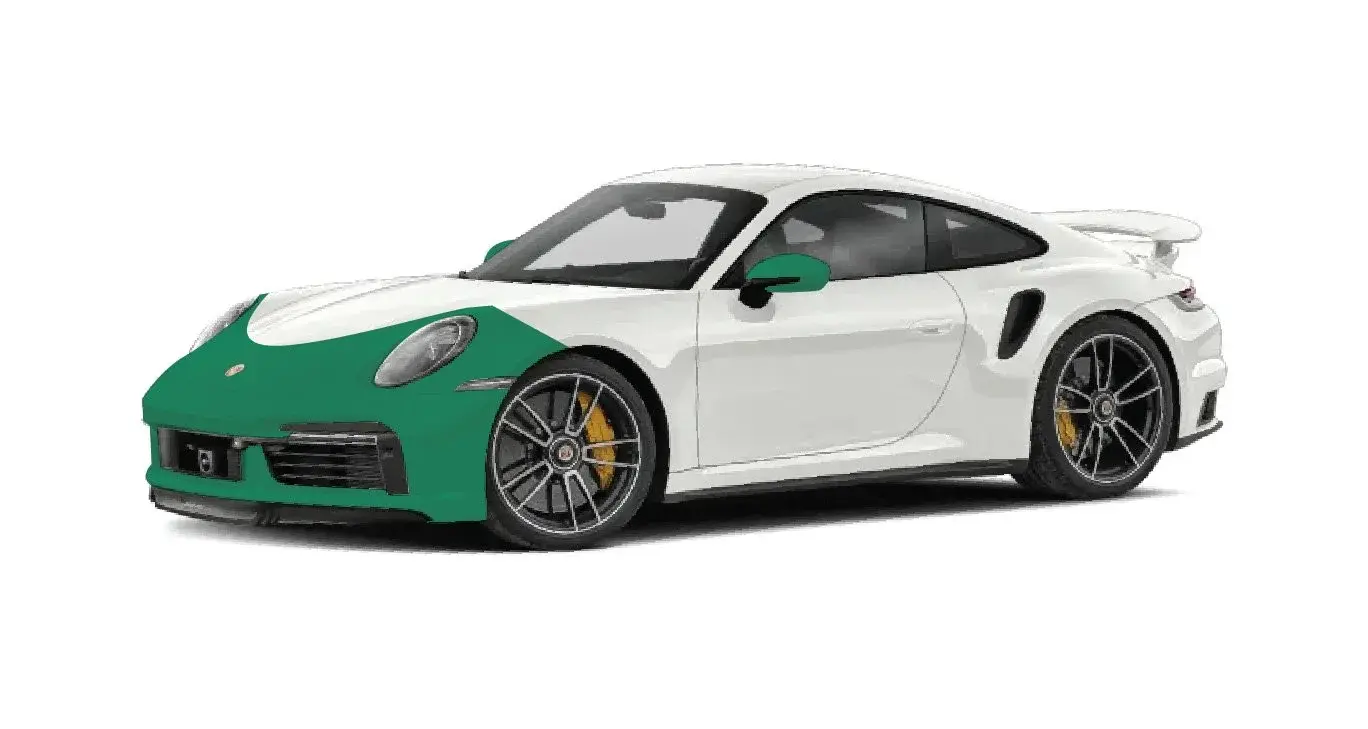
- Regular highway use: a Full Front in LLumar Platinum covers the whole hood, both fenders, the bumper, headlights and mirrors. Its 10-year manufacturer’s limited warranty covers yellowing, cracking, bubbling and peeling, in the shop’s published terms.
- Occasional highway use: a Partial Front protects the bumper, mirrors, headlights and the leading part of the hood and fenders.
- Rocker panels too: the Track Package extends film to the rockers, the A-pillars and a section of the roof.
- Heat: LLumar IRX nano-ceramic film, quoted per package, rejects more of the sun’s energy than the ATC base film.
Glass behind the driver can take any shade in BC. The front side windows are different: MVAR s. 7.05(8) allows no film there at all, and on the windshield only the top 75 mm. Film on those doors is something the shop installs only on request, and an Abbotsford driver who chooses it is driving a car that isn’t road-legal: the risk is a $109 ticket, or a Notice & Order sending the car for inspection once the film is off, and the shop talks through both first.
How do you book from Abbotsford?
Book one trip for everything you want, and ask for the drop-off and pick-up days with the quote. Paint protection packages and their usual time in the shop:
| LLumar Platinum package | From | Usual time |
|---|---|---|
| Partial Front: bumper, lights, mirrors, leading edges | $850 | A day |
| Full Front: whole hood and fenders | $1,550 | 1 to 2 days |
| Track Package: adds rockers, A-pillars, part of the roof | $1,900 | 1 to 2 days |
| Full Vehicle: every painted surface | $4,000 | 3 to 5 days |
Larger vehicles and complex panels can price higher, and paint is decontaminated and corrected if needed before film goes on. Window tint starts at $240 for a sedan’s five rear windows and $260 for a full-size SUV’s seven; IRX and AIR are quoted per package. Request a price on the Full Front PPF page or through the quote form, Monday to Saturday, 9:00 to 17:00.