
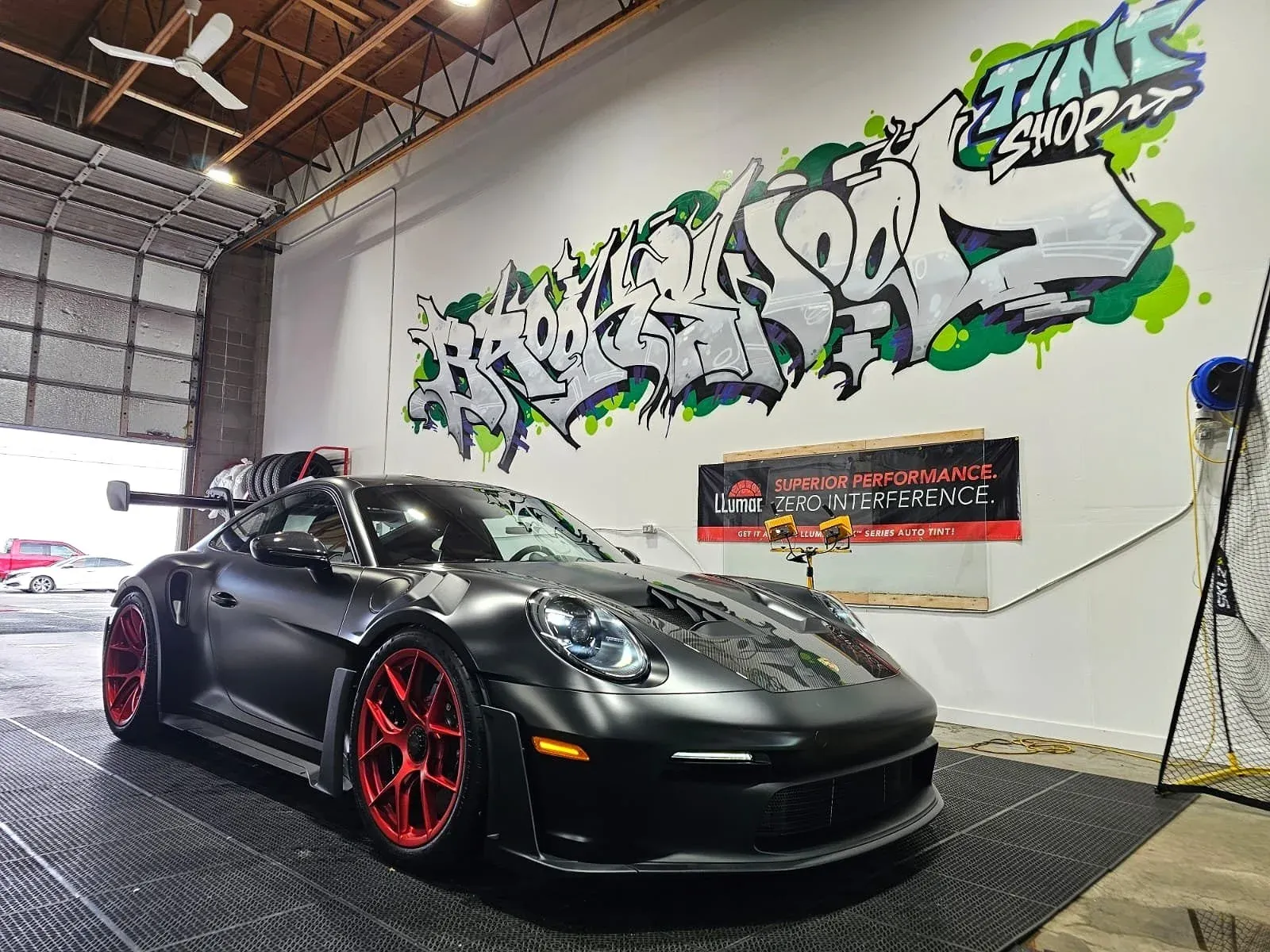
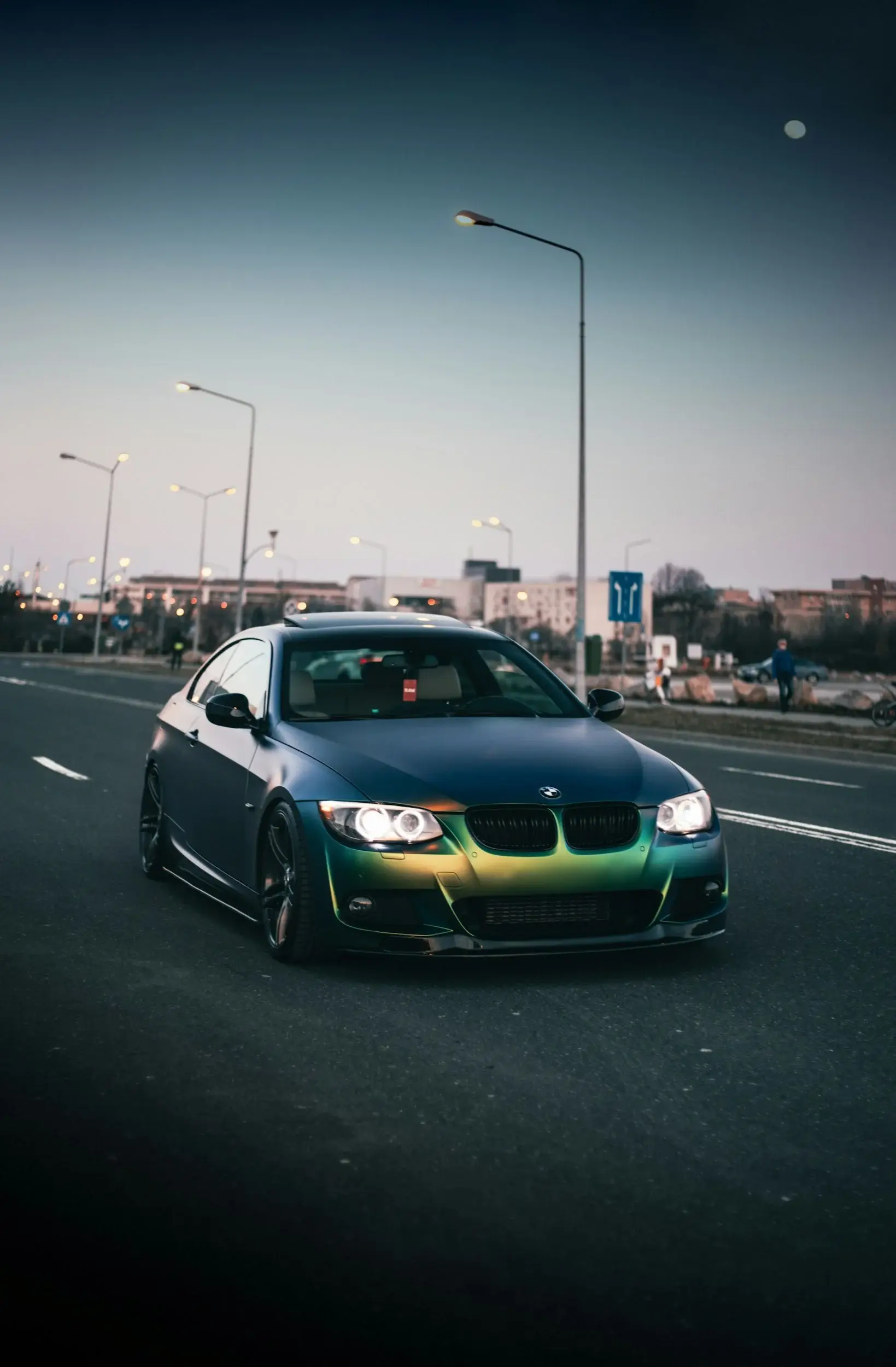
How do 5% and 20% tint compare side by side?
The two shades differ most in light: 20% lets through three to five times as much. They differ least in heat, where the film line counts for far more than the shade. All figures are LLumar’s, from its performance data sheet (LL0116NAEN, 03/26), measured with each film applied to a single sheet of clear 6 mm glass.
| 5% | 20% | |
|---|---|---|
| LLumar shades | ATC 05, IRX 05 | IRX 15, ATC 15, or off-menu ATC 20 |
| Measured VLT | 5% (ATC 05), 6% (IRX 05) | 20% (IRX 15), 18% (ATC 15), 25% (ATC 20) |
| Glare reduction | 94% | 78% (IRX 15), 79% (ATC 15), 72% (ATC 20) |
| Total solar energy rejected (TSER) | 44% (ATC 05), 62% (IRX 05) | 59% (IRX 15), 40% (ATC 15), 38% (ATC 20) |
| Infrared energy rejected (IRER) | 22% (ATC), 60% (IRX) | 22% (ATC), 61% (IRX) |
| UV, 300–380 nm | Above 99% | Above 99% |
| Over factory glass that passes 20% | About 1% | About 4–5% |
| Road-legal in BC | Behind the driver | Behind the driver |
Heat: the film line outweighs the shade
Going from 20% down to 5% in the same film adds only 3 to 6 points of TSER: IRX 15 to IRX 05 is 59% to 62%, ATC 15 or ATC 20 to ATC 05 is 40% or 38% to 44%. Infrared energy rejection doesn’t move at all within a line. Switching from ATC 05 to IRX 15, on the other hand, adds 15 points of TSER while letting in four times the light. If you’re choosing 5% to keep the car cool, a lighter ceramic does that job better.
What do you get when you ask for 20% at Brookswood Tint?
The shop’s menu runs 5, 15, 35 and 50, so a request for 20% becomes one of the two 15 shades, which measure 18 to 20%, unless you ask for something else. LLumar does make a 20 in its ATC line, but its name and its measurement don’t match.
| Option | On the shop’s menu | Measured VLT | TSER |
|---|---|---|---|
| ATC 15 | Yes | 18% | 40% |
| IRX 15 | Yes | 20% | 59% |
| ATC 20 | No | 25% | 38% |
| IRX 25 | No | 26% | 57% |
So if “20%” to you means a film that lets through 20% of the light, IRX 15 is the closest match on LLumar’s sheet. If it means the darkness of a friend’s car, find out what film and code are on that car, because the same shade name can measure differently from one film line to the next: ATC 15 measures 18% and IRX 15 measures 20%. ATC 20 and IRX 25 are on LLumar’s sheet but not on the shop’s menu, so ask when you book whether either can be ordered.
How much harder is it to see out through 5% than through 20%?
Noticeably harder, and most of all at night. Through 5% film you get between a fifth and a third of the light a 20% film gives you, and after dark there’s little light to spare.
That matters most when you look back through the rear glass. In a laboratory study published in Human Factors in 1993, Freedman, Zador and Staplin simulated the look through the back window before reversing. A car behind was always detected, but “detection probability decreased with reduced luminous transmittance for the child and roadway debris targets”, and older drivers did worse. The authors concluded that backing safety “is compromised for all drivers at the darkest tinting levels studied”.
What 5% dims is the over-the-shoulder glance and the view through the inside mirror on a dark, wet night. Inspection item 14c checks that a car with filmed back glass has an outside mirror on each side. The trade-offs after dark have their own page: is dark tint safe for night driving.
What 5% adds over 20%: privacy and glare
- Privacy. Film passes light the same amount in both directions, so whatever is lit inside the car shows through a 20% film three to five times as readily as through a 5% film.
- Glare. 5% cuts glare by 94%; the 20% options cut 72 to 79%. Both take most of the sting out of low sun through the side glass, and 5% takes nearly all of it.
What happens when 5% or 20% goes over factory privacy glass?
They multiply, so on dark factory glass even a 20% film ends up very dark. Hyundai’s 2023 Palisade bulletin says privacy glass usually lets through less than 20% of visible light (Hyundai TSB 23-BD-001H).
As a rough guide, multiply the two figures. On glass that passes 20%:
- ATC 05 or IRX 05 leaves about 1% of the light.
- IRX 15 leaves about 4%, and ATC 20 about 5%.
In other words, a 20% film over that glass comes out about as dark as a 5% film on clear glass. On an SUV or van that already has privacy glass behind the front doors, that’s worth knowing before you ask for 5%. More on this is on can you tint over factory tint and SUV window tint.
Which windows can take 5% or 20% tint in BC?
Any side window behind the driver can take either shade, and so can the rear window when a mirror is mounted outside on each side. BC sets no darkness limit on that glass, so 5% is as legal there as 20%. Neither shade is legal on the driver’s or front passenger’s window.
That comes from MVAR s. 7.05(8), which allows film only behind the driver, on a mirrored car’s back glass and in the windshield’s top 75 mm. Under item 13d, the 2025 Vehicle Inspection Manual fails aftermarket tint on side windows ahead of the driver’s seat back. If you still want the front doors done, the shop will do them once it has walked you through the risk: a ticket (Mission RCMP gives $109 as the typical fine), or a Notice & Order, which means taking the film off and getting the car through an inspection inside 30 days or paying $598. The full rule on tint darkness in BC is on how dark tint can legally be in BC.
5% or 20%: which should you choose?
Choose 5% if you want the back of the car blacked out and you rarely drive or reverse on dark roads. Choose 20% if you want strong privacy but also want to see out comfortably at night.
5% suits you if
- You want maximum privacy for passengers, cargo or tools, and a blacked-out look.
- Your car has clear glass at the back, not factory privacy glass.
- You have a backup camera and mostly drive on lit roads.
20% suits you if
- You drive the Fraser Valley’s unlit roads after dark or reverse into tight spots at night.
- The car already has privacy glass and you want a little more darkness, not a lot.
- Older drivers share the car; in the Freedman study, older drivers had the most trouble spotting targets through dark rear glass.
Where we stand
Both are legal behind the driver in BC, and we fit both. If you can’t decide, our advice is the 15 on the menu, in IRX if heat matters: IRX 15 measures 20% and ATC 15 18%, both keep the back seat out of view in daylight, and both are easier to live with at night than 5%. A different shade later means paying to strip this one first, so judge it by how the car will feel on a dark evening. For every shade on the menu, read what tint percentage you should get; one step lighter is compared on 20% vs 35% tint.
What do 5% and 20% tint cost to install?
The shade doesn’t change the starting price; the package and the film do. Behind-the-driver packages in LLumar ATC are listed from $220 for a sports coupe up to $260 (full-size SUV or wagon), with sedans and pickups at $240. IRX costs more and is quoted per package; the window tint price list has the detail.
Most cars leave the same day; a full sedan or SUV is normally two to four hours in the bay. Plan on keeping the tinted side windows shut for 3 to 5 days afterwards. Send the vehicle, the shade and whether you’d like ATC or IRX through the tint quote form. The full spec tables are on LLumar ATC and LLumar IRX.