How do headlight restoration and replacement compare side by side?
Restoration repairs the outer surface of the lens you already have; replacement swaps the whole lamp assembly for a new one. Restoration is usually the quicker and cheaper job, and replacement is the only fix for anything inside or broken.
| Restoration | Replacement | |
|---|---|---|
| What it fixes | Yellowing, haze, oxidation and fine scratches on the outer lens | Everything, because the whole lamp is new |
| What it can’t fix | Moisture inside, cracks, broken mounts, a failed seal, dead LEDs | Nothing about the lamp; aim still has to be set |
| Light output in AAA’s 2018 test | About 70% of a new lamp | 100% with OEM parts; 83–90% with aftermarket |
| Glare in AAA’s test | More than US DOT criteria accept | Aftermarket units more likely to glare |
| Time | About an hour to half a day | Depends on the model and parts supply |
| Price | Quoted per vehicle | Often expensive for OEM, varies by model; ask your dealer |
| Keeping it clear | Sealant or STEK light film over the restored lens | A new factory hard coat |
| BC inspection | Clears the “clouded” reject if the rest of the lamp is sound | Must carry CMVSS or compliant ECE markings |
The test figures come from AAA’s 2018 lab study, and the inspection rules from BC’s 2025 Vehicle Inspection Manual.
Which headlight problems can restoration fix?
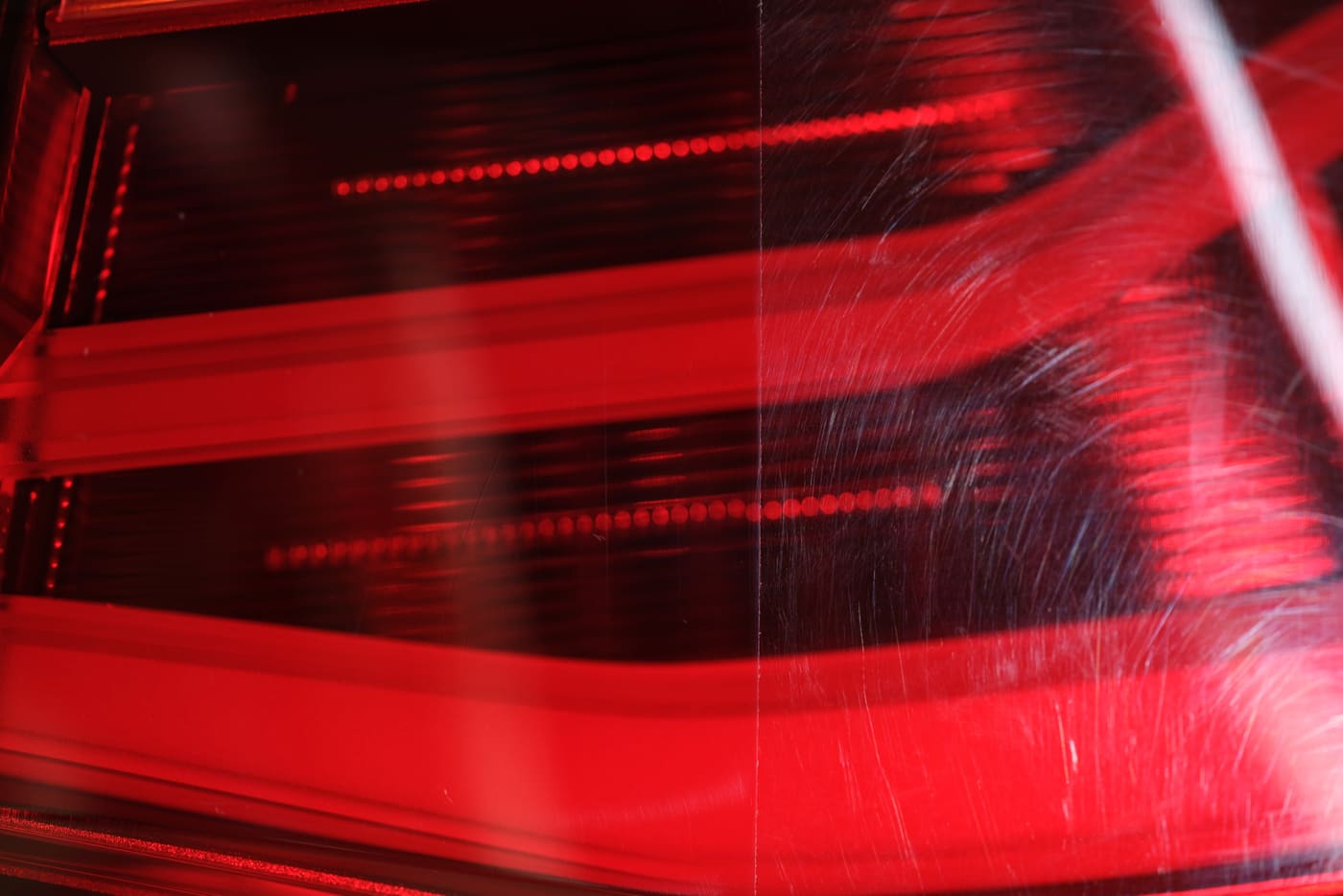
Restoration fixes damage on the outer face of the lens. Yellowing, chalky haze, light oxidation and fine scratches are all surface damage, and wet sanding and polishing remove them down to clear plastic.
The shop offers three levels, matched to how far the damage has gone:
| Level | For lenses that are | Time |
|---|---|---|
| Polish and seal | Lightly hazy, not yet yellow | About an hour |
| Full restoration | Yellowed or chalky, with the factory coat failing | 2 to 3 hours |
| Restoration plus STEK film | Yellowed, and you want a warranted layer on top | Half a day |
The full restoration uses progressive wet sanding to take off the failed coat and the oxidation under it, then compounding and polishing back to clear. For lenses that have already gone yellow, the steps are covered on yellow headlight restoration, and the service as a whole on headlight restoration.
When does a headlight need replacing instead?
A headlight needs replacing when the problem is inside it or in its structure. Polishing works on one surface of the lens, so it can’t dry out a lamp, close a crack, rebuild a mounting tab or bring back a dead LED.
These are the faults to look for, each of them a reject item in Section 6 of the 2025 inspection manual:
- Moisture inside the lamp. The manual’s wording is “moisture is present inside the lamp assembly”. Droplets or fog behind the lens mean water is getting in, which is the subject of foggy headlight repair.
- Cracks and breaks. A lamp that is “broken, cracked” or has an “insecure mounting” fails, and sanding a cracked lens doesn’t make it whole.
- Broken aim adjusters. Item 1.1(a) rejects headlamp aim adjusters that are “missing, broken, inoperative, mounted insecurely”.
- Dead LEDs. The manual fails a headlamp when “any LED in headlamp assembly required for frontal illumination is inoperative”.
The shop will tell you before it starts if what it sees is a replacement job, rather than charge for a restoration that can’t fix the fault.
How does the 2025 BC inspection treat each fix?
A clouded lens fails a BC inspection on its own, so a restoration can turn that reject into a pass when the rest of the lamp is sound. A replacement has to clear a different set of checks: proper markings, the right light source and correct aim.
In the 2025 Vehicle Inspection Manual, Section 6 item 1.0(a) fails a lamp whose “lens is clouded”, one that cuts the light passing through it, and one that is hard to see or covered. For a replacement, the same item fails a lamp missing clear CMVSS or ECE “function markings”, and item 1.1(a) rejects an “HID or LED bulb” installed in a housing built for incandescent bulbs. Aim is checked too, under item 6, using aiming equipment or an aiming screen, so whoever fits a new assembly should aim it.
Cars coming into BC from elsewhere face the same lamp checks, listed with the glass rules in the out-of-province inspection guide.
What did AAA’s testing find about restored and replaced headlights?
In AAA’s 2018 lab test, clouded headlights produced only about 20% of the light of new ones. Restoration brought them back to about 70%, OEM replacement to 100%, and aftermarket replacement to between 83 and 90%.
The details matter. AAA tested headlights from two popular sedans, about 11 years old, against the US standard FMVSS 108. Both the professional and the do-it-yourself restorations it tried “produced more glare than is acceptable according DOT criteria”, while the aftermarket replacements missed some light-intensity requirements and were more likely to glare at oncoming drivers. AAA still called restoration “the most cost effective option”.
Read it as one useful study, not the last word. It used US standards, generic restoration methods and two car models. What it does show clearly is the trade: restoration recovers much of the lost light at the lowest cost of the options AAA tried, and a genuine new assembly is the only route back to full output.
Light output counts on Fraser Valley roads. Abbotsford’s climate normals, published by Environment and Climate Change Canada, record 26.6 days of fog in an average year and about 106 hours with visibility under a kilometre, about 90% of them between September and February.
What keeps a restored lens clear, compared with a new one?
A new assembly arrives with its factory UV hard coat intact. A restored lens has had what was left of that coat sanded away, so it stays clear only as long as whatever replaces the coat holds up.
That’s why no restoration here leaves the lens bare: it is sealed, or covered with STEK light film. The film carries a 7-year warranty against yellowing, cracking and peeling as the shop publishes it, which gives a restored lens a written term of its own. Smoked film in 30% or 50% also cuts light output, the opposite of what a restoration is for. And because item 1.0(a) fails a lens that is “covered in any manner”, even clear film may be questioned at an inspection, so if one is coming up, say so and the lens can be sealed instead. The film range is on headlight and taillight tint, and the legal side of tinted lenses on whether tinted headlights are legal in BC.
Headlight restoration or replacement: which should you choose?
Start with where the damage is. If it’s on the outside of the lens, restore and protect it; if it’s inside the lamp or in its structure, replace the assembly.
Restore if
- The lens is yellow, hazy or chalky, but dry inside.
- There are no cracks and the lamp is mounted firmly.
- You want the lower-cost fix, finished in a few hours.
- You’re happy to add a sealant or film so it stays clear.
Replace if
- You can see droplets or fog behind the lens.
- The lens or housing is cracked, or a mount or adjuster is broken.
- An LED in the headlamp has failed.
- You want full factory light output, and OEM parts are within budget.
Where Brookswood Tint stands on restoring versus replacing
Our side of this is restoring lenses and protecting them; the price of a new assembly is one to get from your dealer. When the lamp is sound and only the outer lens has aged, restoration is the sensible first step and costs less than new parts. When we find moisture inside or a crack, we’ll say it’s a replacement before any sanding starts, because a polished lens on a failing lamp still fails.
Booking a headlight assessment in Langley
Use the headlight restoration quote form to send the year, make and model with a clear photo of each lens, and say whether you’d like a sealant or STEK film finish and whether an inspection is coming up. The shop is open Monday to Saturday at Unit 312, 20560 Langley Bypass.