Is the fog on the outside or the inside of the headlight?
Look at the lens from an angle in daylight. If the outer surface looks dull and chalky all over, the fog is the lens itself and restoration can clear it; if the outside looks glossy but there’s mist, beads or water behind it, the fog is inside the lamp.
| What you see | Where it is | What it usually means | What fixes it |
|---|---|---|---|
| Even, dull haze; the outer surface looks chalky | Outside | The surface of the lens oxidizing | Polish and seal, or a full restoration |
| A thin mist on the inside that clears after a drive with the lights on | Inside | Normal condensation in a vented lamp | Nothing; keep an eye on it |
| Droplets, runs, or water lying in the bottom of the lamp | Inside | A leak through a failed seal or a crack | Replacement, not restoration |
| A crack in the lens or the housing | Either | Physical damage | Replacement |
Both kinds can show up on the same lamp. A lens that’s hazy outside and wet inside needs the leak sorted first, because polishing the outside of a lamp that’s going to be replaced is money spent twice.
What clears haze on the outside of a lens?
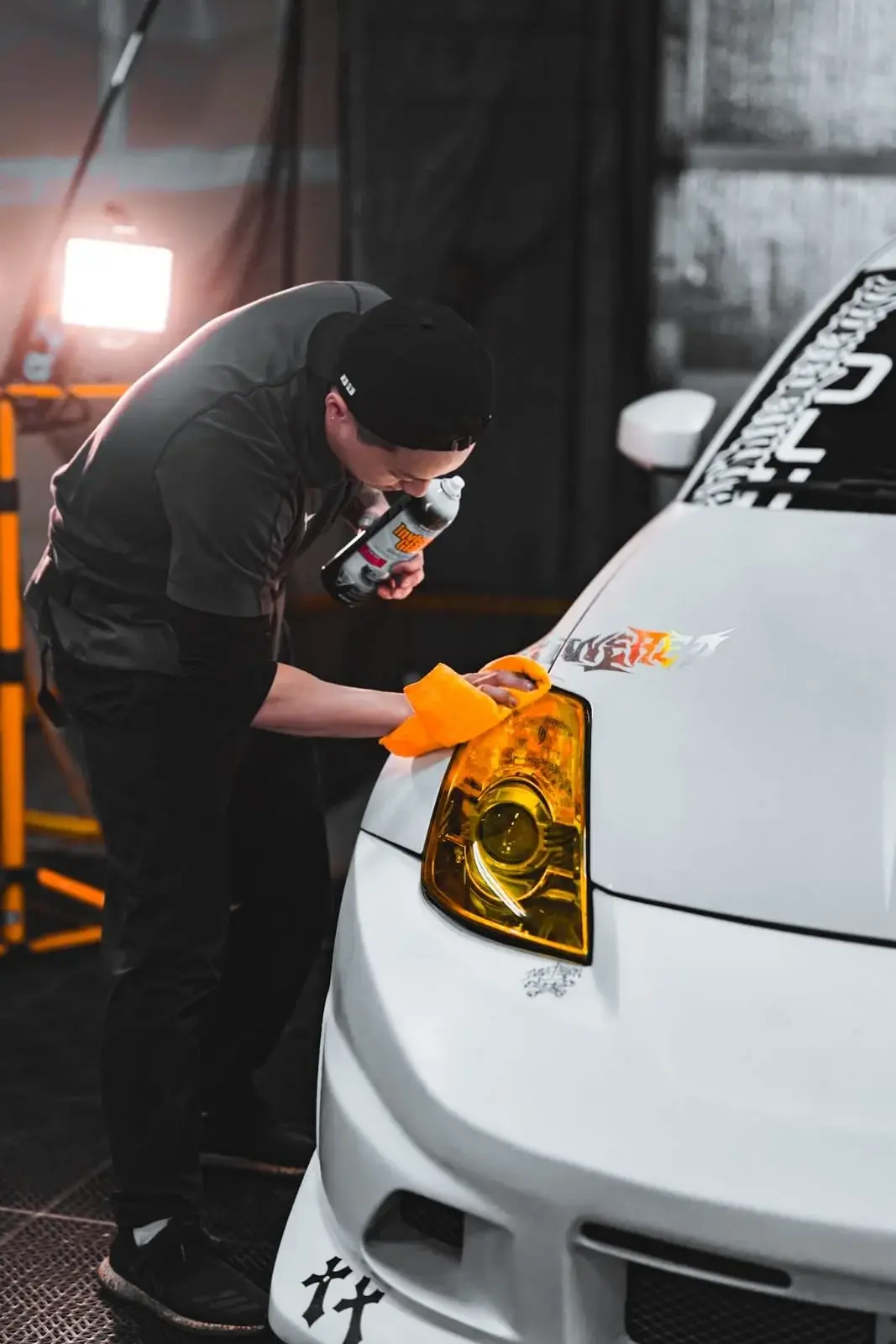
Machine polishing, and sometimes sanding first. Light haze with no yellow in it is what the shop’s polish and seal level is made for: about an hour of machine polishing followed by a sealant.
If the haze runs deeper, or there’s any yellow starting, the lens gets the full restoration instead. That’s 2–3 hours: the lens is wet-sanded in progressively finer steps to take away the failed factory coating and the oxidized plastic beneath, then compounded and polished until it’s clear again, and sealed. The yellow headlight restoration page explains why lenses yellow and what the full restoration involves on badly yellowed plastic.
Either way, the lens doesn’t leave bare, because polished plastic with nothing on it starts to haze again. Haze cleared by a polish is sealed. After a full restoration you can also choose clear STEK light film, which brings the visit to about half a day and puts a layer with a published 7-year warranty where the factory coating used to be.
When is fog inside a headlight normal, and when is it a leak?
A light mist that comes and goes is often normal, because many lamps are vented rather than sealed. Water you can see as drops, runs or a puddle is not normal and means the lamp has a leak.
Nissan’s service bulletin on exterior lamp fogging, which lists all 2001–2014 Nissan models, explains the design: “All current exterior lamp assemblies are vented to the atmosphere (not sealed)”, so damp air moves in and out and can condense on the lens in “a car wash, or parked on a cold, sunny day”. It treats that as normal. Its technicians are told to replace the lamp or housing when there are puddles, runs on the lens or droplets larger than 3 mm, and otherwise to run the low beams for 10 to 20 minutes and see whether the fog clears.
That’s one carmaker’s rule, but the logic carries over: mist that clears is the lamp breathing, water that stays is a leak. The Fraser Valley gives a vented lamp plenty of damp air to breathe, with 179.5 days a year of measurable precipitation in Environment and Climate Change Canada’s Abbotsford climate normals, so a little mist after a wet night isn’t a reason to panic.
Why can’t restoration fix fog inside the lamp?
Because sanding and polishing only reach the outer face of the lens. Liquid water inside the assembly got in through a failed seal or a crack, and nothing done to the outside of the lens closes that path, so the moisture keeps coming back.
That’s a replacement job, and the shop will tell you so before any work starts rather than charge for a polish that can’t help. Weighing the cost of a new assembly against restoring the lens you have is covered in headlight restoration vs replacement.
Will foggy headlights fail a BC inspection?
They can, whichever side the fog is on. Under Section 6, item 1.0(a) of BC’s 2025 Vehicle Inspection Manual, an inspector fails a lamp whose lens “is clouded” or cuts the light passing through it, and a separate line on the same item fails a lamp with moisture present inside it. Lamps are checked switched on.
Before an inspection: restore outside haze ahead of the appointment, and replace a lamp that holds water. A lamp that’s merely misty from a damp night can still be rejected under the moisture line on the day, so drive with the lights on beforehand and let it clear. The same item rejects a lens that “is covered in any manner”, so even clear film may be questioned; ask for a sealant finish instead.
Bringing a car in from another province adds tint and lamp checks of its own, and the out-of-province inspection guide walks through them.
How do you book foggy headlight restoration?
Send a close photo of each lens in daylight, taken after the car has been driven with the lights on so any normal mist has cleared, along with the year, make and model, through the headlight restoration quote form. If the car is due for an inspection, say so.
A polish and seal takes about an hour, a full restoration 2–3 hours and restoration with film about half a day. Restoration is quoted per vehicle. Bring the car to Unit 312, 20560 Langley Bypass, on any day but Sunday, from 9:00 to 17:00; the headlight restoration service page lists all three levels.