What does 15% tint measure on LLumar’s spec sheet?
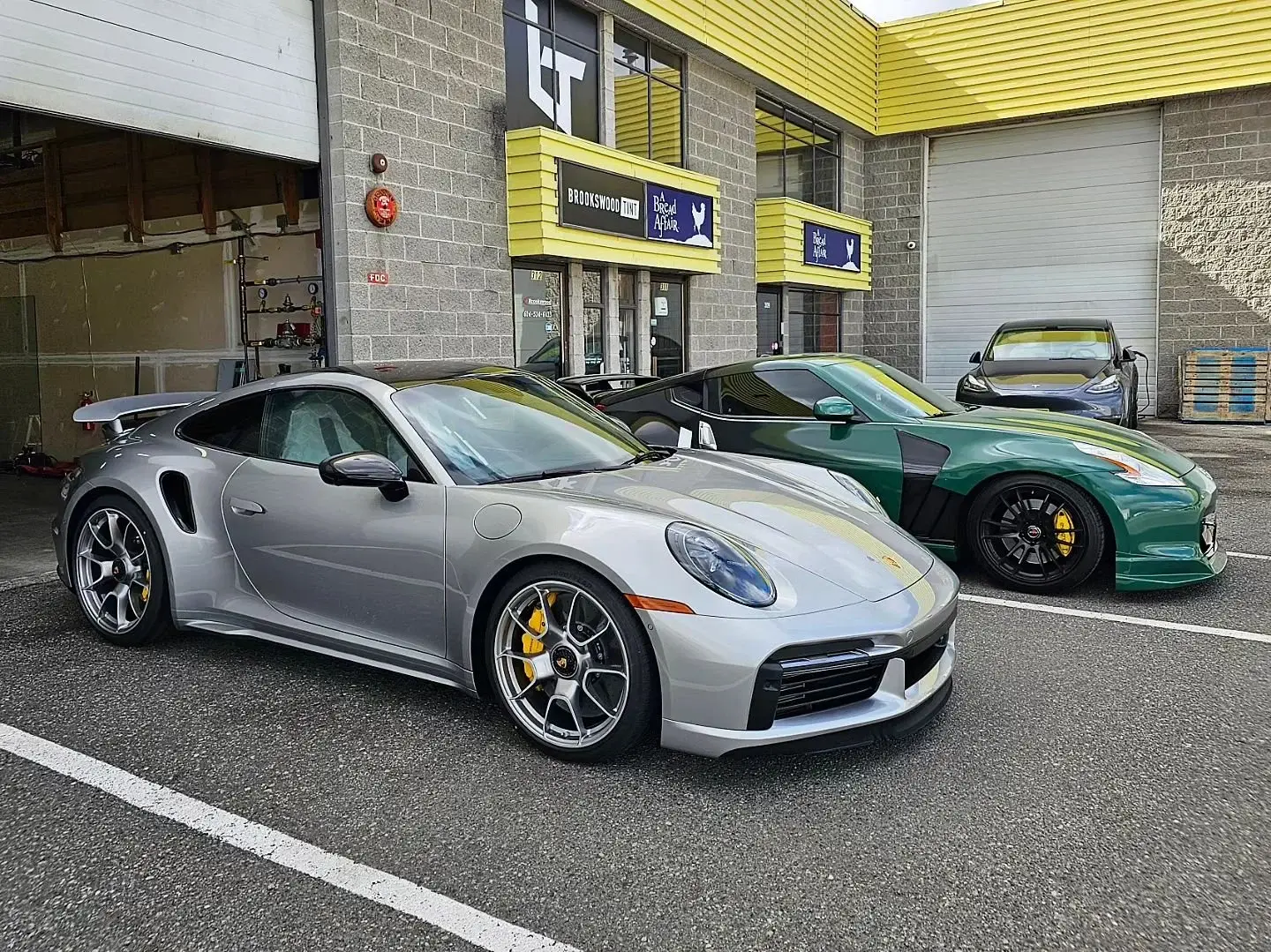
Neither 15 is really 15%: ATC 15 passes 18% of visible light and IRX 15 passes 20%. The CTX 15 on the silver 911 Turbo S in the photo also measures 20%. Where the three differ is in how much heat they keep out.
All three rows are LLumar’s own, printed in data sheet LL0116NAEN (03/26), where film is tested on clear 6 mm glass by NFRC methods.
| Measurement | ATC 15, dyed | IRX 15, nano-ceramic | CTX 15, ceramic |
|---|---|---|---|
| On the shop’s menu | Yes | Yes | On request |
| Visible light through (VLT) | 18% | 20% | 20% |
| Glare reduction | 79% | 78% | 78% |
| Total solar energy rejected (TSER) | 40% | 59% | 53% |
| Infrared energy rejected (IRER) | 22% | 61% | 49% |
| Selective IR rejection (SIRR) | 29% | 88% | 69% |
| Visible light reflected | 5% | 5% | 5% |
One row on that sheet deserves a note. IRX 15 posts the highest infrared figures anywhere on it: 61% IRER and 88% SIRR. Claims that a LLumar film “blocks up to 88% of infrared” trace back to that SIRR number, the larger and narrower of the two infrared measures. IRER also counts heat the film absorbs and gives off again, and the sheet calls it a more complete measurement, so it’s the better one for comparing films. LLumar’s own IRX page describes the film as nano-ceramic technology aimed at infrared heat and puts its UV protection above 99%.
How dark does 15% look on a car?
Dark enough that the back seat is hard to make out in daylight, light enough that the car still has visible windows rather than black panels. Against 5%, it lets in three to four times as much light.
From outside, glare and reflection are close to the 5% films: each 15 cuts 78 to 79% of glare and reflects 5% of visible light, so the glass looks charcoal, not mirrored. From the driver’s seat, the view over your shoulder by day stays usable; the change shows up after dark, when there is less light to spare and the inside mirror shows less of the road behind.
Ask for “20%” at this shop and you’ll be steered to one of the 15s, since the menu runs 5, 15, 35 and 50 and IRX 15 measures exactly 20%. The 20% window tint page goes through the other films that come close to a true 20, including ones that aren’t on the menu.
Is 15% tint legal in BC?
Yes, on every window behind the driver, and on the back glass too as long as the car carries two outside mirrors. It is not legal on the front side windows at any shade, and an inspector applying item 13d of the 2025 Vehicle Inspection Manual will fail it there.
MVAR s. 7.05(8) works by location, not darkness, so 15% behind the driver is no more or less legal than 50%. Front-door film is something the shop installs only on request, with the consequences spelled out first: a ticket that Mission RCMP puts at $109 in most cases, and possibly a Notice & Order, which gives you 30 days to take the film off and pass an inspection before a $598 fine.
South of the border the picture changes with the vehicle. Washington’s RCW 46.37.430 wants at least 24% light transmission through every side and rear window of a passenger car, factory glass and film counted together, so an 18 to 20% film starts below the line before the car’s own glass is counted. Trucks, motor homes and vehicles the maker calls multipurpose passenger vehicles may run darker film behind the driver. A sedan or coupe with 15% rear glass is fine in Langley and out of step in Bellingham.
Where does CTX 15, the film on the Turbo S, fit in?
CTX is a LLumar ceramic film the shop has installed, and it’s what the silver 911 Turbo S at the top of this page wears, in CTX 15. It isn’t on the current menu, but it can still be fitted on request.
Against IRX 15, CTX 15 lets in the same 20% of light and gives up some heat performance: 53% total solar rejection against 59%, and 49% infrared energy rejection against 61%. Both are a long way ahead of dyed ATC 15. If you saw that car and want the same look, IRX 15 matches its darkness exactly and rejects more heat; if you want CTX itself, say so when you book. The LLumar CTX page has every CTX shade, and IRX vs CTX puts the two lines head to head.
Which 15% is worth paying for, ATC or IRX?
ATC 15 is the posted-price option and gives you the privacy; IRX 15 gives you the same privacy plus the strongest infrared numbers LLumar’s sheet contains. The decision is about heat and budget, not looks.
In numbers, IRX 15 rejects 19 more points of total solar energy than ATC 15 and close to three times the infrared energy (61% against 22%). Fraser Valley summers are when that gap earns its keep: Environment Canada’s 1981–2010 normals for Abbotsford put the average July and August high at about 24 °C, and 8.7 days a year topping 30 °C (ECCC climate normals). Both block more than 99% of UV, so the cheaper film doesn’t shortchange the people in the back on that front. For every ATC shade in one table, see the LLumar ATC page.
What does 15% tint cost, and how long does it take?
In ATC 15, rear glass starts at $220 for a sports coupe (three windows), $240 for a sedan or pickup (five) and $260 for a full-size SUV or wagon (seven). IRX 15 is quoted per package on top, and booking several jobs together usually comes in under the list prices added up.
Most cars are done the same day; a full sedan or SUV generally takes two to four hours, longer if old film has to be steamed off first. Keep the tinted side glass shut for three to five days while it cures, and expect a light haze in the first week that clears by itself. The film and the labour are warranted for life. Ask for a price on the 15% tint quote form, or compare it with the shades either side on the 5% tint page and the 35% tint page.