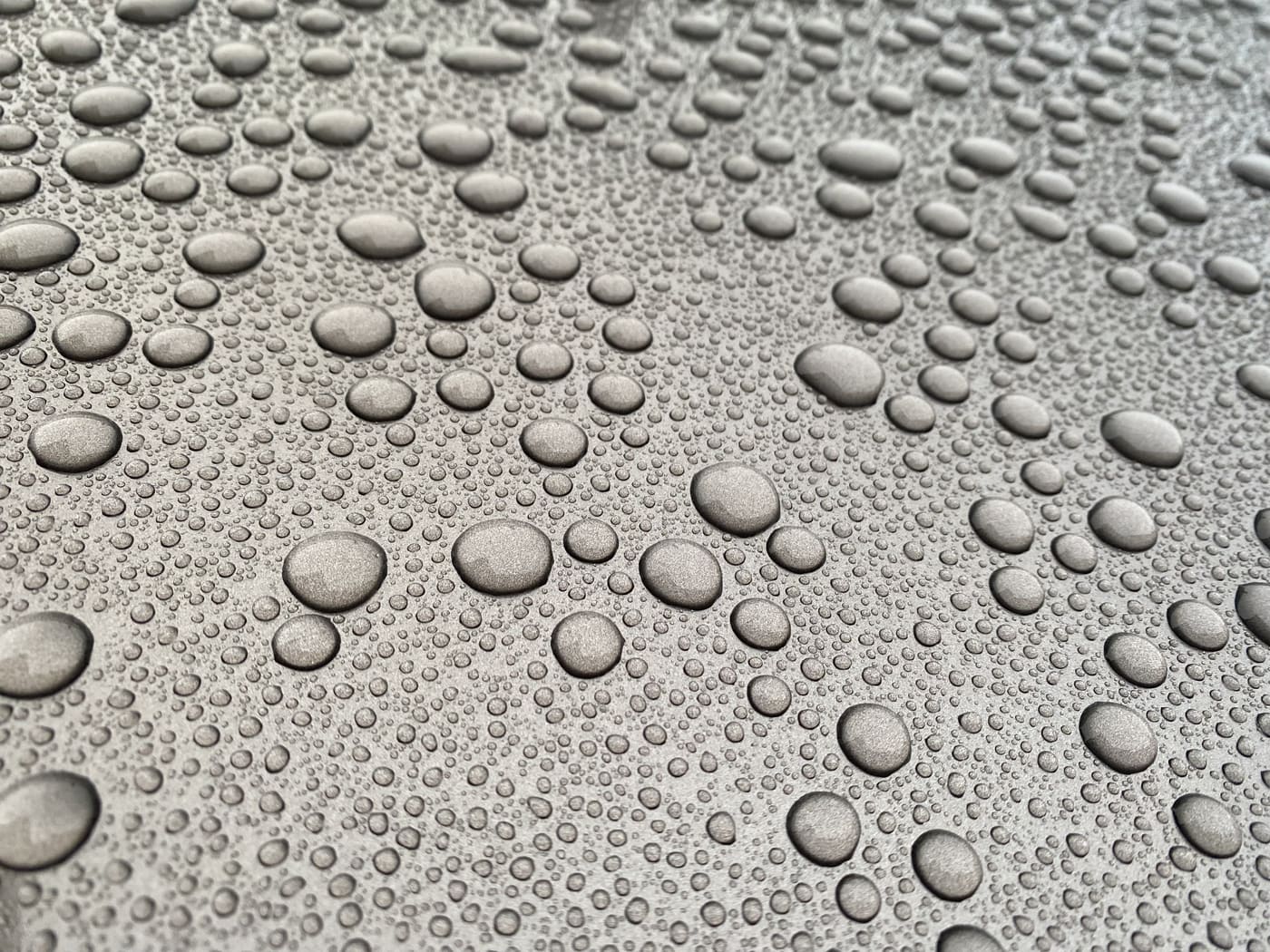
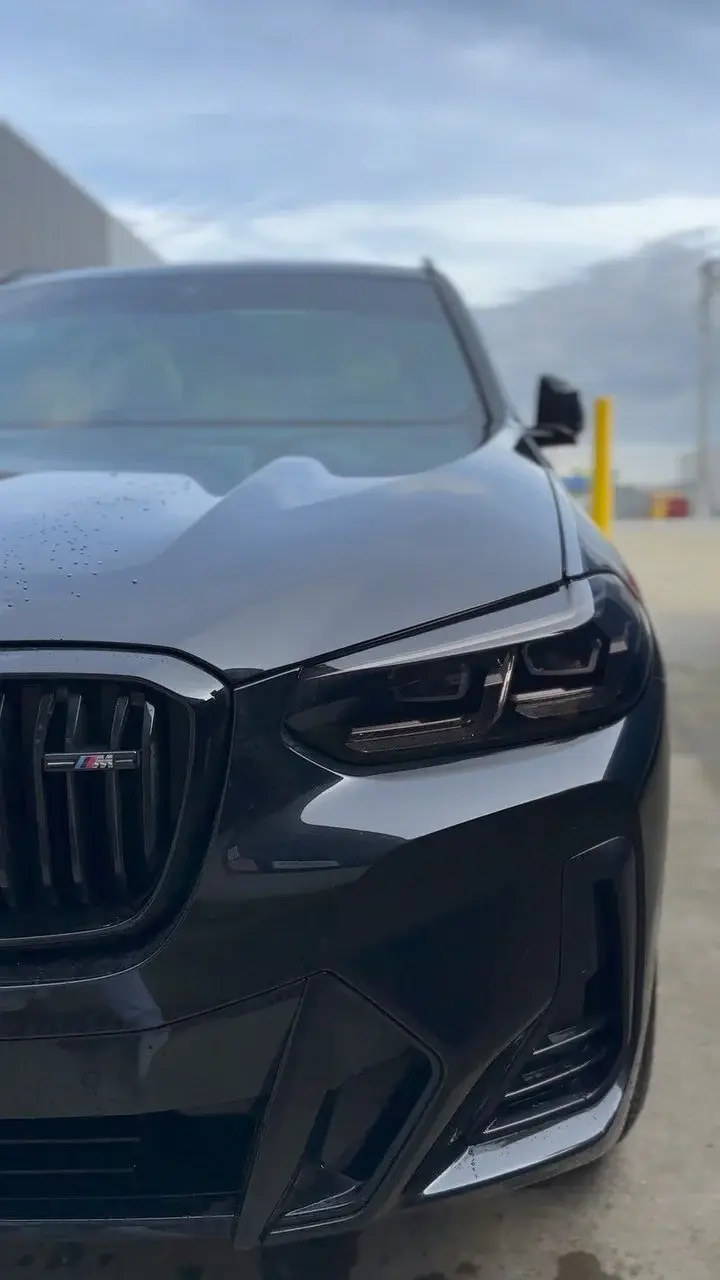
Why does a coated car still get water spots?
Because a coating changes how water leaves the paint, not what’s in the water. Fewer drops stay on a coated panel long enough to dry, but the ones that do still leave behind whatever minerals and grime they carried.
Coating makers say this about their own products. Gtechniq tells owners of its coatings to dry the car thoroughly after washing, “otherwise, it might be subjected to watermarks” (Gtechniq). Carmakers give the same advice for uncoated paint, and Mazda’s manual for Canadian owners tells them to “dry it with a clean chamois to prevent water spots from forming” after washing (Mazda Canada).
What the coating changes is where the residue ends up. The shop’s coating copy describes the coating as blocking contaminants such as acid rain from etching into the clear coat. A fresh spot on a coated car is sitting on the coating, where a rinse or a damp microfibre can usually still lift it.
How hard is the water you wash with in Langley?
Soft, if it comes from City of Langley taps. That helps: there’s very little mineral in it to leave behind when a drop dries.
The City’s 2024 water quality report says its water is supplied and treated by Metro Vancouver from the Coquitlam Lake source. The City also tested six tap-water samples from its own system in April and October 2024 for metals, including the two minerals behind water hardness:
| City of Langley samples, 2024 | Range reported | In mg/L |
|---|---|---|
| Calcium, total | 893–945 µg/L | About 0.9 |
| Magnesium, total | 80–94 µg/L | Under 0.1 |
Those figures only describe the City’s system. Water from a private well or another municipality’s supply has its own chemistry, and the City’s numbers don’t apply to it.
So when a car washed with City water spots badly, look at what else was in the water. Likely suspects are road film the rinse didn’t clear, or shampoo left to dry on a warm panel.
What kinds of water spots can form on coated paint?
Three kinds, sorted by how much work they take to remove. The longer a spot sits, the further down this list it moves.
Fresh deposits
A faint ring of residue resting on top of the coating. A rinse, a gentle wash or a damp microfibre normally takes it away.
Bonded deposits
Residue that has baked on and won’t wipe off. A water-spot remover dissolves it; Gtechniq’s own advice for watermarks on coated paint is a remover of this kind rather than polish. Choose one made for coated surfaces and stick to its directions.
Etched spots
A mark eaten into the surface, still visible as a dull ring on a clean, dry panel. No cleaner lifts it. The shop lists water spots among the defects its two-stage correction removes, and because polishing takes the coating off along with the mark, that panel needs coating again afterwards.
When are coated cars most likely to spot in the Fraser Valley?
On warm, bright days, when drops dry before they can roll away. In a wet stretch one shower tends to rinse off the last; the risk climbs when the sun comes out on a car that’s still wet.
The 1981–2010 climate normals for Abbotsford A, from Environment and Climate Change Canada, show the summer side of that: average July and August highs of 24.0 and 24.4 °C, 8.7 days a year that pass 30 °C, and close to 1,900 hours of sun annually. Those are the days to watch:
- Washing in midday sun. Shampoo and rinse water dry on hot panels before you reach them with a towel.
- Lawn sprinklers. A car parked in their reach gets misted and sun-dried over and over.
- Dew on a sunny morning. Drops that form overnight dry in place once the sun hits the car.
How do you keep water spots off a coated car?
Control when the car gets wet and make sure it dries under your hand, not under the sun. The routine is short.
- Wash early or late, or in shade, on panels that feel cool to the touch.
- Work one section at a time and rinse it before the shampoo can dry.
- Dry straight away with a clean, plush microfibre towel or a blower, top to bottom.
- Do the glass too. Drops left on windows spot as readily as on paint.
- Deal with spots within days. A fresh deposit is a wipe; an old one may be a polishing job.
The rest of the routine is on the full wash method for coated paint. Spots show up most on dark paint, which also heats fastest in the sun, and that’s covered in ceramic coating on a black car.
What should you book when spots won’t come off?
If a water-spot remover hasn’t shifted them, the spots are etched, and the fix is machine polishing followed by a coating to protect the corrected paint. Paint thickness is read first, panel by panel.
Water spots are one of the defects the two-stage level is built for, and it needs one to two days; heavier damage on neglected paint moves to multi-stage work, quoted after inspection. The Performance coating package pairs that level of correction with two coats and extends to the wheel faces and glass. The process is described on water spot removal, and the coating packages on ceramic coating.
Send a photo of the spots in daylight with your year, make and model through the paint correction quote form. Rain is the other half of the story here, and the case for coating in BC’s rain takes it on.