What happens when a tinted side window is smashed?
The glass still shatters, and the film on the inside holds on to part of it. Some of the broken glass stays stuck to the film instead of landing on the seats, but the opening is there all the same.
Car side and back windows are usually tempered glass. AGC, a major supplier of car glass, says its tempered glass is used mainly for rear and side windows and has the characteristic of “fracturing instantly if broken into small ‘nuggets’”. That’s a safety design: no long, sharp shards. It also means one good strike turns the whole pane to gravel.
Tint is bonded across the inner face of that pane, so when the glass breaks, some of those nuggets stay stuck to the adhesive. LLumar’s benefits page puts it this way: “Auto tint adds an extra layer to glass that helps hold it together in the event of an accident.” Brookswood Tint’s own wording is that film holds shattered glass together in a break-in or collision. Both are true in the same limited sense: fewer fragments in the cabin, not a window that stays shut.
Is window tint the same as security film?
No. LLumar makes a separate product for that job, and it isn’t what goes on a car in a normal tint appointment.
On its automotive safety and security page, LLumar says its security film “slows down intruders by reinforcing your windows, making break-ins more difficult and noisy”. It lists the thicknesses:
| LLumar automotive safety film | Thicknesses | Warranty, as LLumar lists it |
|---|---|---|
| Dyed safety film | 8 mil and 4 mil | 3-year limited |
| Clear safety film | 13 mil, 7 mil and 4 mil | 5-year limited |
The page is headed “Exclusive to Latin America”, and LLumar notes that availability varies by region. The films Brookswood Tint installs, ATC, IRX and AIR, are tint films chosen for shade, heat and UV. They help keep broken glass together; they aren’t sold as a barrier.
What actually slows a smash-and-grab?
Laminated glass in the side windows, built to stay in one piece when it cracks. It’s two sheets bonded to a plastic interlayer, the same construction AGC calls mandatory for windshields.
AGC’s page for its laminated glass names the side windows, back window and roof as positions for it, says “the plastic sheet holds glass pieces together in case of breakage”, and describes it as “efficient against break-ins: slows down intrusion attempts”, typically by more than 10 minutes in its words. That’s the glassmaker’s claim, but the principle is plain: a cracked laminated pane stays in one piece.
Some cars already leave the factory with laminated side windows. If yours does, the glass is already doing much of the job security film would. Whether that glass can also take tint is covered on tinting acoustic laminated side glass.
Keeping valuables out of sight
Where tint can make a difference is what a passer-by sees. LLumar says tint “makes it more difficult to see inside your vehicle, helping to disguise potential valuables”. On an SUV or wagon, a dark rear shade hides the cargo area from someone walking past the car.
Which windows can carry film in BC?
Only glass behind the driver, plus a shallow band across the windshield’s top. MVAR s. 7.05(8) forbids light-reducing material on the glass except in three places: rear side glass, the back glass of a vehicle with outside mirrors on both sides, and a band within 75 mm of the windshield’s upper edge.
That rule makes no exception for clear safety film. The driver’s and front passenger’s windows can’t legally carry any film in BC, clear or dark, security or not. If you ask for front-door film anyway, the shop will fit it, after telling you it isn’t road-legal and that what you risk is a $109 fine on a violation ticket or a police notice demanding removal and an inspection.
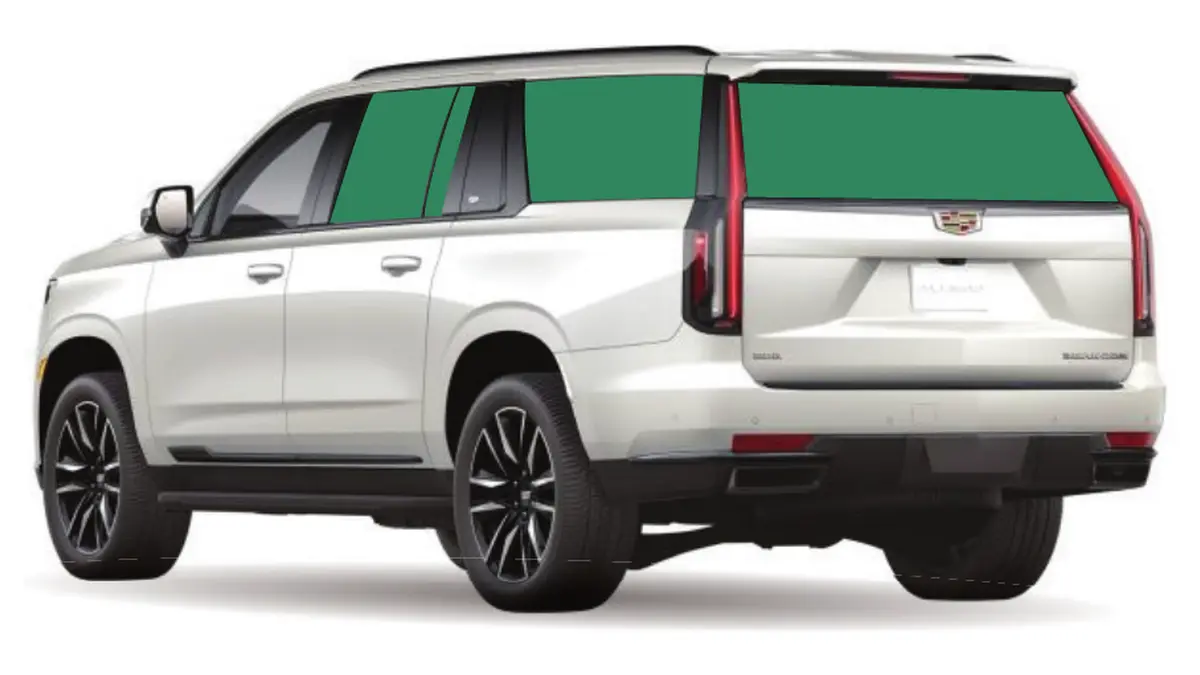
Behind the driver there’s no darkness limit, so rear doors, quarter windows and the cargo glass of an SUV can go as dark as 5%. What the seven-window package includes is listed under SUV window tint.
What should you do after a tinted window is broken?
Get the glass replaced, keep the paperwork, and plan to re-film that window. Replacement glass comes without film, so it won’t match the rest until it’s tinted.
ICBC handles glass claims under Comprehensive coverage. ICBC’s pages don’t say how aftermarket film is treated, so keep your tint invoice with the claim and ask ICBC directly. Once the new glass is in, send the shop the year, make, model and which window was replaced, and it can be cut on the plotter to match the film and shade already on the car.
Booking privacy film for the glass behind you
If theft is the worry, choose a shade that hides the seats and cargo area: 15% or 5% on the rear doors, quarters and back glass. Ceramic IRX adds heat rejection, and every LLumar film blocks over 99% of UV.
A coupe’s rear glass is $220 in ATC; on a sedan or pickup it’s $240, and on a full-size SUV or wagon, $260, with ceramic film quoted per package; a single visit covers most cars. Start with the pricing page, then send your details on the quote form; texts go to 604 534 6433.