What should you clean tinted windows with?
Two soft microfibre cloths and a glass cleaner without ammonia. That’s the shop’s rule; LLumar’s own is looser.
LLumar’s tint FAQ says its film is scratch-resistant and “requires no special products or complex process”: ordinary window washing is fine, using a household cleaner plus paper towels or cotton cloths, provided they aren’t abrasive. Brookswood Tint asks for a bit more care, ammonia-free cleaner on soft microfibre, because it costs nothing and keeps harsh chemicals and grit off the film.
| Item | Why it’s in the kit |
|---|---|
| Microfibre cloth, for cleaning | Soft, and holds the cleaner without dripping |
| Second microfibre, dry | Buffs off streaks before they set |
| Ammonia-free glass cleaner | The shop’s standard for the inside of filmed glass |
| Spray bottle of plain water | For the back glass and for rinsing a streaky window |
| Nothing with an edge | Blades, scrapers and abrasive pads stay out of the car |
Read the label before you buy: if ammonia is listed among the ingredients, keep that bottle for the outside of the glass, where there’s no film.
How do you clean the inside of a tinted window, step by step?
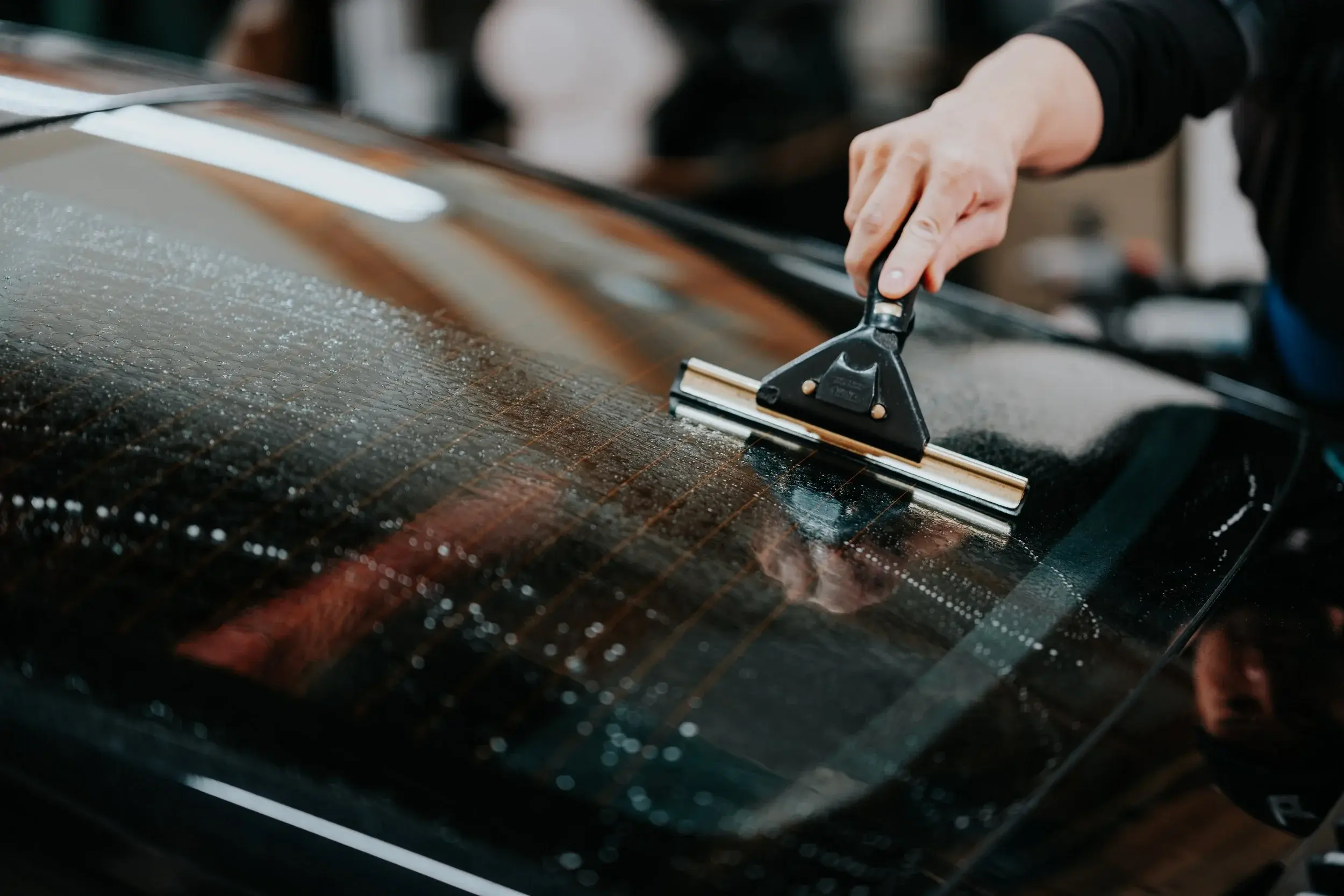
Spray the cloth, wipe in straight passes, then buff dry. The whole point is to move dirt off the film without dragging anything hard across it.
1. Shake out the cloths
Start with clean microfibre. A cloth that has picked up sand from a floor mat will do more harm than the dirt you’re removing.
2. Mist the cloth instead of the window
Cleaner sprayed straight at the glass runs into the door seal and down inside the door. Damp is enough; a soaking cloth leaves streaks.
3. Wipe in straight, overlapping passes
Light pressure, straight lines, top to bottom. Turn the cloth to a clean face as it gets grubby.
4. Buff with the dry cloth
Go over the window straight away with the second cloth. Streaks come from cleaner drying on the glass, so take it off while it’s still wet.
5. Do the top edge once the window is lowered
Drop the glass slightly so the band that usually sits inside the seal is exposed, wipe along it gently, then close the window.
How do you clean tinted back glass with defroster lines?
With water, not glass cleaner, and with the lines rather than across them. On the back window the film lies over the defroster grid and, on some cars, antenna lines too.
Toyota’s owner’s manual for the 2025 Tacoma tells owners: “Do not use a glass cleaner to clean the back window, as this may cause damage to the back window defogger heater wires or antenna.” It asks for a cloth dampened with lukewarm water, wiped “in strokes running parallel to the heater wires or antenna”. Follow your own carmaker’s manual if it says something different. More on film over the grid is in tinting over rear defroster lines.
When can you clean new tint for the first time?
Once the film has cured, which takes 3 to 5 days of keeping the windows closed. Until then the film is still drying onto the glass, and pressure on the inside can shift it or push water around.
A faint haze or a few small water blisters during that week are expected and fade by themselves, so don’t try to wipe them away. Why new tint looks hazy explains what’s happening. The outside of the glass has no film, so a normal wash is fine; when you can wash your car after tint covers the details.
Does the windshield need different care?
Yes, around the camera. Many newer cars have a forward camera behind the mirror, and carmakers are strict about keeping cleaner off it.
Toyota’s manual says not to let glass cleaner contact the camera lens, and not to touch the lens. A Subaru EyeSight bulletin goes further: cover the camera openings with removable tape or plastic wrap before any glass cleaner goes on the inside of the windshield, because overspray on the lenses means replacing them. At the very least, spray the cloth and never the windshield itself. MVAR s. 7.05(8) only permits windshield film in a top band 75 mm deep. The shop will film a whole windshield on request after warning that it risks a ticket or a police order to remove it, and either way the camera rules don’t change.
What should you do about a scratch, a nick or a lifting edge?
Leave it and show the shop. Scratches, a nicked corner or an edge that has started to lift get worse with rubbing, trimming or pressing.
If a mark looks like a defect rather than damage, the warranty page explains how the lifetime cover on film and workmanship works. If the film is old, scratched through or bubbling, the fix is tint removal and new film; for film that may have been fitted badly in the first place, check the signs in spotting a bad tint job.
Keeping tint looking new, and getting help
Clean gently, keep hard objects off the inside of the glass, and you’ll rarely think about the film again. For a full care routine through the first week and beyond, the window tint aftercare guide covers it.
Questions about a mark, or film from another shop that’s past saving? Send photos through the window tint contact form. Hours are 9:00 to 17:00, Monday to Saturday, and the number for calls or texts is 604 534 6433.