How do 3M 2080 and Avery SW900 compare on paper?
On paper they’re close: both are cast films with pressure-activated adhesive, both go on dry, and both are made for factory-painted cars. The table lines up each maker’s own numbers, taken from the 2080 bulletin 3M publishes and Avery Dennison’s SW900 data sheet.
| 3M 2080 | Avery Dennison SW900 | |
|---|---|---|
| Film | Multi-layer cast film | Cast film |
| Face thickness | 3.5 mil (0.09 mm) on 2080-M12; other colours differ slightly | 3.2 to 4.7 mil, depending on colour |
| Adhesive | Controltac and Comply, with air-release channels | Easy Apply RS, long-term removable acrylic |
| Application method | Dry only | Dry only |
| Application temperature | 18 to 24 °C | 10 °C minimum on flat or gently curved parts; 16 °C on complex curves |
| Gloss colours | Supplied under a clear protective film | No protective top film listed on the data sheet |
| Removal | Heat and/or chemicals, within the warranty period | With heat and chemical methods, for the length of the durability period |
| Intended surface | Standard OEM vehicle paint | Solid surfaces such as passenger vehicles; non-OEM paint listed as unsuitable |
| Range | Colour list in 3M’s 2080 brochure | More than 140 colours and finishes in North America |
Neither sheet makes one film the obvious winner. What usually decides it is the exact colour and finish you want, and which brand makes it.
How do the adhesives and install behaviour differ?
Both adhesives are built so the installer can slide and reposition the film before pressing it down. They get there differently, and those differences show most on curves and in the temperature the film likes.
3M Controltac and Comply
3M says Controltac keeps the adhesive’s first contact small, so the film slides, tacks, snaps back up and repositions, while Comply channels let trapped air escape to the edges. The bulletin also lists when snap-up stops working: after firm squeegee pressure, above 38 °C even under light finger pressure, or once film has been lifted from its liner and put back. 3M ships its gloss and high gloss colours under a clear protective film meant to cut down on surface marks and scratches while the film is worked; it can stay on for the whole install and is peeled before post-heating. 3M also claims its high gloss colours give 250% better reflected image quality than a typical premium cast wrap film.
Avery Easy Apply RS
Avery credits its patented Easy Apply RS feature with faster positioning, bubble-free application and long-term removability. Its data sheet lets the film go on at 10 °C where the surface is flat or only gently curved, wants 16 °C for complex curves, and warns that thicker faces, such as several reds, greens and white pearls at 4.2 mil, may not conform as easily.
Both sheets ask for one production lot per car, because colour can shift between lots, and both ask that metallic, pearl and colour-shift films keep the same orientation from panel to panel. Those are installer disciplines rather than brand differences, and an indoor bay held at temperature keeps either film inside its comfort zone.
What do the warranty and durability tables say?
Both makers rate their film by geographic zone and by the angle of the surface, with flat panels getting far shorter terms than doors and sides. 3M publishes one set of numbers for the whole 2080 series; Avery splits SW900 by colour type.
| Film and colour type | Zone 1, vertical / horizontal | Zone 2, vertical / horizontal |
|---|---|---|
| 3M 2080, every colour | 8 / 3 years | 7 / 2 years |
| SW900, solid black or white | 12 / 3 years | 9.6 years / 6 months |
| SW900, other solid colours | 10 / 2 years | 8 years / 6 months |
| SW900, metallics and pearls | 5 / 2 years | 4 years / 6 months |
| SW900, ColorFlow | 4 / 1 years | 3 years / 6 months |
Each maker draws its own zones. 3M’s zone map shades Canada as Zone 2, which puts 2080 on a BC car at 7 years vertical and 2 horizontal on its warranty card. Avery assigns its zones in a separate instructional bulletin, so ask the installer which Avery zone applies before comparing the two columns. Avery states that the term of its warranty equals the product’s durability, and it leaves out abrasion and loss of gloss, which it counts as ordinary wear and tear.
3M’s card covers defects including yellowing, bubbling and cracking, applies only to the original consumer purchaser, and can’t be transferred. Brookswood Tint’s own published term is 5 years on the vinyl, whichever brand goes on.
Which film gives more colour and finish choice?
Avery publishes the bigger count: its North American product overview lists more than 140 colours and finishes. 3M sorts 2080 into gloss, high gloss, satin, matte, metallic, pearl, colour flip and textured films, with the full list in its brochure.
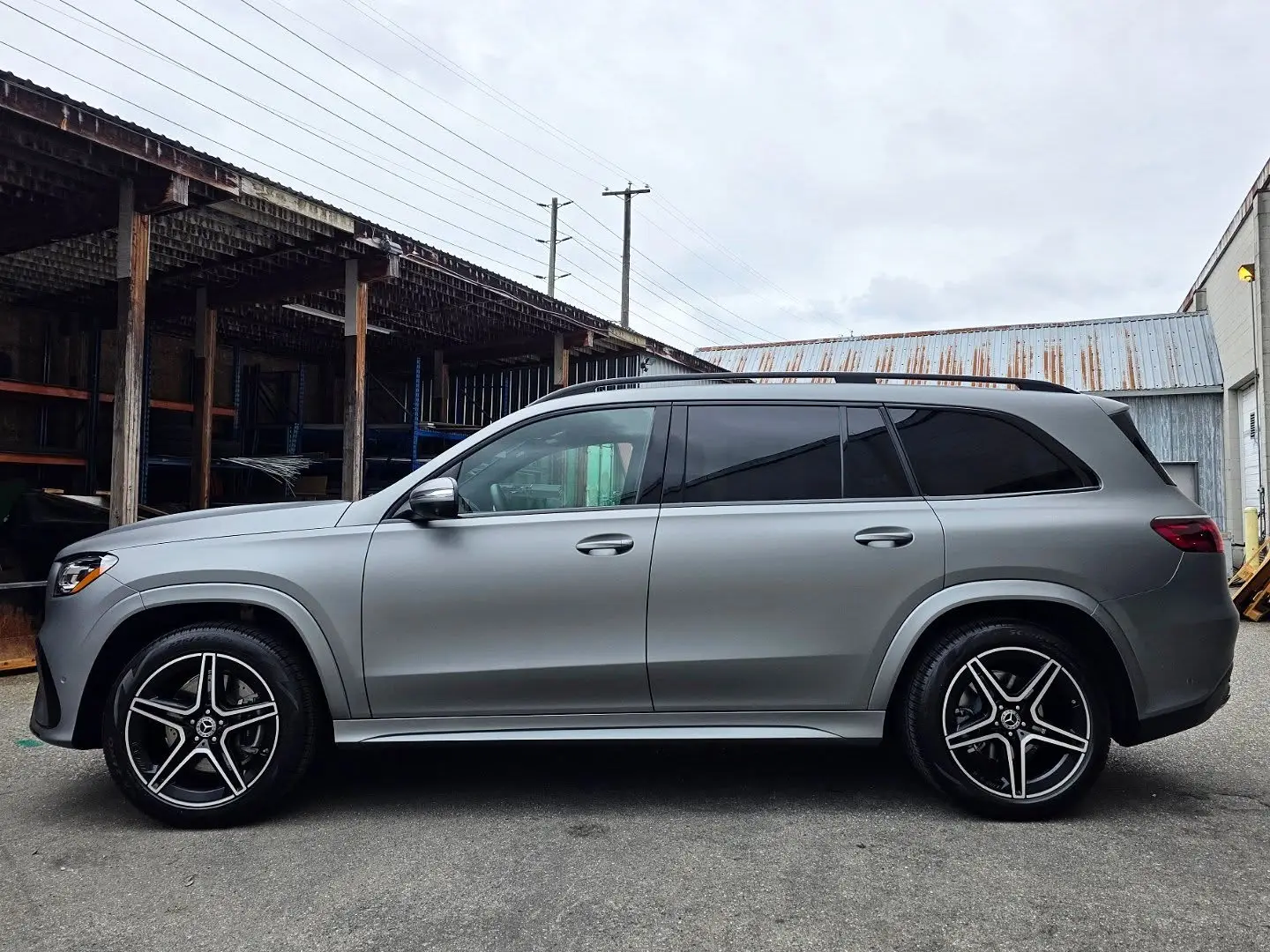
In practice the choice is made colour by colour. Avery’s overview groups SW900 into gloss, satin and matte with metallic versions of each, Diamond, pearl, ColorFlow special effects, Conform Chrome, and textures such as Rugged, brushed metal and carbon fibre, and its latest edition opens with a new spring collection. The GLS in the shop’s photos is Avery’s Matte Metallic Gunmetal, covered in depth on matte metallic gunmetal. Ask to see a physical swatch of both brands’ versions of your shade in daylight; a screen won’t show flake, sheen or how a colour-shift film moves. The film-by-film detail lives on 3M 2080 and Avery Dennison SW900.
How do care rules and coatings differ?
3M’s cleaning window is wider and its warning on coatings is blunter; Avery is stricter about which chemicals touch the film. Either way, gentle hand washing with a mild cleaner sits inside both sets of rules.
3M’s rule is a wet cleaner with no abrasives or solvents, somewhere between pH 3 and 11, tried on a small patch first, and no brushes or harsh chemicals. On coatings it’s direct: they’re excluded from its MCS warranty, and 3M doesn’t warrant 2080 with coatings or other aftermarket additions on it. Avery narrows the range to pH 5 to 9, rules out ammonia, chlorine, alcohol and petroleum distillates, and warns that soaps, waxes or coatings carrying solvents or distillates void the warranty altogether. Avery also cautions that cleaners, wax and polish can badly shift the colour and gloss of its matte films.
So before a coating goes on top of either brand, read can you ceramic coat a vinyl wrap. Day-to-day washing is covered in how to wash a wrapped car.
What surfaces is each film meant for?
Both are designed for sound factory paint, and both rule out stainless steel. Avery’s unsuitable list is longer and more specific.
3M designs 2080 around ordinary factory car paint, rules out stainless steel and powder-coated metal, and wants an adhesion test on any powder-coated or water-based paint. Avery lists as unsuitable paint that isn’t fully cured, painted surfaces with a poor bond, non-OEM painted vehicles, stainless steel, and low-surface-energy materials such as rubber and unpainted plastic. Neither maker stands behind removal from tired paint: Avery won’t warrant it once the paint is past five years old, and 3M’s card doesn’t cover paint lifting off with the film. If your car has been resprayed or is getting on in years, raise it at the quote. Why a cast film behaves this way in the first place is explained on cast vinyl.
3M 2080 or Avery SW900: which should you pick?
Pick the brand that makes the exact colour and finish you want. If both do, the details below can tip it.
3M 2080 suits you if
- Your colour is a gloss or high gloss, where the protective top film helps during the install.
- You want one warranty term across the whole series rather than one by colour type.
- The colour you love is only in 3M’s range.
Avery SW900 suits you if
- You want the widest published range, including Diamond, ColorFlow and Rugged textures.
- Your colour is a solid black, white or standard colour, which carries Avery’s longest durability rows.
- The colour you love is only in Avery’s range.
Where Brookswood Tint stands on 3M and Avery
The shop installs both. The GLS in the photos is in Avery film because Matte Metallic Gunmetal is an Avery colour; another shade could as easily have come from 3M. When a colour exists in both ranges, ask to see the two swatches against your car before you decide.
How do you get a wrap quoted in either film?
The vinyl wrap quote form takes your car, the brand and code of the colour if you know it, and which panels you want done; a text to 604 534 6433 works too. Prices are set car by car, and a complete colour change means leaving the car with the shop for three to five days.
Not sure which code you’re after? Bring photos of colours you like, and ask to compare swatches from both makers side by side. Brookswood Tint is at Unit 312, 20560 Langley Bypass, open Monday to Saturday from 9:00 to 17:00.