
What is the difference between a graphene coating and a ceramic coating?
Less than the labels suggest. A graphene coating is a ceramic-type paint coating with graphene (in XPEL’s case, graphene oxides) mixed in; on one maker’s own sheets, it goes on the same way, cures in the same time and carries the same hardness rating.
One maker sells both kinds, which makes a clean comparison possible. XPEL publishes data sheets for its regular ceramic coating, FUSION PLUS PAINT & PPF, and its graphene one, PRO SERIES GRAPHENE:
| XPEL ceramic coating | XPEL graphene coating | |
|---|---|---|
| How XPEL describes it | “a flexible and thin, 9H ceramic coating” | “a hydrophobic, scratch-resistant coating” |
| Ingredients named | Not listed | “Polyzylezene and graphene oxides” (XPEL’s spelling) |
| Pencil hardness | 9H | 9H |
| Water claim | “super hydrophobic formula” | “superior hydrophobic properties” |
| Dry before it gets wet | 6 hours | 24 hours |
| Full cure | 3 days | 3 days |
| Applied with | Foam block and microsuede towel | Foam block and microsuede towel |
Side by side, the graphene version looks like a variation on the ceramic one rather than a new category. It asks for a longer dry time before the first rain, but the hardness rating, the cure and the method are the same.
What does “graphene” actually mean in a car coating?
It means graphene or graphene oxide is one ingredient in the liquid, not that your car ends up wearing a sheet of graphene. The coating still behaves like a thin ceramic layer.
Graphene itself is a material: Australia’s national science agency, CSIRO, defines it as “a single layer of carbon atoms arranged in a hexagonal lattice.” Coating makers don’t claim to lay that lattice across a car. XPEL’s sheet names “graphene oxides” as an ingredient alongside the coating resin, and Adam’s Polishes, which sells a product literally called Graphene Ceramic Coating Advanced, describes it as “an easy-to-use Ceramic Coating” with “Additional Silicate Resin for Added Durability and Longevity.” The product name tells you what it is: a ceramic coating with graphene in the recipe. The term itself is defined on graphene coating.
What do coating makers say graphene adds?
Mostly better water behaviour, with some claims about wash scratches. These are the makers’ own claims; we found no independent test that separates the graphene from the rest of the formula.
Adam’s lists these for its graphene coating:
- “Less prone to water spotting”
- “Lower sliding angle with water evacuating at angles less than 10-15°”
- “Higher contact angles averaging more than 110-118°”
- “Higher scratch resistance during the washing process”
XPEL’s graphene sheet claims “superior hydrophobic properties and scratch resistance with a high-gloss finish.” A low sliding angle means beads roll off a panel at a slight tilt instead of sitting on it, and a high contact angle means tighter, rounder beads.
Why water spots get the attention
Water spots are mineral marks. XPEL’s own film warranty explains that they “are caused by mineral deposits, which if left to dry” can leave a stain. Water that runs off before it dries leaves less behind. Around Langley, water is rarely in short supply: Environment and Climate Change Canada’s Abbotsford normals average 179.5 wet days a year and 1,537.8 mm of rain and snow. Whether any coating, graphene or not, keeps spots away is covered on does ceramic coating prevent water spots.
Is a graphene coating harder or tougher than a ceramic coating?
Not on paper. XPEL rates both its coatings 9H on the pencil hardness scale, and either one is still a layer measured in microns that won’t stop a stone.
XPEL puts its graphene coating at 2 to 3 µm thick. For scale, TranBC caps each piece of winter abrasive on main highways at 9.5 mm. Speed raises the stakes: going from 80 km/h up to 110, it adds, “will almost double the impact energy” behind the chips and dings that grit leaves. A layer 2 to 3 µm thick can make washing easier and, by its makers’ account, resist light wash marring; it can’t absorb a 9.5 mm stone at highway speed. That job belongs to paint protection film, compared on PPF vs ceramic coating.
Does a graphene coating need different prep or care?
No. Both kinds need clean, decontaminated, polished paint before they go on, a dry first day, and gentle washing afterwards.
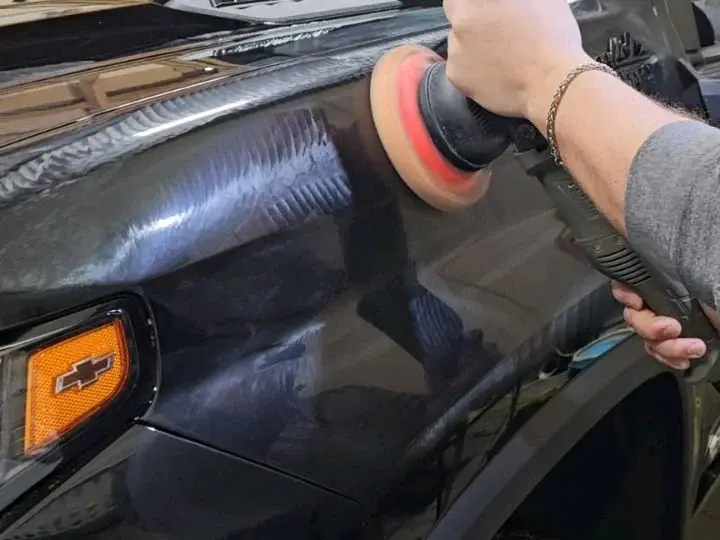
Adam’s instructions say “users must Wash, Clay/Decontaminate, and Polish their paint prior to application”, the same steps any ceramic coating asks for. Every coating package at Brookswood Tint starts with a decontamination wash, a clay bar and at least one stage of machine polishing, with paint thickness measured before any polishing, because a coating seals in whatever is underneath, swirls included. The polishing side is explained on paint correction.
Once it’s on, no water should touch the car for a full day. From then on, wash by hand with a pH-neutral soap, or use a touchless wash, and skip brush washes, which mar any finish over time. We don’t put a number of years on a coating; the package, the prep and your wash routine all change it, so ask about it when you get a quote.
Graphene or ceramic coating: which should you choose?
Judge the job, not the label. A well-prepared ceramic coating and a well-prepared graphene coating will be closer to each other than either is to a coating rushed onto swirled paint.
A graphene-labelled coating suits you if
- Water spotting is your main complaint, and you like the maker’s run-off claims.
- The car sits outside through the wet months and you want water off the paint quickly.
- The price difference, if any, on your quote is small.
Paying extra for graphene makes less sense if
- Your real worry is rock chips, which no coating stops.
- The cheaper quote includes more prep or more layers than the graphene one.
- The quote can’t tell you what’s in the bottle, how many layers go on or how long it cures.
Our view as a graphene-ceramic installer
We apply a graphene-ceramic coating, so we’re not neutral on the label. Even so, we’d judge any coating quote, ours included, by the paint correction underneath, the number of layers and the aftercare plan. More on our coating is on graphene ceramic coating, and a comparison with waxes and sealants is on ceramic coating vs wax and sealant.
How do you book a graphene-ceramic coating in Langley?
Pick one of three packages and send us the car’s details; coatings are quoted per vehicle because the prep depends on the paint. Expect the car to stay with us for one to three days.
| Coating package | Coats | Paint prep first | What gets coated |
|---|---|---|---|
| Essential | One | Decontaminated, with at least one polishing stage | Painted panels |
| Performance | Two | A two-stage correction | Paint, glass and the faces of the wheels |
| Signature | Four | Full correction | Paint, PPF, wheels, glass and trim |
Tell us the car and how its paint looks today on the coating quote form; photos of swirls or water spots help us judge the correction. The packages themselves are on ceramic coating.