Skip to content
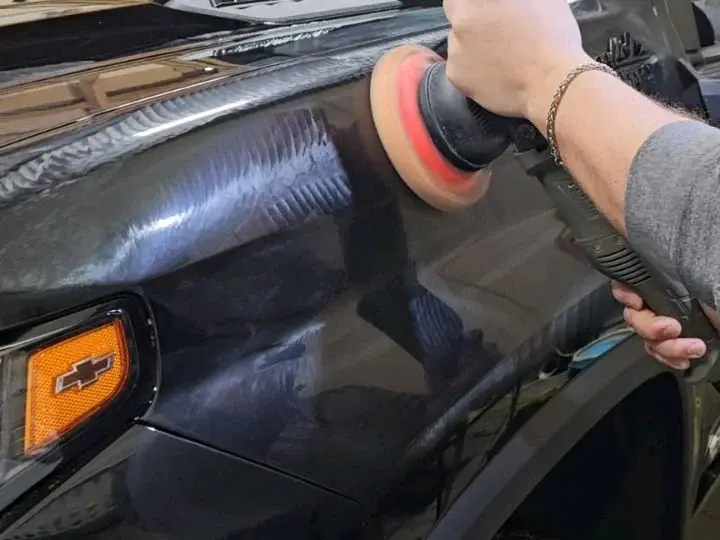
Close view of a dual-action style polisher, orange foam pad on a red backing plate, held flat to a black Chevrolet fender inside Brookswood Tint's Langley shop

Glossary · Paint correction

What Is Dual-Action Polisher?

Brookswood Tint Shop · Updated · 2 min read

The short answer

A dual-action (DA) polisher, also sold as a random orbital polisher, is a machine polisher whose pad travels in a small orbit while it also rotates, instead of only spinning on a fixed axis like a rotary buffer. That combined motion spreads the abrasive's work, which makes it the gentler machine for removing swirls and finishing paint.

Also called
Random orbital polisher
Motion
Pad rotates and orbits at once
Example orbit (Makita PO5000C)
5.5 mm (7/32 in.)
Used for
Polishing, finishing, removing swirls
Rotary buffer instead
Trained technicians only (Chrysler)

How does a dual-action polisher move?

Its pad does two things at once: it orbits around an offset centre and it rotates. The pad’s path over the paint keeps changing, where a rotary buffer simply spins in one place.

Makita’s PO5000C feature sheet shows the numbers on one such machine: a 5.5 mm (7/32 in.) orbit, up to 6,800 orbits per minute, and a choice of two modes. Its instruction manual explains them:

Mode How the pad moves Makita’s intended use
Random orbit with forced rotation Orbits while the motor drives the spin Rough polishing, such as surface treatment
Random orbit, free rotation Orbits while the pad turns freely Fine polishing

Why do carmakers reach for a DA before a rotary?

Because it’s the less aggressive machine, and Chrysler tells technicians to always begin with the least aggressive method. Chrysler’s bulletin 31-001-13 has technicians try clay first, then a D.A. polisher with a foam finishing pad, and only then a rotary buffer, a machine Chrysler limits to trained technicians because in the wrong hands it can permanently damage paint.

GM’s PIT5763 gives the DA the last word on a repair: after the sanding and polishing, a dual action orbital machine on a foam pad takes out whatever swirls are left. That finishing role is why a DA is the usual answer to holograms left by heavier work.

What a DA can and can’t do for your car’s paint

It can remove wash swirl marks and the fine marks heavier polishing leaves, and carmakers rank it below the rotary for risk. It can’t avoid removing clear coat, because the polish under the pad is still an abrasive.

That’s why the machine matters less than the reading taken before it touches the car. On paint that has been polished or repainted before, the thickness gauge decides how far even a DA can go.

Where you’ll see a DA at Brookswood Tint

On the shop’s correction and coating work. The photo on this page was taken there, during correction on a black Chevrolet, with swirls still visible in the fender’s reflection.

Paint thickness is read before any machine goes on, and the level is chosen to match. The lightest is the one-step paint correction, about a day; the full ladder of levels is on paint correction, and the process is explained in what is paint correction?

Asked at the counter

Questions about dual-action polisher

01Is a random orbital polisher the same as a dual-action polisher?

In practice, yes. Makita, for one, sells its PO5000C as a dual action random orbit polisher, and the two names describe the same pad motion.

02What is the difference between forced rotation and free rotation?

In free rotation the pad is left to turn on its own as it orbits; in forced rotation the machine drives the turning as well. Makita recommends its forced mode for rough polishing and its free mode for fine polishing.

03Can a dual-action polisher still damage paint?

Yes. It's gentler than a rotary, but every pass with an abrasive takes some clear coat, so thin or repainted panels still need a thickness reading first.

How we checked this

Sources

  1. Makita U.S.A., PO5000C 5 in. Dual Action Random Orbit Polisher feature sheet
  2. Makita, PO5000C and PO6000C Random Orbit Polisher instruction manual
  3. Chrysler Group LLC, Collision Bulletin 31-001-13, Overspray Removal (January 11, 2013)
  4. General Motors, Preliminary Information PIT5763, Spots, Bug or Insect Residue, Grease Substance on Paint Surface (August 10, 2020)

Prices, timing and process come from Brookswood Tint Shop. Legal and product facts are quoted from the sources listed, checked on October 8, 2026. Laws and product lines change; call the shop if anything here doesn't match what you've been told.

Get a quote today.

Call or text 604.534.6433, email us, or send the form and we'll come back with a price and a date.