How does paint correction work?
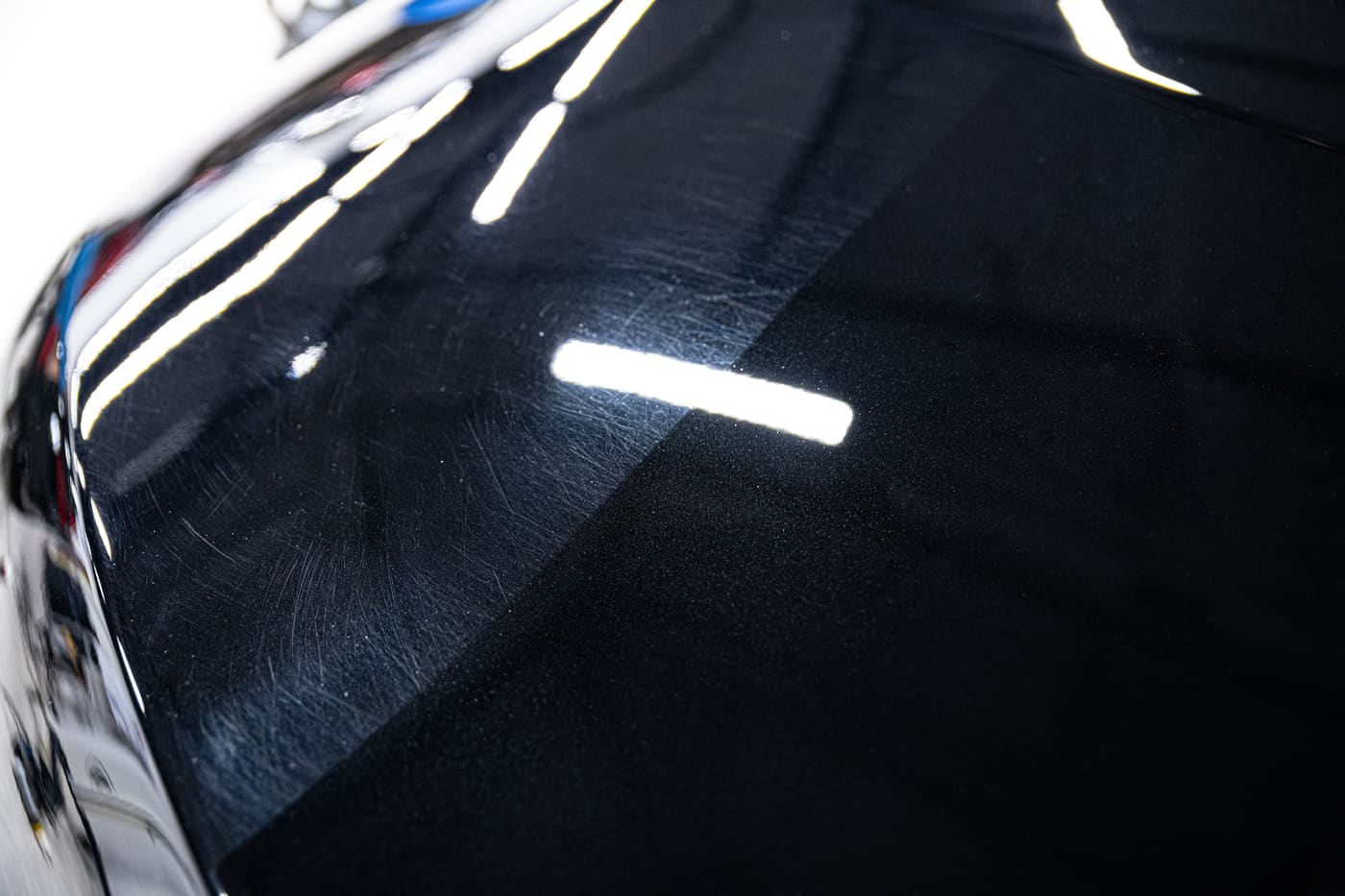
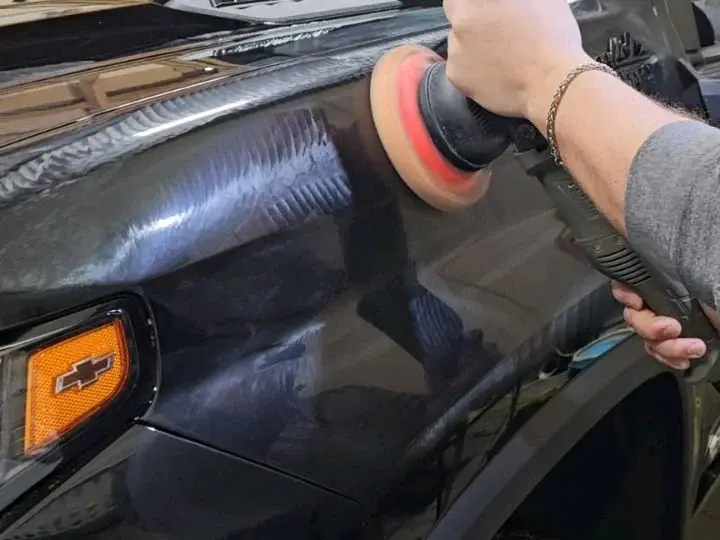
It cuts the surface down to the bottom of the defects. A swirl or light scratch is a small groove in the clear coat; machine polishing with an abrasive compound removes the surrounding clear coat until the surface is level again, then finer polishes take out the marks the coarser step left.
The clear coat is the layer being worked. Ford’s paint research group, in a presentation hosted by NIST, describes a typical body paint system like this:
| Layer, top down | Typical thickness (Ford) | Its job |
|---|---|---|
| Clearcoat | 45 µm | Gloss, and protects the basecoat from UV light |
| Basecoat | 10–20 µm | Colour and metallic flakes |
| Primer | 25 µm | Smooths the e-coat, protects it from light, helps adhesion |
| Electrocoat | 20 µm | Corrosion protection |
| Phosphate | 5 µm | Corrosion protection |
On paint built like that, every correction happens inside the top 45 µm or so, and the aim is to leave as much of it on the car as possible.
What are the steps from cutting to finishing?
Coarse to fine, with each step erasing the marks of the one before. 3M’s Perfect-It paint finishing chart shows the full sequence a refinisher can use:
- Defect removal: fine sanding at P1500 or P2000 to level a defect.
- Scratch refinement: 3000, then optionally 5000, to shrink the sanding marks.
- Compound: a rubbing compound to remove the sand scratches.
- Polish: a machine polish to remove the swirls the compound leaves.
- Swirl elimination: an ultrafine polish for the last fine swirls, “even on dark colored vehicles.”
The sanding steps are for defects too deep for compound alone. On the shop’s menu they belong to multi-stage restoration and are done only where the paint is thick enough, since sanding is the most aggressive step in the sequence.
What can paint correction fix, and what can’t it?
It fixes damage that sits within the clear coat and can’t put back paint that’s gone. That splits paint problems into two groups.
| Problem | Can correction fix it? | Other fix needed |
|---|---|---|
| Swirl marks and wash marring | Yes | None |
| Haze, dullness and oxidation | Yes, while clear coat remains | None |
| Water spots | Yes, at two-stage level | None |
| Light scratches | Yes, if they stop in the clear coat | None |
| Scratches into the colour, primer or bare panel | No | Touch-up paint or a panel refinish |
| Stone chips | No | Touch-up; PPF stops the next ones |
| Dents | No | Body repair |
Toyota’s owner’s manual for the 2026 Tacoma says chipped or scratched paint should be repaired immediately, to prevent paint deterioration and corrosion, and that’s the line between correction and paint repair. Where a scratch sits is covered on car scratch removal.
What levels of correction does the shop offer?
Three, chosen after the thickness reading. The lightest level that removes the defects is the one used.
- Enhancement polish: one pass with a fine finishing polish, about a day. It clears light swirls and haze, and it’s the usual groundwork for a coating on newer paint. Detail on one-step paint correction.
- Two-stage correction: a cut with compound followed by a refining polish, over one to two days, for deeper swirls, marring left by washing, water spots, and the bulk of light scratches. Detail on two-step paint correction.
- Multi-stage restoration: wet sanding where the paint allows, heavy compounding and several refining passes, three days or more and priced only after inspection. It’s meant for neglected, oxidized or badly scratched paint with clear coat to spare.
Why is paint thickness measured first?
Because paint thickness varies from car to car and from panel to panel. PPG’s refinish division puts a factory finish at roughly 90 to 120 µm in total in its guidance on OEM film builds, and says checking film thickness should be standard during the first inspection, before any repair starts.
Factory paint isn’t uniform either. Ford’s presentation notes that 5 to 10% of vehicles are repainted at the plant, some with clearcoat and basecoat only, others with primer too. Add earlier polishing or a body shop respray, and the reading is how the shop knows how far a panel can safely be taken. How much clear coat a correction actually removes is its own question, answered on how much clear coat paint correction removes.
Booking paint correction in Langley
Through the correction quote form, list the car’s year, make, model and colour, ideally with a photo of the paint in direct sun, and note any respray or earlier polishing. Correction is priced after inspection, because the paint’s condition sets the work.
Expect the car to be with the shop for roughly a day at the lightest level and three days or more for restoration. If a coating or PPF is going on afterwards, book them together so the corrected paint is protected before it’s washed again; the packages are on ceramic coating. Drop-offs run from 9:00 to 17:00 except Sundays, at Unit 312 on the Langley Bypass, number 20560.