What does two-step paint correction fix?
Defects that a single fine polish can’t fully reach. The shop publishes its two-stage correction for deeper swirls, wash marring and water spots, plus most light scratches, with 85 to 95% of defects removed.
| Stage | What it does | What it leaves |
|---|---|---|
| 1. Cutting compound | Levels the clear coat down to the bottom of the deeper marks | A fine haze or light swirls of its own |
| 2. Finishing polish | Removes the compound’s haze and refines the gloss | A clear finish, with the deepest 5 to 15% of marks possibly still there |
The difference from a one-step is the cutting pass. A one-step correction uses only a fine polish, which the shop rates at 60 to 80% defect removal; the compound is what moves the number up. Once a scratch cuts through the clear into the colour layer, neither level can fix it, as car scratch removal explains.
Why does paint correction need a second step?
Because the compound that removes the deeper marks leaves marks of its own. A cutting compound is more abrasive than a finishing polish, and that extra cut shows up as fine haze or swirling in the clear coat once the compound is wiped off.
3M’s Perfect-It paint finishing chart is written around this. Its compounding step lists pads by what they trade off: wool when the job needs the quickest cut and less heat, low-lint for a cleaner result, and foam for the finest finish of the three. Its next step, a machine polish on a black foam pad, exists “to remove compound swirl marks”, with medium pressure to take the swirls out and light pressure to polish.
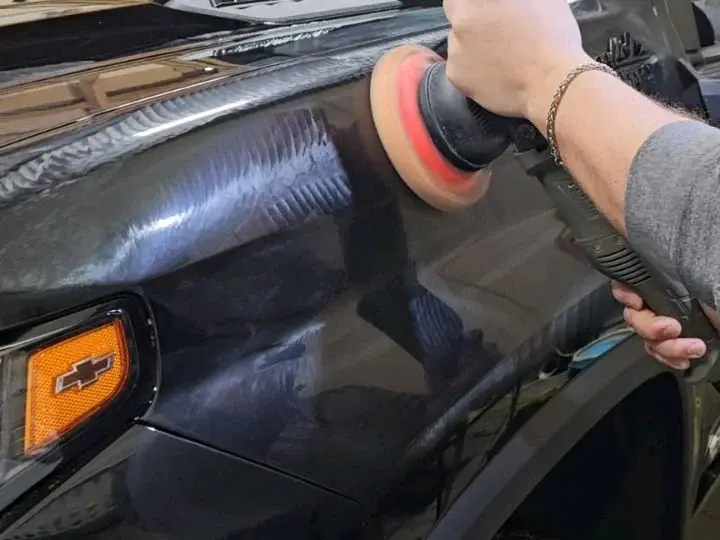
On black paint, like the Chevrolet fender in this page’s main photo, haze of that kind is easy to see under shop lights. Marks left behind by machine polishing are often called holograms, and they’re the reason a two-step always finishes on the finer product.
How much clear coat does a two-step correction use?
More than a one-step and still only a small part of the layer, which is why the paint is measured before any polishing. The clear coat is thin and does more than shine.
General Motors’ preliminary information PIT5763 puts the clear coat on the vehicles it covers at about 0.059 to 0.078 mm, 1.5 to 2 mils, and notes that it contains ultraviolet screeners. Its warning is that taking off more than 0.5 mil may lead to early paint failure. Chrysler’s collision bulletin 31-001-13 sets a tighter line for polishing alone, 0.2 mil, and says most vehicles have 1.5 mils of clear.
That’s the reason the shop reads thickness before it chooses a level and doesn’t promise 100%. Whatever remains in the last 5 to 15% is the deepest damage, and chasing it would cost the most clear coat. The arithmetic behind those limits is in clear coat removed by correction.
When is two-step the right choice over one-step?
When the marks are more than surface haze, or when the paint is about to be sealed under a coating for years. These are the cases where the second stage pays for its extra day:
- Dark paint with heavy swirls. Dark colours in sunlight show every mark, by the shop’s account, so a one-step’s leftover 20 to 40% is easier to see on black.
- Wash marring. The scuffing left by brush washes and gritty towels is on the shop’s two-stage list, not the one-step one.
- Water spots. The shop files water spots under two-stage work too; water spot removal covers how they form and what can’t be polished out.
- The Performance coating package. Two coating layers go over a two-stage correction in the shop’s Performance package, which it aims at hand-washed cars staying with their owners a while.
Paint that’s oxidized, neglected or deeply scratched goes to multi-stage restoration, the level above, which runs three or more days and is priced after inspection.
How long does two-step correction take, and what comes after?
One to two days for the correction itself, depending on the car’s size and how the paint reads. Add the protection days if you’re sealing it straight away, which the shop recommends.
Corrected paint has nothing on top of it, so the next wash can start new marks. A coating package keeps the car one to three days including its prep, and it needs to stay dry for the first 24 hours once you’ve collected it. PPF over the corrected paint adds roughly one day for a partial front, or three to five if every painted panel is covered. Book the correction and the protection together so the car leaves sealed, and see ceramic coating for what each package includes.
How do you book two-step correction in Langley?
Text 604 534 6433, or use the paint correction quote form: give the year, make, model and colour, plus a direct-sun photo of the worst panel. Mention any repaints, earlier polishing or touch-up work, since those change the thickness readings. Correction is priced after inspection; paint correction cost explains the factors.
Plan one to two days for the two stages, more with protection added. Cars drop at 20560 Langley Bypass, Unit 312, from 9:00 Monday to Saturday, ready for pickup by 17:00, and swirl mark removal looks at swirls on their own.