
What does post-heating do to wrap film?
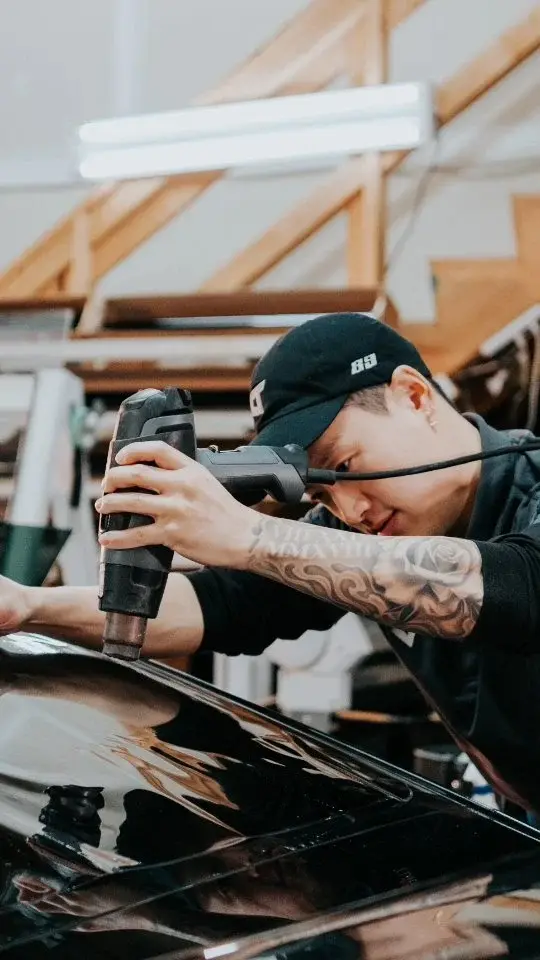
It lets stretched vinyl relax into its new shape. 3M’s colour change bulletin tells installers to heat the finished graphic “to reduce the internal stress in the vinyl film”, moving the heat slowly over stretched areas and pressing the film down with a roller while it’s still hot so the adhesive fully wets out and the risk of lifting drops (3M, Application: Vehicle Color Change).
It’s a separate step from the gentler warmth used while fitting. 3M has installers soften 2080 at 40 to 50 °C to work it around complex curves, then come back with more heat once the film is down. 2080 is designed for this treatment; 3M says it isn’t cold-stretch capable at all. The film class behind that behaviour is defined under cast vinyl.
How hot is post-heating, and where does it go?
Roughly twice the fitting temperature, aimed at the areas that were stretched rather than the whole car. 3M’s figures for 2080:
| Stage | 3M’s temperature | Where it’s applied |
|---|---|---|
| Softening while fitting | 40 to 50 °C | Complex curves |
| Post-heating | 80 to 95 °C | Stretched film, recesses, deep channels |
| Finishing the edges | “Light heat”, then re-squeegee | Every edge, to prevent lifting |
For film laid into recesses, 3M says post-heating “is required”, followed straight away by re-rolling with a small hand roller. The clear protective layer that ships on 2080 gloss colours has to come off first. The installer reads the film with an infrared thermometer trailing slightly behind the heat gun, so the number is the vinyl’s temperature and not the air’s.
Why does post-heating count for more in BC?
Edges and recesses are where wraps let go first, and a wet climate punishes a weak edge. 3M’s removal bulletin warns that water forced under a graphic lessens its adhesion and lets it lift or curl (3M Instruction Bulletin 6.5), and Abbotsford averages 241 mm of rain in November (ECCC climate normals).
3M’s aftercare follows the same logic. It asks for at least 12 hours with the vehicle kept above 16 °C before it faces cold or rain, no washing for 72 hours, and no pressure wand aimed at film edges after that. The term belongs to vinyl. Window tint uses heat differently: the film is shrunk to match the curve of the glass, a step defined under heat-shrinking.
Where post-heating shows up at Brookswood Tint
It applies to every vinyl job the shop quotes, from a full colour change to chrome delete trim, because all of them use 3M or Avery Dennison cast film. The steps in the bulletins aren’t optional extras: 3M’s 2080 bulletin ties its warranty for eligible graphics to the installer reading and following its current product and instruction bulletins (3M 2080 bulletin).
Jobs with the most recesses get the most of this finishing work, which is part of why wrapping door jambs adds time. A full colour change wrap is booked for three to five days, and the shop’s vinyl carries its published 5-year warranty. Get a price through the vinyl wrap quote form.