What does sedan window tint cost?
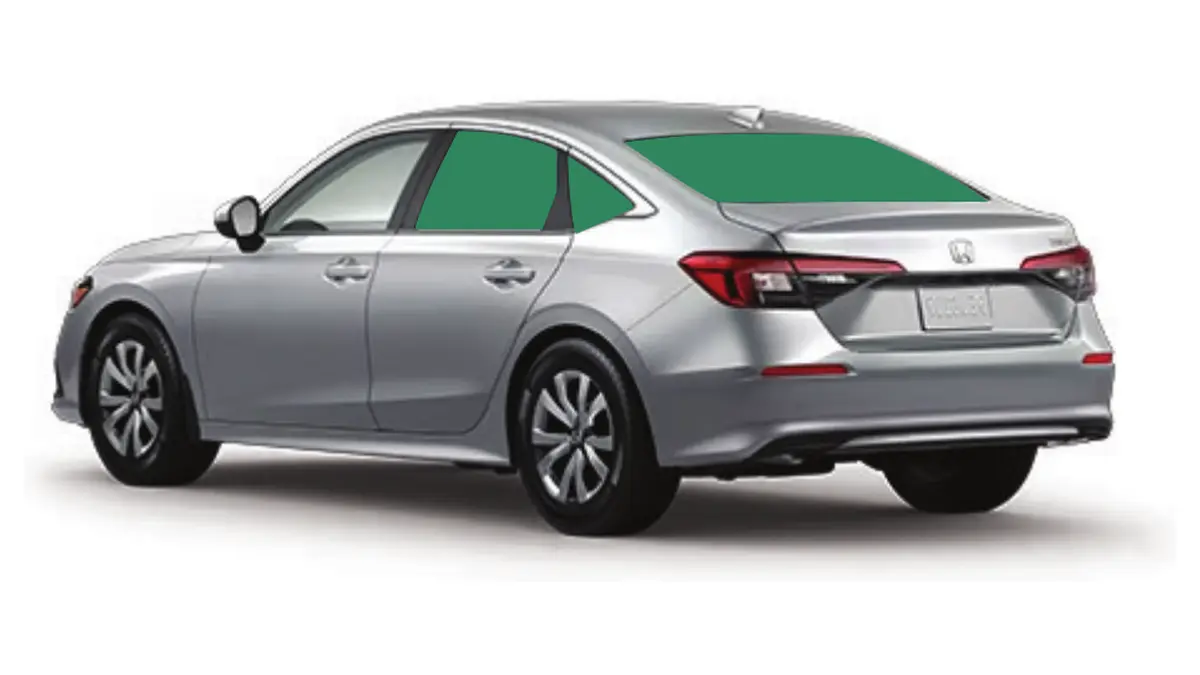
The rear glass of a sedan costs from $240 in dyed LLumar ATC, for up to five windows. Ceramic IRX or AIR on the same glass is an upgrade the shop prices for the package, so you see the dyed and ceramic figures side by side.
| Sedan package | Windows | From |
|---|---|---|
| Rear glass, LLumar ATC | Up to 5: rear door glass, quarter panes if fitted, back glass | $240 |
| Rear glass, LLumar IRX or AIR | Those windows in ceramic | Priced per package |
| Front doors | Driver’s and front passenger’s windows | $140, not road-legal in BC |
The $140 front-door job is something the shop does on request, and it breaks BC law. Under MVAR s. 7.05(8), film is lawful behind the driver and nowhere on side glass next to or in front of the driver, so even near-clear film on those two doors is illegal. A tint ticket usually comes to $109, according to Mission RCMP, and police can also order the film removed and the car inspected. The shop explains that before you decide, and the rule is laid out at tinting front windows in BC.
What the $240 buys: genuine LLumar film, a plotter pattern for your sedan’s year, make and model, hand fitting, and a lifetime warranty on both the film and the labour. Book more than one package in a visit and the shop usually prices the whole job below the list prices added together. The window tint prices page has every package drawn out.
Which windows are in the sedan rear package?
Up to five panes: the glass in both rear doors, the small fixed quarter windows on sedans that have them, and the back glass. Everything in the package sits behind the driver, the glass BC allows you to tint at any shade; the back window also needs an outside mirror on each side and film that passes inspection item 14c.
Rear door windows
These are the roll-down panes in the back doors, filmed on the inside surface like every other window. Keep them up for three to five days after the install so the film can bond before the glass slides into the door.
Quarter windows
Many sedans have a small fixed pane behind each rear door. On some it sits in the pillar between the door and the back glass, as on the car in the package diagram; on others it is a fixed section built into the rear door itself. They are small, often with tight corners and a rubber seal close to the edge, which is where a plotter-cut pattern helps most: the film is cut to the pane’s outline before it reaches the car, so nobody trims it against the glass. Sedans without quarter windows simply have three panes in the package instead of five.
The curved back window
The largest and most curved pane on the car, usually carrying the defroster grid, and the one that takes longest to fit.
Why does sedan back glass take the most work?
Sedan back glass bends in two directions, lies at a shallow angle under the roofline, and usually carries the defroster grid. Flat film won’t sit on that shape until it has been shrunk to fit, and the grid means any later removal has to be done carefully.
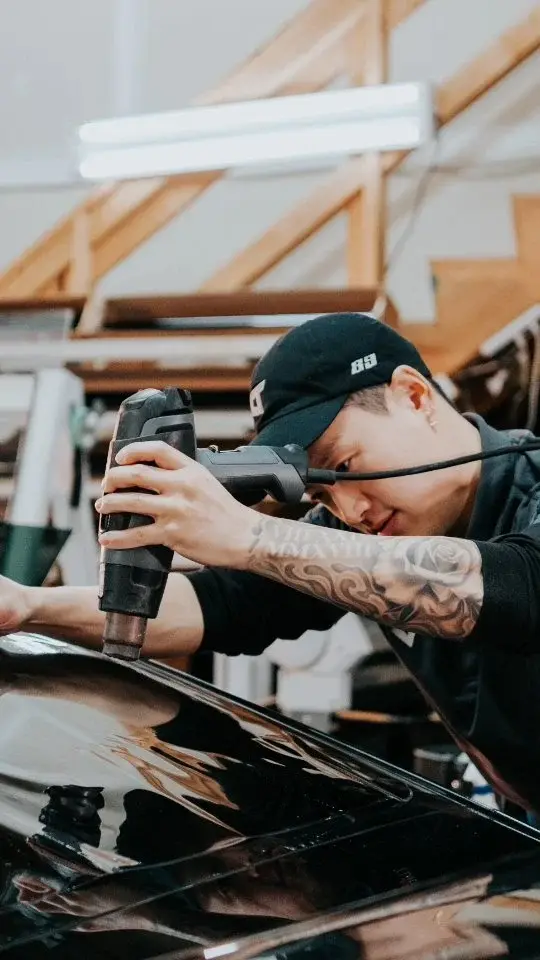
- The curve. Window film comes off the roll flat. To make it follow glass that curves side to side and top to bottom, heat from a heat gun shrinks it until it matches the glass, and then it is fitted by hand. In the shop’s photos this shaping is done with the film laid over the outside of the glass, before the piece goes on the inside, where all the film is installed.
- The defroster grid. A 2023 Kia owner’s manual for Canada says the defroster’s conductors are bonded to the cabin side of the rear window, the same face the film covers. New film goes over them without harm; the care comes later, when old film has to come off with steam rather than a blade. Rear window tint removal explains why.
- The third brake light. On many sedans the high-mounted brake light sits inside the car, on the rear shelf or at the top of the back glass, and shines out through it. Mention where yours is when you ask for a quote, so the shop can tell you how your model is handled.
Complex rear glass is one of the things the shop names as adding time to a tint, along with old film and vans. Allow for it if your sedan has a long, steeply raked back window.
Which LLumar film suits a sedan?
All three LLumar films fit a sedan; the choice is between price, heat rejection and how dark you want the glass. Whichever you pick, the shop matches the shade across every window in the package.
| LLumar film | Shades the shop sells | Light transmitted, measured | Solar energy rejected (TSER) | Infrared energy rejected (IRER) |
|---|---|---|---|---|
| ATC, dyed | 5, 15, 35, 50% | 5–60% | 28–44% | 22% |
| IRX, nano-ceramic | 5, 15, 35, 50% | 6–54% | 50–62% | 59–61% |
| AIR, clear ceramic | 70, 80, 90% | AIR 80: 77%, AIR 90: 84% | AIR 80: 43%, AIR 90: 30% | AIR 80: 60%, AIR 90: 40% |
LLumar measured these on single-pane 6 mm clear glass, and a sedan’s own glass will shift them a little. Don’t read the shade names as measurements: ATC 50 lets through 60% of visible light, and IRX 05 lets through 6%. ATC is the film behind the $240 price and is covered on the LLumar ATC film page; IRX keeps the same shades and turns back far more heat, with every shade listed on the LLumar IRX page. Every one of them blocks over 99% of UV.
How do you book sedan tint in Langley?
Tell the shop your sedan’s year, make, model and trim, the windows you want done, and the film you’re leaning towards. If you only want the glass behind the driver, back window tint sets the three rear packages side by side, and an electric sedan’s extra questions, from glass roofs to antennas, are answered on EV window tint.
Most sedans leave the same day; tinting the whole car typically takes two to four hours. Afterwards the side windows stay closed for three to five days, and a slight haze in the first week is the film drying, not a fault. Clean it with a soft microfibre and a cleaner with no ammonia, and keep blades off it. Request a price through the sedan tint quote form, or text the car’s details to 604 534 6433.