What does BC’s inspection manual say about cloudy headlights?
A clouded lens is a reject on its own, with nothing else wrong. Section 6 of the 2025 Vehicle Inspection Manual, which inspectors have had to follow since September 2, 2025, opens by requiring every lamp, lens and bulb to meet the Canadian or US federal lighting standard, and inspectors check the lamps with the headlamps and other lights switched on and the brakes applied.
Item 1.0(a) then lists the ways a lamp fails. Several of them describe what an ageing or modified lens looks like:
| What the lamp looks like | Reject wording in item 1.0(a) | What fixes it |
|---|---|---|
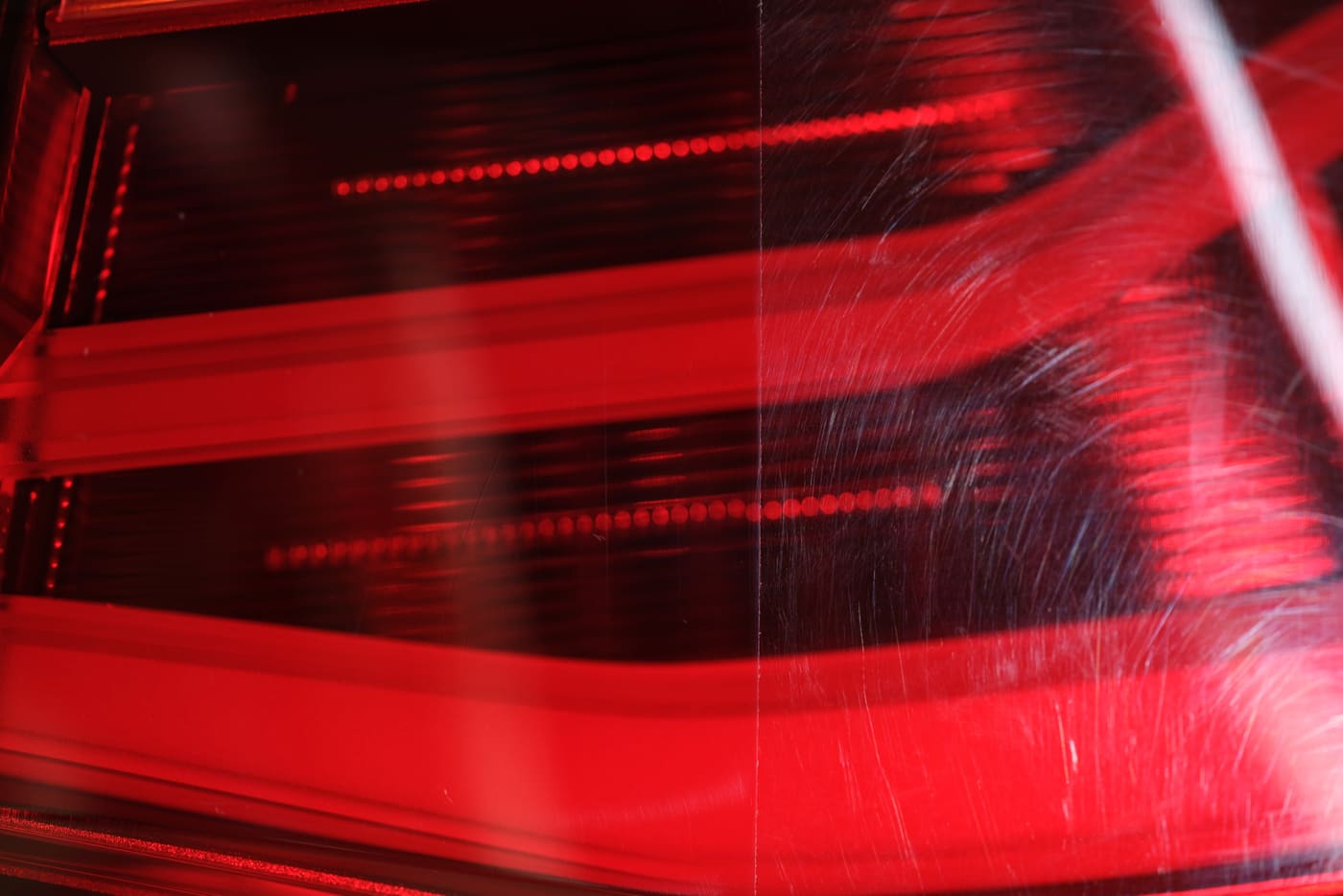
| Hazy, yellowed or chalky outer lens | “lens is clouded” | Restoration, if the lamp is otherwise sound |
| Lens darkened by smoked film or tint spray | “reduces transmission of light” | Taking the film or coating off |
| Lens hidden under a cover or film | “covered in any manner” | Removing the cover; even clear film may be questioned |
| Mist, droplets or water behind the lens | “moisture is present” | Reseal or replace the lamp |
| Cracks or missing pieces | “broken, cracked” | Replacement |
The item applies to inspection classes 1 to 6, so the same rule covers light vehicles, heavy trucks, trailers, buses, school buses and motorcycles. What the manual says about film specifically is covered in are tinted headlights legal in BC?
When does a car in BC actually go through an inspection?
Two events send many private cars to a designated inspection facility: coming in from another province or country, and a Notice and Order from police. Either way, the whole car is checked, lamps included.
Registering a car from outside BC. MVAR sections 25.24 and 25.25 require a passed inspection before ICBC registers a vehicle last plated outside the province, up to 3,500 kg net (ICBC, importing a vehicle). Some vehicles coming from the three Prairie provinces are exempt; the out-of-province inspection guide explains who qualifies.
A Notice and Order. Commercial Vehicle Safety and Enforcement describes three levels (CVSE, Notice and Order):
| Level | What it means for the car |
|---|---|
| Box 1 | Off the road until it passes a complete mechanical inspection |
| Box 2 | To a facility promptly, repaired and passed within 30 days; $598 fine if not satisfied |
| Box 3 | A named part to fix, with no inspection required |
By Mission RCMP’s estimate, an inspection usually costs somewhere between $150 and $250 (Mission RCMP FAQs), so fixing a lens before the appointment costs less than paying twice.
Can police act on cloudy headlights without an inspection?
They can. Lamp rules in the Motor Vehicle Act Regulations apply to every car on the road, and CVSE confirms that police officers are among those who can issue a Notice and Order for a vehicle that doesn’t comply.
MVAR Division 4 is the part to know:
- s. 4.04(1): required lighting devices must be “maintained in good working order”.
- s. 4.06(1): the high beam must reveal an object 100 m ahead and the low beam one 30 m ahead, with the bright part of the low beam kept out of oncoming drivers’ eyes.
- s. 4.01: headlights go on between 30 minutes after sunset and 30 minutes before sunrise, and whenever you can’t clearly see things 150 m away.
A lens that scatters light works against both of the beam requirements in s. 4.06, so the safe plan is a lens that would pass an inspection on any day.
How much light does a cloudy lens actually cost you?
Most of it. In AAA’s 2018 laboratory testing of headlights from two roughly 11-year-old sedans, clouded and yellowed lamps put out only about a fifth of the light of new ones (AAA).
Restoration recovered a large share of that. AAA found professional and DIY restoration brought output back to about 70 percent, and new OEM lamps to 100 percent. The difference shows most on dark rural roads, where your headlights are the only light there is. How long a restored lens stays clear is covered in how long headlight restoration lasts.
How do you get cloudy headlights ready for an inspection?
Fix what’s on the outside of the lens, replace what’s wrong inside it, and leave film off until after the inspection. In order:
- Check where the haze is. A rough, chalky outer surface is the lens itself. Droplets or mist behind a smooth lens mean moisture inside the lamp; foggy headlight repair explains how to tell normal condensation from a leak.
- Restore outside haze. Light haze needs the polish-and-seal level, roughly an hour; yellowed lenses need full restoration with progressive wet sanding, two to three hours.
- Finish with a sealant, not film. Film over a lens can be treated as a covering under item 1.0(a). If smoked or yellow light film is already on, film the shop installed can be peeled off before the inspection.
- Replace lamps that hold water or are cracked. A replacement must carry proper CMVSS or compliant ECE function markings, or it fails item 1.0(a) too.
- Look at the rest of the lamp. A dead LED in a headlamp assembly is a reject, and so are broken aim adjusters under item 1.1(a).
Booking headlight restoration before an inspection
Tell the shop your inspection date and what the order or registration requires, and the restoration will be finished with a sealant so nothing covers the lens. Brookswood Tint quotes restoration per vehicle, and the headlight restoration quote form only needs a daylight photo of each lens and that date.
If the car also has film on its front side windows, which isn’t legal in BC at any darkness, that has to come off for the inspection too. Tint removal for out-of-province inspections takes the film off just the front two windows and leaves legal rear tint in place, and the headlight restoration page lists all three restoration levels.