
What causes silvering?
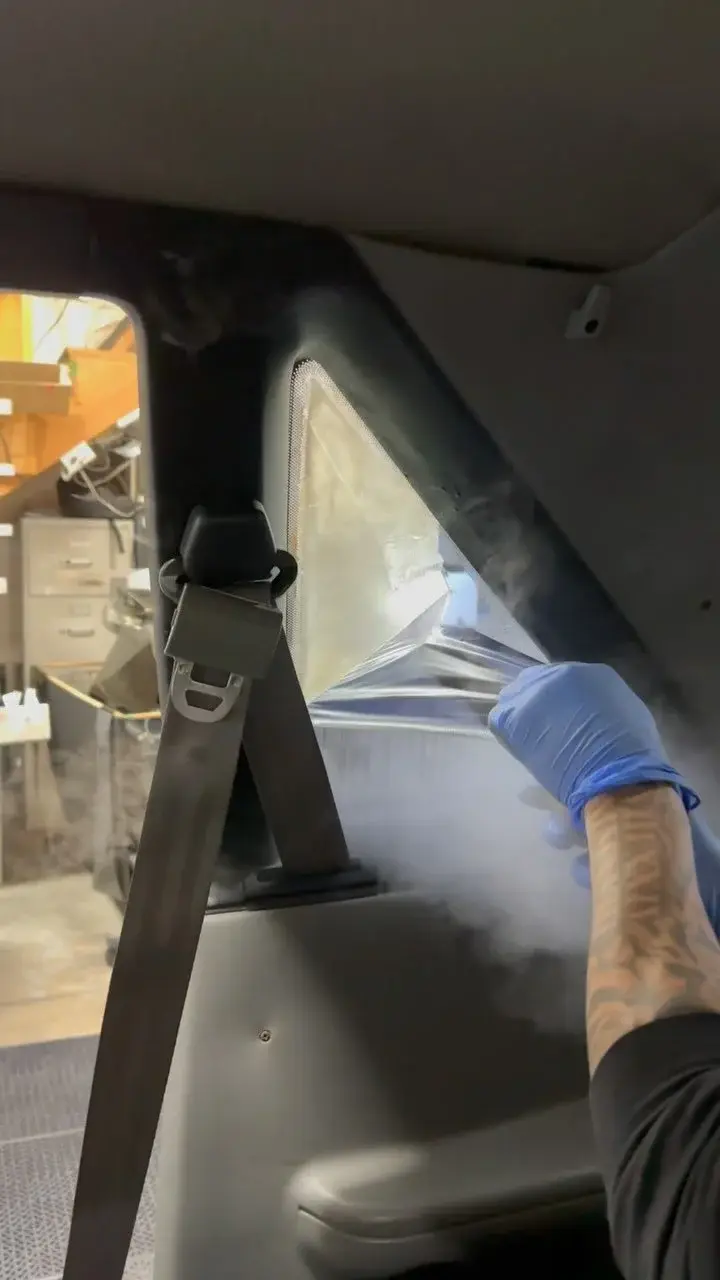
Air that the adhesive never pushed out. General Formulations, which makes pressure-sensitive films, explains in a technical tip on silvering that the adhesive has to make total contact with the surface for an unbroken view through the film. Where a thin layer of air is left behind, it adds “two additional interfaces” that scatter light and give a “white appearance”, seen against a dark background “as a flecked or salt crystal form”.
Texture raises the risk. The same tip says any rough surface is more prone than a smooth one, because the adhesive has to reach into every valley; where it can’t, air stays at the bottom. Its remedies on a laminating machine are warmth, pressure and a slower pass, all of which help the adhesive flow.
Does silvering go away on its own?
Light silvering can. General Formulations says fine silvering “will dissipate from 24 to 48 hours” as the adhesive keeps wetting out the surface, but moderate to heavy silvering usually won’t clear that way.
New window tint has its own, separate settling period. Film goes on wet, and for the first week the shop expects some haze, or the odd pocket of water, that dries out by itself; meanwhile the glass stays rolled up for three to five days. That’s water drying out, not air, and it’s explained on why new tint looks hazy.
Where can it show up on a car?
Most likely where film meets a surface that isn’t smooth. On back glass, film crosses a printed pattern at the edge: the band of black enamel dots called the frit. Avery Dennison’s window film bulletin has rear film trimmed so its edge reaches 2 or 3 mm past the dots and onto the solid enamel, rather than stopping across the dot pattern.
In graphics, General Formulations uses the word for air caught under clear laminating film on printed decals; that layer is defined on overlaminate.
Is silvering the same as silver or mirror tint?
No. Silvering is a defect; a silver or mirror look is a product choice. LLumar’s performance data sheet lists a metallized line, ATR, “with a slightly reflective look”, separately from the shop’s own three lines, ATC, IRX and AIR, whose visible reflectance runs 5 to 9%.
Reflective film also has legal limits here. BC’s 2025 Vehicle Inspection Manual fails reflective-type film in three places: the windshield (item 12e), the back window (14c) and glass ahead of the driver’s seat back (13d). No film of any type, mirror or otherwise, is legal on BC front side windows; Brookswood Tint fits it there only if asked, and only after laying out the $109 fine and the Notice & Order risk. For what’s allowed behind the driver, read reflective and coloured tint in BC.