What does the GT-R rear glass photo show?
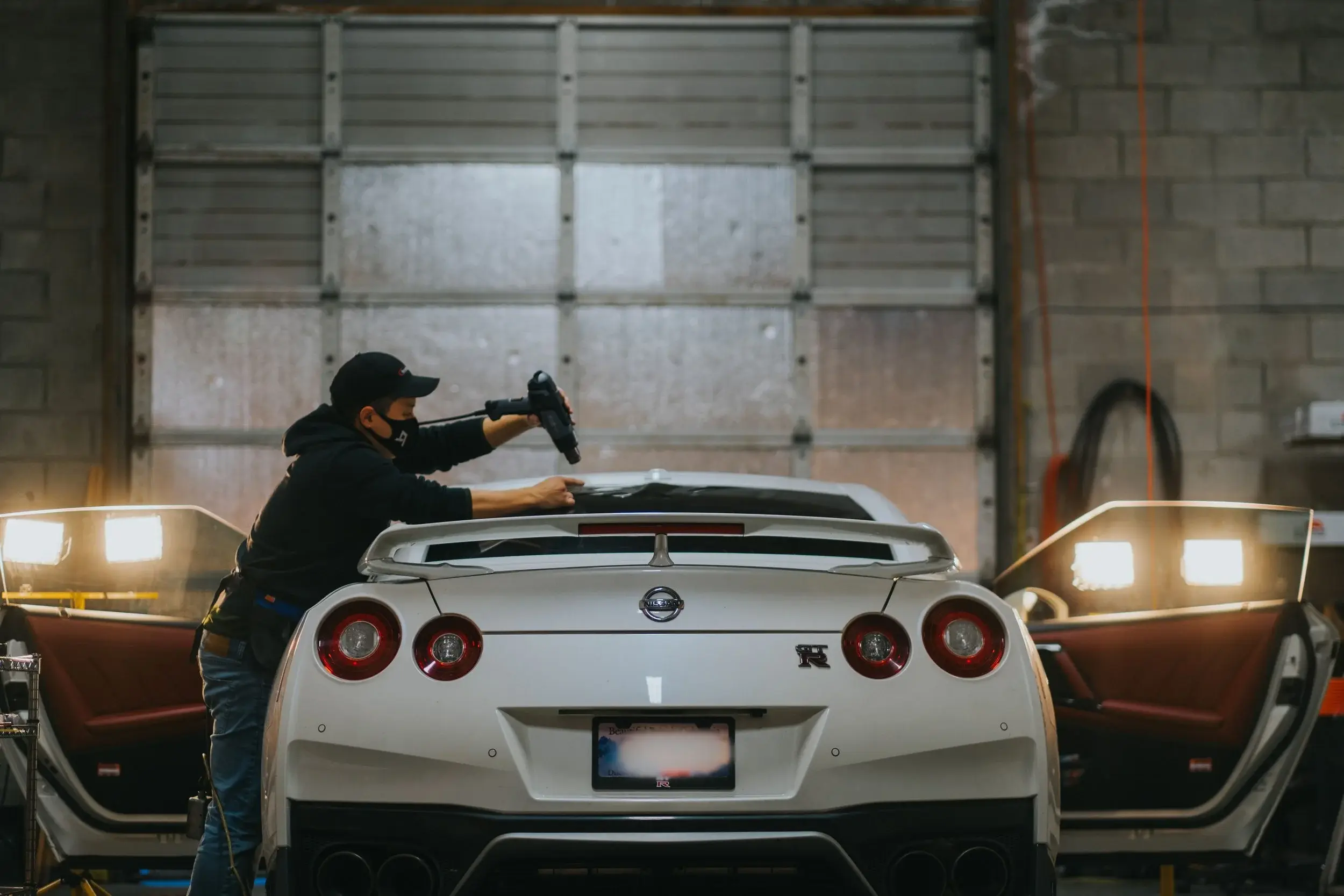
It shows a white Nissan GT-R in the shop with its rear glass mid-job. A masked installer in a cap leans over the rear wing, a heat gun in one hand, the other hand pressing a sheet of film flat against the outside of the back window.
Both doors stand open, showing red door panels, and work lights on stands throw light across the glass from each side. The wing runs right across the lower part of the back window, with a red light strip set into its middle, so every pass with the heat gun happens over it. The photo doesn’t record which film or shade went on this car, so this page doesn’t name one.
Why is a GT-R’s back window shaped on the outside first?
Because flat film can’t lie on curved glass without fingers of excess along the edges. Laid wet on the outer face, the film is warmed with a heat gun until that excess shrinks and the sheet follows the curve exactly. It’s then trimmed, and the shaped piece goes on the cleaned inside face of the glass.
That is the step in the photo, and the heat-shrinking entry explains the technique. The answer on whether tint goes on the inside or outside covers why film lives on the cabin side. On a GT-R the wing adds a complication: the installer has to reach the bottom edge of the glass from above it. The shop’s timing notes say complex rear glass takes longer than an ordinary window.
Which LLumar films fit a GT-R’s rear glass?
Any of the three lines the shop sells, in any shade it lists. The figures are LLumar’s, taken on 6 mm clear test glass for its Window Film Performance Data sheet, so the GT-R’s own glass will shift them slightly.
| Shade code | ATC visible light passed | ATC solar energy blocked | IRX visible light passed | IRX solar energy blocked |
|---|---|---|---|---|
| 05 | 5% | 44% | 6% | 62% |
| 15 | 18% | 40% | 20% | 59% |
| 35 | 38% | 35% | 39% | 54% |
| 50 | 60% | 28% | 54% | 50% |
ATC is the dyed base film; IRX is the nano-ceramic upgrade. Clear AIR 80 lets 77% of light through and still rejects 43% of solar energy. Every shade is rated above 99% UV rejection.
Is dark tint on a GT-R’s back glass legal in BC?
Yes, at any darkness. MVAR s. 7.05(8) permits back-window film on a vehicle with outside mirrors on its left and right sides, and the GT-R in the shop’s photos has both.
The 2025 Vehicle Inspection Manual adds one condition under item 14c: no reflective film on the rear window. The door glass is a different matter: no film of any shade is allowed beside the driver.
What does rear glass film do for a GT-R?
It shades the cabin from behind and hides what sits behind the seats. Our view, as general reasoning: on a low coupe the back glass sits close behind the occupants’ heads, so it carries a lot of sun in summer and a lot of headlight glare at night. IRX 15 cuts glare by 78% on the sheet, and every option blocks more than 99% of UV.
Looking after new film on curved back glass
Expect light haze or small water pockets during the first week; both are normal and evaporate. To clean it, wipe the inside of the back glass with a soft microfibre cloth and a cleaner with no ammonia in it. Scraping is out, because the film sits over any defroster lines there. If it ever needs replacing, rear window tint removal uses steam rather than blades.
To book, see the GT-R window tint page and request a price through the quote form with your GT-R’s year.