Which windows on a rideshare car can be tinted in BC?
Every pane behind your seat, at any darkness, plus a band across the top of the windshield. Both front door windows take no film at all, and carrying fares doesn’t change that.
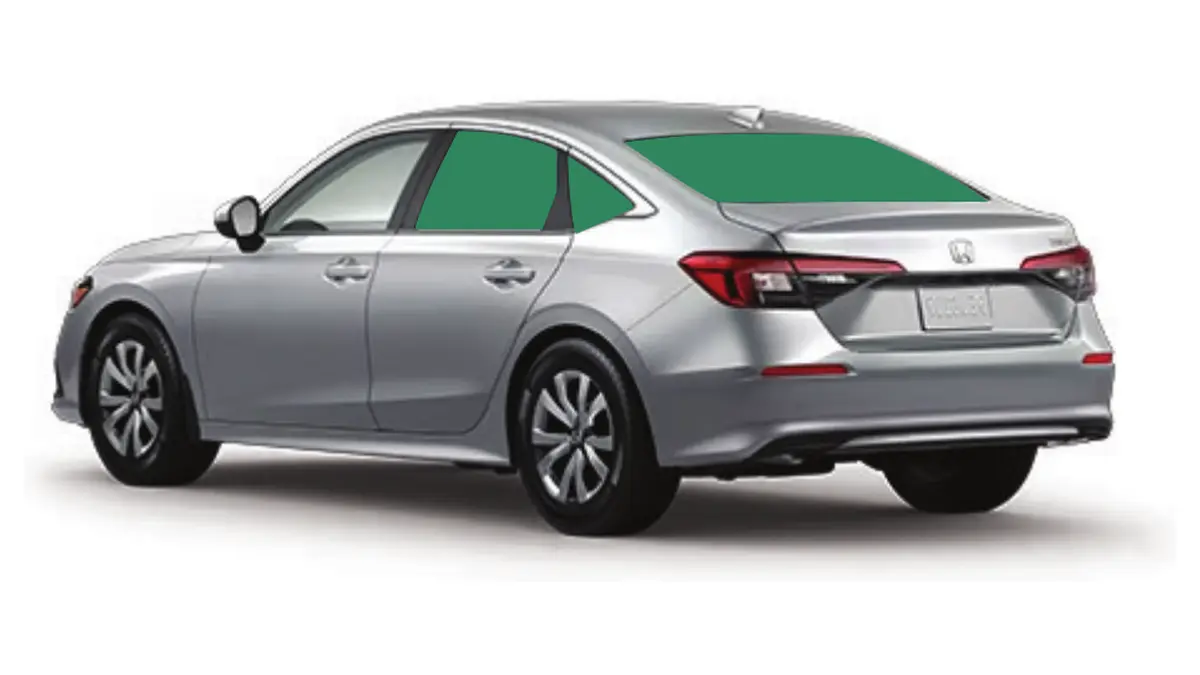
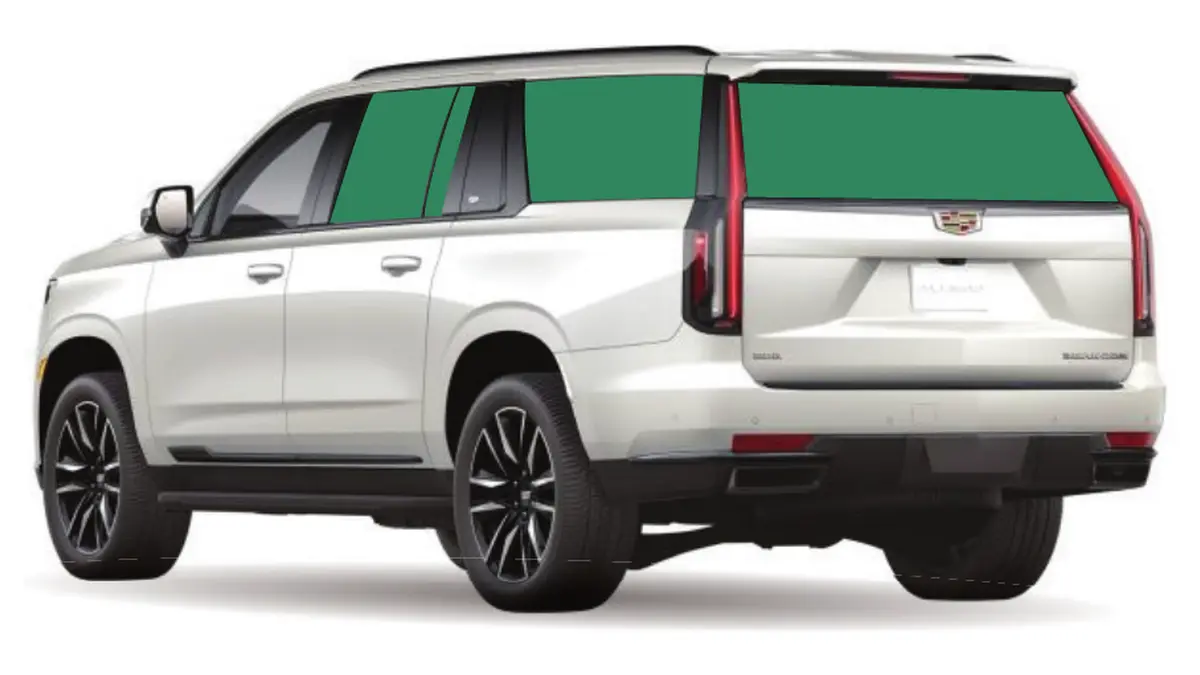
MVAR s. 7.05(8) permits light-reducing material in just three spots: a windshield band ending 75 mm or less below the top edge, every side pane behind where the driver sits, and the rear glass, provided exterior mirrors are fitted left and right. A car on the Uber or Lyft app follows the same map as a family car:
| Glass on a ride-hail car | What BC allows | Who it serves |
|---|---|---|
| Rear door windows and quarter panes | Film of any shade | Passengers seated right beside them |
| Back glass or hatch | Any shade, given an outside mirror left and right | Riders in the back seat, and your rear view |
| Windshield | Top strip, no deeper than 75 mm | You, against low sun |
| Driver and front passenger door glass | Nothing, clear film included | You, and any rider in the front seat |
The province’s tips for ride-hail passengers ask riders to check that the vehicle and driver match the app before getting in, and bare front door glass keeps your face visible for it. Taxis, vans and buses are covered in tint rules for commercial vehicles.
How often is a ride-hail car inspected, and does front film pass?
Once a year, or twice a year after a 12-month stretch of 40,000 km or more, and front film fails at every visit. A private car can go years between inspections; a rideshare car can’t.
The province’s requirements for passenger directed vehicle drivers set the schedule: annual if the car was driven less than 40,000 km in the previous year, semi-annual at 40,000 km or more. It’s done at a designated inspection facility, at a cost the province says “typically ranges from $100 to $300.” The 12-month certificate sits in s. 25.14 of the inspection regulations, and CVSE’s 2019 bulletin to inspection facilities explains the six-month step past 40,000 km.
The inspector works from the 2025 Vehicle Inspection Manual, where three items cover tint:
- Item 13d fails tint added after the factory, whether “by film or any material or coating”, on any side window in front of the driver’s seat back.
- Item 12e fails windshield film extending past the top 75 mm.
- Item 14c rejects rear-window film without outside mirrors on both sides.
For ride-hail drivers: On a car with a fixed inspection date, front door film is a certain fail, not a roadside gamble. If you still ask for front film, the shop will fit it only after telling you plainly that front door film breaks BC law, and that a Notice & Order or a $109 ticket could follow.
What does rear film do for passengers in the back seat?
It blocks UV and cuts solar heat at the seats your riders use. Every LLumar film the shop installs blocks over 99% of UV in the 300–380 nm band, dark or near-clear.
A 2025 study of 34 vehicle models (Axelson et al.) noted that with rideshare apps in wide use, “it becomes important to consider UV exposure while in the rear passenger seats”. It measured average UVA attenuation of 93.18% through rear left windows and 95.57% through rear right ones, and suggested rideshare drivers give “consideration to protective window films”. The Skin Cancer Foundation explains the gap: the side and rear panes are tempered, and SCF says that kind of glass “does not block UVA rays effectively”.
Heat matters too. In Environment Canada’s 1981–2010 Abbotsford normals, August afternoons average 24.4 °C and a typical year brings 8.7 days over 30 °C. LLumar’s spec sheet rates total solar energy rejected (TSER) at 28–44% for dyed ATC and 50–62% for nano-ceramic LLumar IRX.
Which shade suits a car that carries riders?
Any shade is legal behind you, so choose by the trade: darker film gives riders more privacy and glare relief, lighter film leaves you more view through the back glass after dark. These figures come from LLumar’s sheet, measured on 6 mm clear glass:
| Film and shade | Light let through (VLT) | Glare reduction | TSER |
|---|---|---|---|
| ATC 35 | 38% | 57% | 35% |
| IRX 35 | 39% | 56% | 54% |
| IRX 15 | 20% | 78% | 59% |
| IRX 05 | 6% | 94% | 62% |
A film’s name carries a product code rather than its measured transmission. Over factory privacy glass the darkness multiplies: 20% film on 20% glass passes about 4%. Driving evenings? Read how dark tint affects night driving first.
Can the driver’s window get UV film for long shifts?
No. BC allows no film on the driver’s door glass, clear UV film included, so the pane beside you all shift stays as the factory made it.
It’s also the weaker pane for UV: the 2025 study measured driver’s windows at 88.78% UVA attenuation on average, against 99.25% for laminated windshields. In BC, film can’t close that gap, and the regulation has no medical exemption for front side glass. The research is laid out in the guide to UV, health and car window film.
How long is a rideshare car off the road for tint?
Usually part of one day. Most cars are finished the same day, a sedan or SUV usually needs 2–4 hours for a full tint, and old film removal, complex back glass or a van adds time.
The film then cures for 3–5 days with the windows up. Riders won’t know that, so switch on the rear window lock if your car has one. Light haze or small water pockets that first week are normal and evaporate. For wiping off passengers’ handprints, use ammonia-free cleaner on soft microfibre and never scrape; more on cleaning tinted windows.
Booking rear tint around your driving hours
Pick the package for your body style and book a slot between shifts. Rear-glass packages start at:
| Package | Windows | From |
|---|---|---|
| Sedan or pickup, rear glass | 5: rear doors, quarter panes if fitted, back glass or slider | $240 |
| Full-size SUV or wagon, rear glass | 7: rear doors, quarters, extended windows, hatch | $260 |
| Minivan | Sliding-door, third-row and hatch glass | Quoted per van |
Prices are LLumar ATC; IRX and AIR are quoted as upgrades, and the minivan tint page explains why vans are priced one by one. Film and workmanship carry a lifetime warranty. Several cars under one business? Fleet tinting sets a shade per vehicle type and invoices the company. Send your car’s details through the window tint quote form or call or text 604 534 6433; the shop is at Unit 312, 20560 Langley Bypass, Monday to Saturday, 9:00 to 17:00.