What kind of UV gets through car glass?
Mostly UVA. Sunlight carries three bands of ultraviolet: one never reaches the ground, one is largely stopped by the atmosphere and then by glass, and the third gets through both in part.
| Band | Wavelength | What Health Canada says |
|---|---|---|
| UVC | 100–280 nm | Filtered out by the ozone layer; never reaches the earth |
| UVB | 280–320 nm | Largely absorbed by the ozone layer, about 5% reaching the surface; responsible for sunburn |
| UVA | 320–400 nm | Not readily absorbed by the ozone layer; penetrates deep into the skin, to the dermis; can bring on tanning and premature skin aging |
Those definitions come from Health Canada’s page on ultraviolet radiation. Ordinary car glass deals with most UVB, so inside a vehicle the question is how much UVA each pane lets in, and that depends on how the glass is built.
Windshield versus side glass
A windshield is laminated glass, and the Skin Cancer Foundation says it is “treated to shield drivers from some UVA”. Side windows, back glass and sunroofs are usually tempered glass, which the same source says “does not block UVA rays effectively”. Measured on real cars, the gap looks like this:
| Glass | 2016 study, 29 cars | 2025 study, 34 models from 2015 to 2025 | Gap to the windshield in 2025 |
|---|---|---|---|
| Windshield (laminated) | 96% of UVA blocked | 99.25% of UVA blocked | None |
| Side glass by the driver (tempered) | 71% of UVA blocked | 88.78% of UVA blocked | About 10 points |
The 2016 figures come from Dr. Brian Boxer Wachler’s paper in JAMA Ophthalmology, where only 4 of the 29 cars had side windows above 90%; the 2025 figures from Axelson and colleagues in Archives of Dermatological Research. Newer glass does better, but the driver’s window still trails. Each window’s figure from the 2025 study is listed in the full UV-blocking answer.
What film adds
LLumar rates every automotive film on its performance data sheet above 99% UV blocked, from the darkest ATC to the clearest AIR. One detail worth knowing: that rating covers 300 to 380 nm, while Health Canada’s UVA band runs to 400 nm, so the top 20 nm of UVA sits outside the published figure. What the term means on a spec sheet is explained under UV rejection.
Does UV through car windows matter on grey Fraser Valley days?
Yes. It drops in winter and under heavy cloud, but light cloud doesn’t stop it, and the Fraser Valley still gets close to 1,900 hours of sunshine a year.
The Government of Canada puts the highest UV risk in Canada from April to September, and from 11 a.m. until 3 p.m. each day, and warns that UV still gets through in cool or slightly cloudy weather; only thick cloud reduces it much. The World Health Organization says the same in its own words: UV levels “can be high even with cloud cover.” Health Canada’s sun safety basics ask people to protect against UV “all year round, not just in the summer.”
Locally, the federal climate normals for Abbotsford Airport for 1981 to 2010 record 179.5 days with precipitation in an average year but also 1,886.7 hours of sun, with the drier months falling inside that April to September window: 43 mm of rain in July against 241 mm in November.
| UV index | Federal category | Advice in short |
|---|---|---|
| 0–2 | Low | Minimal risk, except on bright days with snow on the ground, which can almost double the UV you get |
| 3–7 | Moderate to high | Cover up, use sunscreen on skin you can’t cover, look for shade near midday |
| 8 and over | Very high to extreme | Keep sun time short around midday, wear UV-protective sunglasses, seek shade |
The WHO recommends sun protection from an index of 3 up. Film doesn’t care about the forecast: on the glass it covers, it filters the same in July sun as in a November drizzle.
What does car-window UV mean for your skin?
Studies associate the UVA that comes through side glass with more sun damage on whichever side of the body faces that window. No study has shown that window film prevents skin cancer, and nothing here is medical advice.
The numbers usually quoted come from Butler and Fosko’s 2010 dermatology paper. Among the skin cancer patients they reviewed, 52.6% of cancers sat on the left side of the body against 47.4% on the right (P = .059, just above the usual cut-off for significance), and 74% of melanoma in situ was on the left. In Canada the driver sits on the left, beside the window that blocks the least UVA. That is an association, and other explanations exist; the research for and against the driving link, including a UK study that points the other way, is weighed in the skin cancer evidence, for and against.
What film can honestly claim is narrower. The Skin Cancer Foundation recommends UV window film within a complete sun protection strategy, alongside shade, covering clothing, a broad hat and sunglasses that block UV, and says film can stop over 99% of UVA and of UVB alike. It’s a filter on a pane of glass, not a substitute for the rest of that list, and questions about your own skin belong with a doctor or dermatologist.
How does UV in a car affect your eyes?
There is some evidence that years of bright-sun UV raise the risk of cataracts, and the windows that let the most UVA in sit right beside the driver’s face. In BC that glass can’t be filmed, so UV-labelled sunglasses do the job there.
Health Canada’s page on sunglasses says: “There is some evidence that daily exposure to UV radiation in very bright sunlight over many years may increase the risk of developing cataracts.” The WHO estimates that 15 million people worldwide are blind from cataracts and that “some 10% may be due to exposure to UVR.” Writing about his 2016 car study, Dr. Brian Boxer Wachler said its low side-window figures “may in part explain the reported increased rates of cataract in left eyes”. Those are possibilities and population estimates, not a diagnosis for any one driver.
Sunglasses for the driver’s side
Health Canada’s advice lines up neatly with what film can’t legally do in BC:
- Look for a label stating UVA and UVB protection, because you can’t judge it “by their price, colour, or by the darkness of the lenses.”
- “Wear sunglasses when driving a vehicle in bright sunlight, because they reduce glare and improve contrast.”
- Close-fitting or wrap-around frames help stop stray light coming in from the sides, which is where the driver’s window is.
Film behaves like lenses on that first point. An International Window Film Association consultant, answering a reader for the Skin Cancer Foundation, made the same point about tint: a darker film is no better at stopping UV than clear UV film.
Glare behind you
Shade does change glare. LLumar’s sheet gives ATC 05 a 94% glare reduction, ATC 50 32% and AIR 90 just 5%, so dark film tames bright light from behind while near-clear film barely changes it. Dark rear glass also makes shoulder checks and reversing harder at night; weigh both on does window tint reduce glare and is dark tint safe for night driving.
Who gains most from UV film in a car?
Three groups: babies and young children in the back seat, people whose skin reacts to UV, and anyone who spends the working day behind the wheel. For each, film behind the driver is one legal piece of the answer.
Babies and young children
Health Canada’s tips for parents say babies have more sensitive skin “because the outer layer of their skin is thinner”, and advise keeping babies under one year out of direct sunlight altogether. Car seats sit behind the rear door glass, which BC lets you film at any shade, so filmed rear windows cut the UV reaching a child through them. Filmed glass doesn’t make direct sun on a baby acceptable, and it does nothing once the window is down. Film for family vehicles has its own page: UV window film for family cars.
People whose skin reacts to UV
Health Canada notes that some medications can make skin more sensitive to UV rays. The 2025 vehicle study names UVA as a trigger that can worsen photodermatoses, light-sensitive skin conditions, and says film blocking UVA and infrared “may be added to car windows”, calling it “particularly useful for patients with photodermatoses”. The authors add that local laws on visibility through windows “must be factored in”. In BC that law leaves the front side windows bare whatever the medical reason, as the medical exemption answer explains.
Drivers who are on the road all day
The 2025 authors raised rideshare driving specifically, suggesting drivers think about UV-protective glass and protective window films. Rideshare cars and work fleets are covered on window tint for rideshare drivers and fleet tinting.
Which car windows can carry UV film in BC?
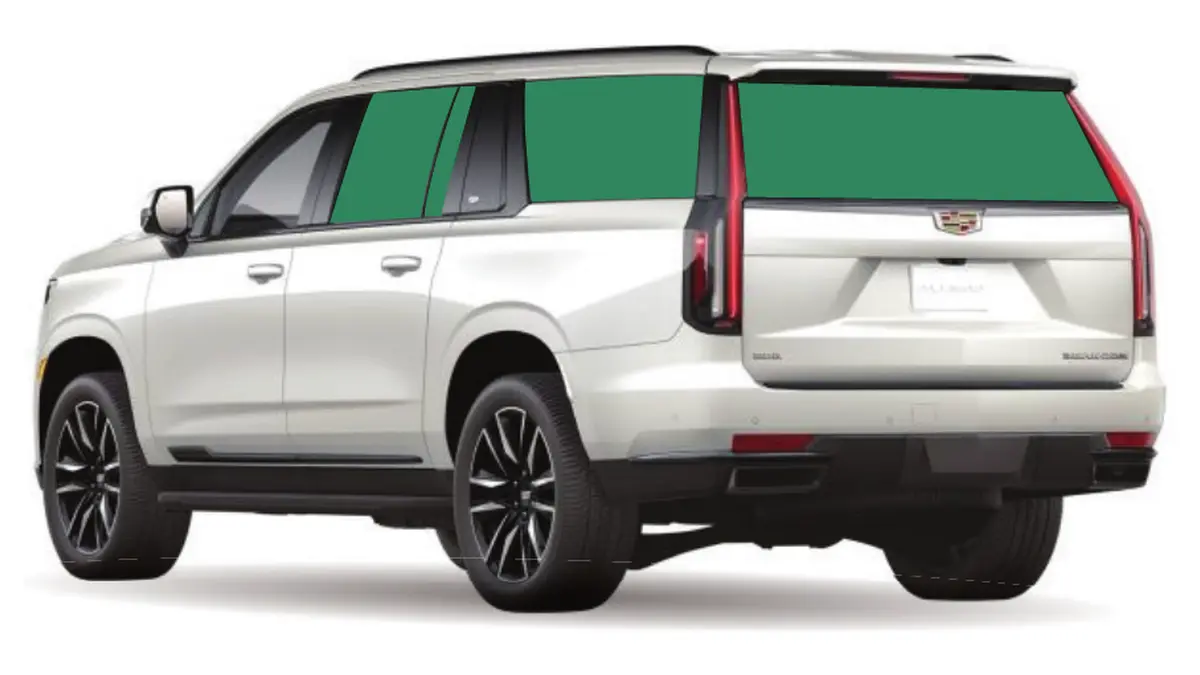
All the glass behind the driver can, plus a strip along the top of the windshield. The two front door windows have to stay bare in BC, clear UV film included.
MVAR s. 7.05(8) allows anything that reduces light in just three spots: a windshield band whose lower edge sits within 75 mm of the glass’s top, side glass located behind the driver, and the back window, as long as there’s an exterior mirror on both the left and the right. Lay that over the 2025 measurements and the rule happens to leave the two weakest panes unfilmed:
| Window | Film in BC | UVA blocked without film, 2025 average |
|---|---|---|
| Windshield | Top 75 mm only | 99.25% |
| Driver’s window | None, any shade | 88.78% |
| Front passenger’s window | None, any shade | 88.99% |
| Rear left window | Any shade | 93.18% |
| Rear right window | Any shade | 95.57% |
| Back glass | Any shade, if both outside mirrors are fitted | 95.36% |
Roof glass is a separate case, covered on sunroof and panoramic roof tint.
No medical exemption
The regulation contains no medical exemption. The last provincial statement found, a 2008 CVSE bulletin quoted by DriveSmartBC (a secondary source), states in capitals that there are “NO EXEMPTIONS, PERMITS OR PERMISSIONS” to get around the rule. Alberta runs a medical permit of its own; it has no force here.
If you put film on the front anyway
Front-door film can cost you $109 at the roadside, the figure Mission RCMP gives for a typical tint ticket. Police may go further with a Notice & Order. That order requires the film off and an inspection, and if the 30-day deadline passes, the fine is $598. Brookswood Tint will still fit film on the front doors when a driver insists, but it is not legal on BC roads, a diagnosis doesn’t make it legal, and the shop explains the fine, the Notice & Order and the inspection deadline before any film is cut. BC’s front-window rule in full has the rest.
Can window film help with heat, and where does that stop?
It cuts the solar heat coming through the glass it covers, which makes a summer drive more comfortable. It does not make a parked car safe for a child, a vulnerable adult or a pet, at any shade.
On LLumar’s sheet, total solar energy rejected (TSER) runs from 28 to 44% for ATC, 50 to 62% for IRX, 43% for AIR 80 and 30% for AIR 90. Abbotsford averages 8.7 days a year hotter than 30 °C, so the Fraser Valley gets real heat, if not every week.
Heat in a closed car is a different matter. HealthLinkBC File #35 is direct: “Never leave children, dependent adults or pets alone in a parked car.” Its figures: with 34°C outside, a closed vehicle can climb to 52°C in 20 minutes, and windows left open a crack don’t bring it back to a safe level. Health Canada makes a parallel point for parents: sunscreen protects against UV “but will not protect children from the heat.” Film is similar: it trims the UV and some of the solar heat coming through the glass, and offers no protection once a closed car starts heating up. How hot a parked car actually gets here is measured on how hot does a parked car get in Langley, and pet owners will find film and dogs in parked cars covered separately.
Choosing a film for UV protection and booking it
For UV alone, any LLumar film does the job, so choose the shade for looks and the line for heat. Clear AIR suits drivers who want the UV filter without darker glass; IRX suits those who also want the most heat rejection.
| LLumar film | Visible light through | UV blocked | Solar energy rejected (TSER) | Glare cut |
|---|---|---|---|---|
| ATC 05 | 5% | >99% | 44% | 94% |
| ATC 50 | 60% | >99% | 28% | 32% |
| IRX 05 | 6% | >99% | 62% | 94% |
| IRX 50 | 54% | >99% | 50% | 39% |
| AIR 80 | 77% | >99% | 43% | 13% |
| AIR 90 | 84% | >99% | 30% | 5% |
Film names carry product codes rather than measurements: ATC 50, for instance, passes 60% of visible light. Both ATC and IRX come in four shades at the shop (5, 15, 35 and 50), and the shop lists LLumar AIR at 70, 80 and 90%; LLumar publishes data for AIR 80 and 90 only.
What it costs and how long it takes
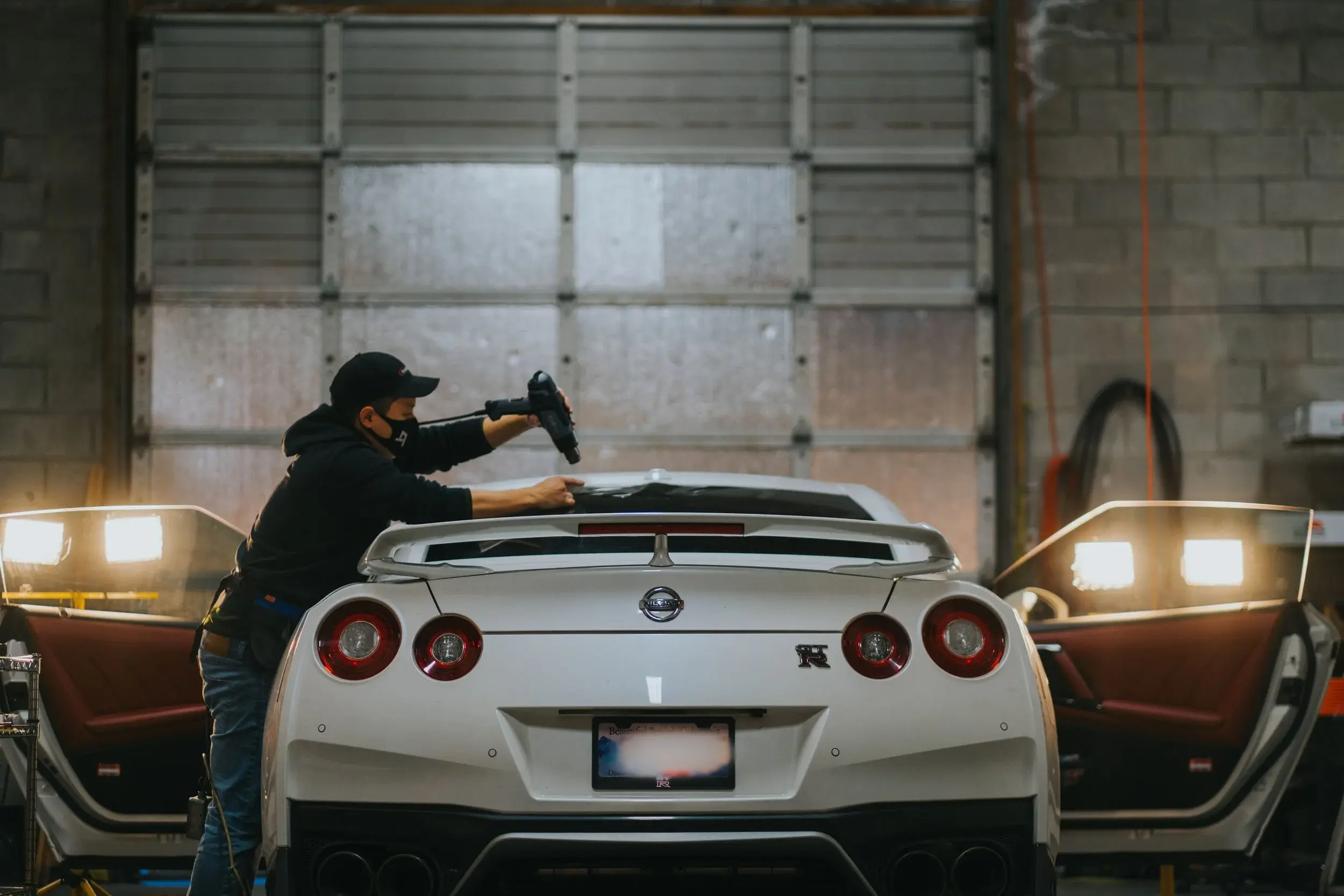
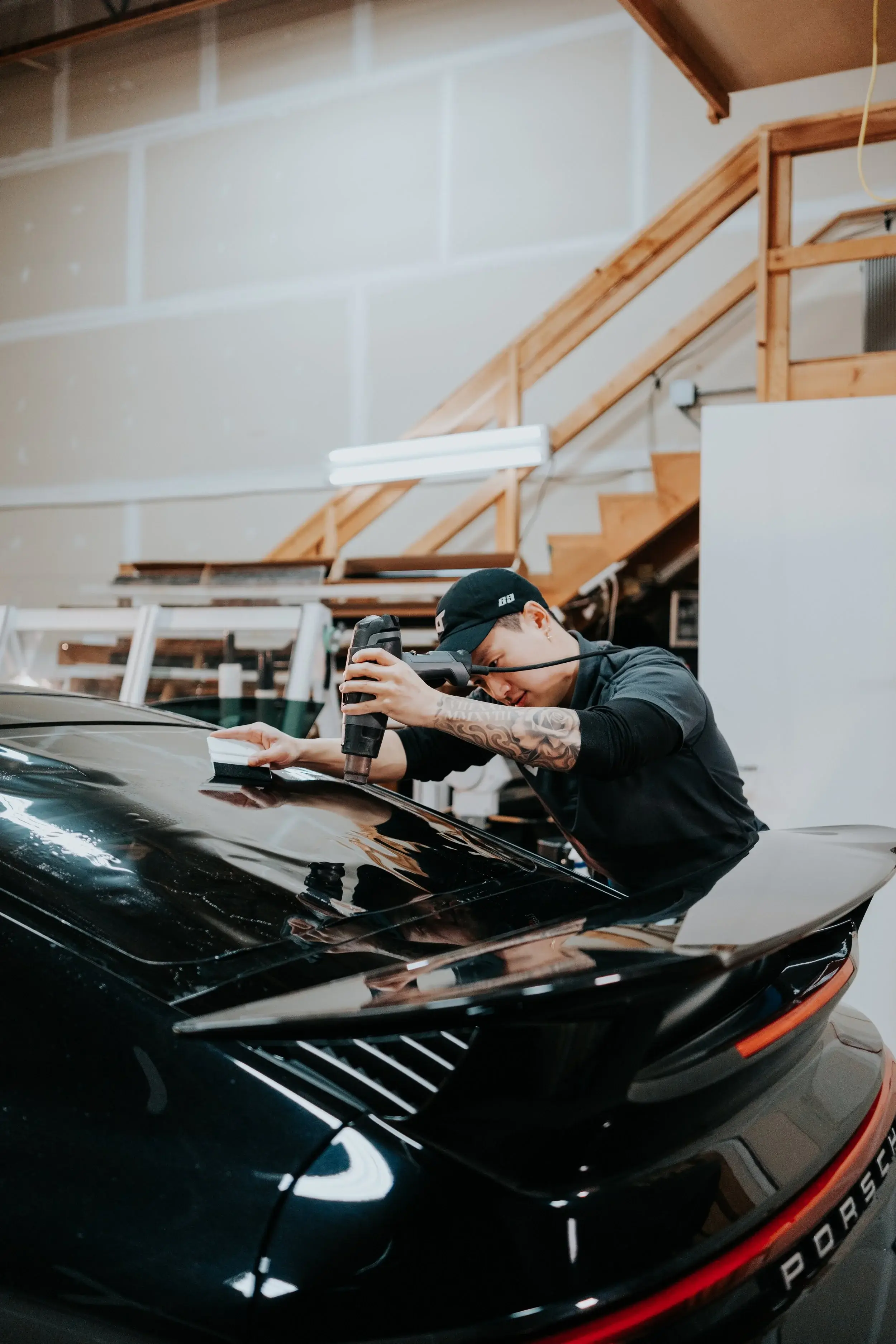
In LLumar ATC, three-window coupe packages start at $220, five-window sedan and pickup packages at $240, and seven-window packages for full-size SUVs and wagons at $260; IRX and AIR are upgrades priced per package. Expect to collect most cars the day you drop them off, then keep the tinted windows closed for 3 to 5 days so the film can cure. LLumar backs the film with a lifetime limited warranty, and the shop backs its own labour for life.
Booking
Use the window tint quote request to give the vehicle’s year, make and model, say whether UV, heat or both is the priority, and mention any child seats or long daily drives. The full price list is on window tint pricing. The shop is in Langley at Unit 312, 20560 Langley Bypass, closed Sundays and open the other six days from 9:00 to 17:00. Questions first? Text or ring 604 534 6433.