How does a vinyl wrap compare with a paint job?
A wrap is a removable film laid over the paint you already have; a paint job puts new paint where the old finish was. Almost every other difference between them follows from that.
| Vinyl wrap | Paint job | |
|---|---|---|
| What happens to the car | Cast film covers each painted panel | Surfaces are prepared and new coating is sprayed |
| The paint you have now | Stays underneath, untouched | Refinished or covered for good |
| Going back | Film comes off with heat | Only by painting again |
| Fixes peeling clear coat, rust or dents | No | Yes, with bodywork first |
| Finish choice | Gloss, satin, matte, metallic, colour-shift, textured, chrome | Any colour a painter can mix or match |
| Where the work happens | An indoor bay held at the film’s application temperature | A registered refinishing shop, spraying in a booth |
| Time at Brookswood Tint | 3 to 5 days, whole car | Not a service the shop offers |
| Price | Quoted per vehicle | Quoted by the body shop |
| Warranty | The shop’s published 5-year term on the vinyl | Set by the body shop |
| ICBC | Talk to your broker about the colour change | Talk to your broker about the colour change |
When is a paint job the right choice instead of a wrap?
When the paint is the problem. Peeling clear coat, rust and dents need refinishing, and both wrap makers write their films for sound factory paint rather than as a cover for a surface that’s letting go.
Avery Dennison’s SW900 data sheet rules out paint that bonds poorly to the panel or to an earlier coat, “Non-OEM painted vehicles,” and any surface that isn’t clean and smooth. 3M’s 2080 bulletin is written around standard factory paint, and its warranty card won’t cover paint that pulls away as the film is removed. Read together, the order is plain: film goes onto paint that’s holding and comes back off it later. It won’t hold loose paint down, and lifting it can take flaking paint with it.
Not sure whether your paint needs a respray at all? Paint correction vs respray covers what machine polishing can rescue, and the shop’s paint correction starts by measuring paint thickness.
What does a wrap keep that a respray can’t?
It keeps the original paint and the choice to go back to it. Under a wrap, the paint you have, factory finish and all, is still there; a respray replaces it permanently.
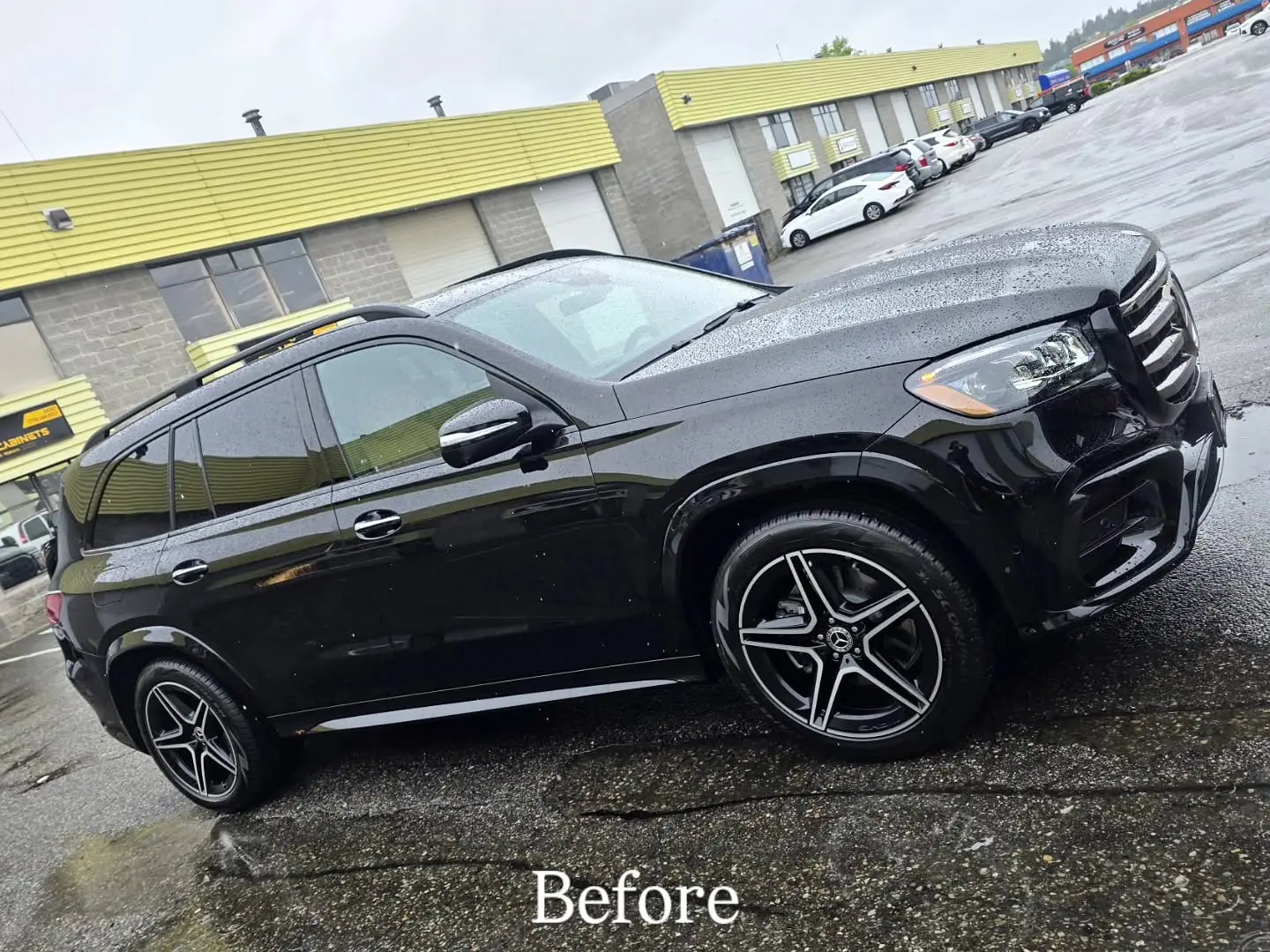
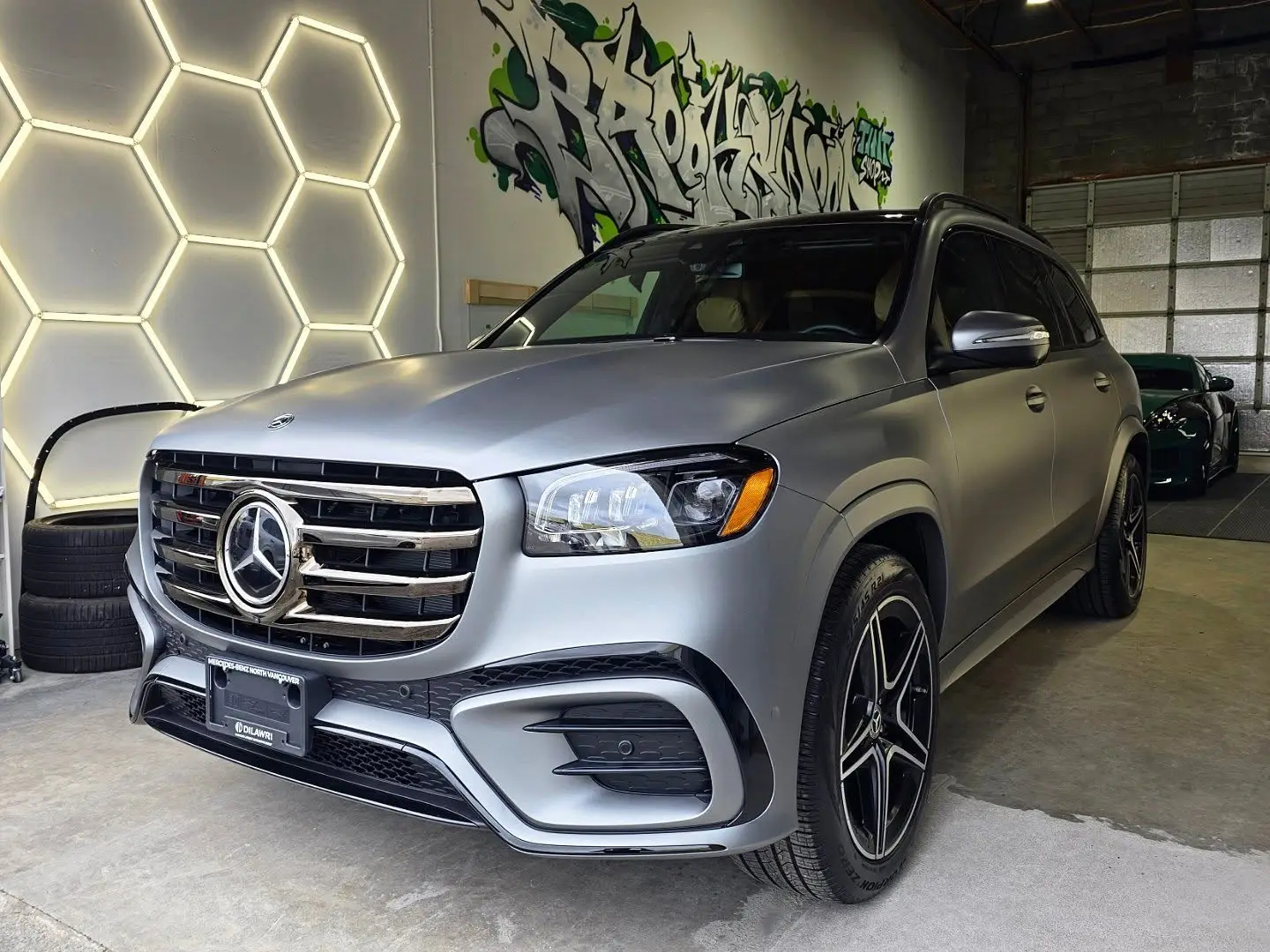
It also widens the colour choice. Avery Dennison’s North American product overview counts more than 140 colours and finishes in its Supreme Wrapping Film range, across gloss, satin, matte, metallic, chrome, ColorFlow and textured lines. The GLS on this page came in gloss black and now wears Matte Metallic Gunmetal, code SW900-840-M in that range.
Going back is part of the design, too: 3M rates 2080 as removable, with heat or chemicals, for as long as its warranty lasts. One limit is worth knowing on an older car. Avery won’t warrant taking SW900 off car paint that’s more than five years old, so on an older finish the paint’s own condition counts for more when the film comes off. For removal on healthy paint, read does a vinyl wrap damage paint.
What does a full respray involve in Metro Vancouver?
It’s booth work at a registered shop. Langley sits in Metro Vancouver, where Automotive Refinishing Emission Regulation Bylaw No. 1086 governs anyone who paints vehicles as a business.
The bylaw’s consolidated text, amended in 2019, requires the following:
- Registration. Every automotive refinishing facility must hold a valid registration with the regional district.
- A spray booth. Spray coating happens inside a booth whose ventilation runs to an exhaust stack, with overspray filters on the exhaust side.
- Low-pressure guns. Painters use high-volume low-pressure spray guns or an approved system with equivalent transfer efficiency.
- VOC limits. Coatings and surface cleaners must meet set VOC concentration limits, calculated by the method in the federal regulations for automotive refinishing products (SOR/2009-197).
- Training. Operators renew an environmental training certification every two years, and the technicians they employ must be certified too.
- Mobile limits. A mobile refinisher may only do spot repairs, which the bylaw caps at 0.5 square metres of surface.
None of that is a reason to avoid paint. It’s why a proper colour change in paint is a body shop booking with real prep time, and why it isn’t work a tint and wrap bay takes on.
How do care and lifespan compare?
A wrap asks for gentler washing than paint, and its life is shorter on flat, sun-facing panels. Paint can be machine-polished when it gets marked; wrap film mostly can’t.
3M’s bulletin says to “Never scrub the film,” cautions that scuffs in its finish may be permanent, and limits cleaners to a pH of 3 to 11 with no solvents. Avery says cleaners, wax and polish can visibly change the colour and sheen of its matte films, and it doesn’t count scuffing or fading gloss as a defect. For durability, Canada falls in Zone 2 on 3M’s zone map, and for that zone the 2080 card gives doors and sides 7 years but horizontal surfaces such as a hood or roof only 2. The shop’s own published term on the vinyl is 5 years.
Painted panels, by contrast, can be polished to take out swirls and light scratches, as long as there’s enough clear coat to work with. Wrap life in this climate gets its own answer: car wrap lifespan in BC.
What about insurance, resale and adding PPF later?
Both routes change the car’s colour, which ICBC wants to hear about. Resale and any later paint protection film favour keeping the factory paint, which only the wrap does.
ICBC’s Autoplan page names a change of colour among the modifications you should mention to your broker, and a respray changes the colour just as surely as vinyl does. For wraps specifically, ICBC’s repair partner policy counts them as “additional vehicle equipment”; keep the invoice. The wrap side is spelled out in what to tell ICBC about a wrap.
If clear film is in your future, the order matters. LLumar’s PPF FAQ writes its film for factory paint, won’t cover trouble that starts in refinished paint, and suggests giving a new paint job about a month to outgas before film goes over it. A wrap leaves the original paint ready for film later; after a respray, any film goes onto refinished paint, where LLumar won’t stand behind paint-related problems.
Vinyl wrap or paint job: which should you choose?
If the paint is sound and the goal is a new look, wrap it. If the paint is failing, or you want the colour to be permanent, paint it.
A wrap suits you if
- The paint is original and in good shape, and you want a different colour.
- You want the option of handing the car over in its original colour later.
- You’re after a finish like satin, matte metallic or colour-shift.
- The car is leased; wrapping a leased car covers what to check first.
A paint job suits you if
- The clear coat is peeling, there’s rust, or panels need bodywork.
- The car has an old respray that’s failing.
- You want the new colour to be permanent.
- You’re restoring the car to its original colour.
Where Brookswood Tint stands on wraps and paint
We wrap, and we don’t paint. Every car’s paint is looked over first, and doubtful panels, resprays or peeling areas are pointed out so you can decide with the facts in front of you. If the honest answer is that the car needs a body shop first, you’ll hear that before a wrap is booked.
How do you plan a colour change wrap in Langley?
The quickest start is the vinyl wrap quote form; texting 604 534 6433 works as well. Tell the shop the car, the shade or film code you have in mind, whether door jambs are in or out, and any respray or touch-up history you know of. Each wrap is priced for the vehicle, and vinyl wrap cost explains what moves that price.
A whole-car colour change wrap takes three to five days in the bay. If you’re still weighing options, the vinyl wrap buyer’s guide walks through films, finishes and coverage. The shop is at Unit 312, 20560 Langley Bypass, open Monday to Saturday.