How much of the car should a wrap cover?
Decide coverage first, because it sets the price, the time in the shop and how much paint ends up under vinyl. Most wraps fall into four groups, and 3M’s own bulletin for its 2080 film splits them much the same way: accents, partial coverage and full colour change, with commercial graphics as a separate job.
| Coverage | What it usually means | Time at Brookswood Tint | Read more |
|---|---|---|---|
| Accents | Mirror caps, a spoiler, stripes, rocker panels, chrome trim | Same day to 2 days | Chrome delete |
| One or two panels | A roof or a hood in a contrasting finish | Same day to 2 days | Roof wrap, hood wrap |
| Full colour change | Every painted exterior panel, door jambs on request | 3 to 5 days | Colour change wrap |
| Livery and commercial | Lettering, logos and graphics built from a brand file | Quoted per design | Commercial vehicle wraps, racing livery |
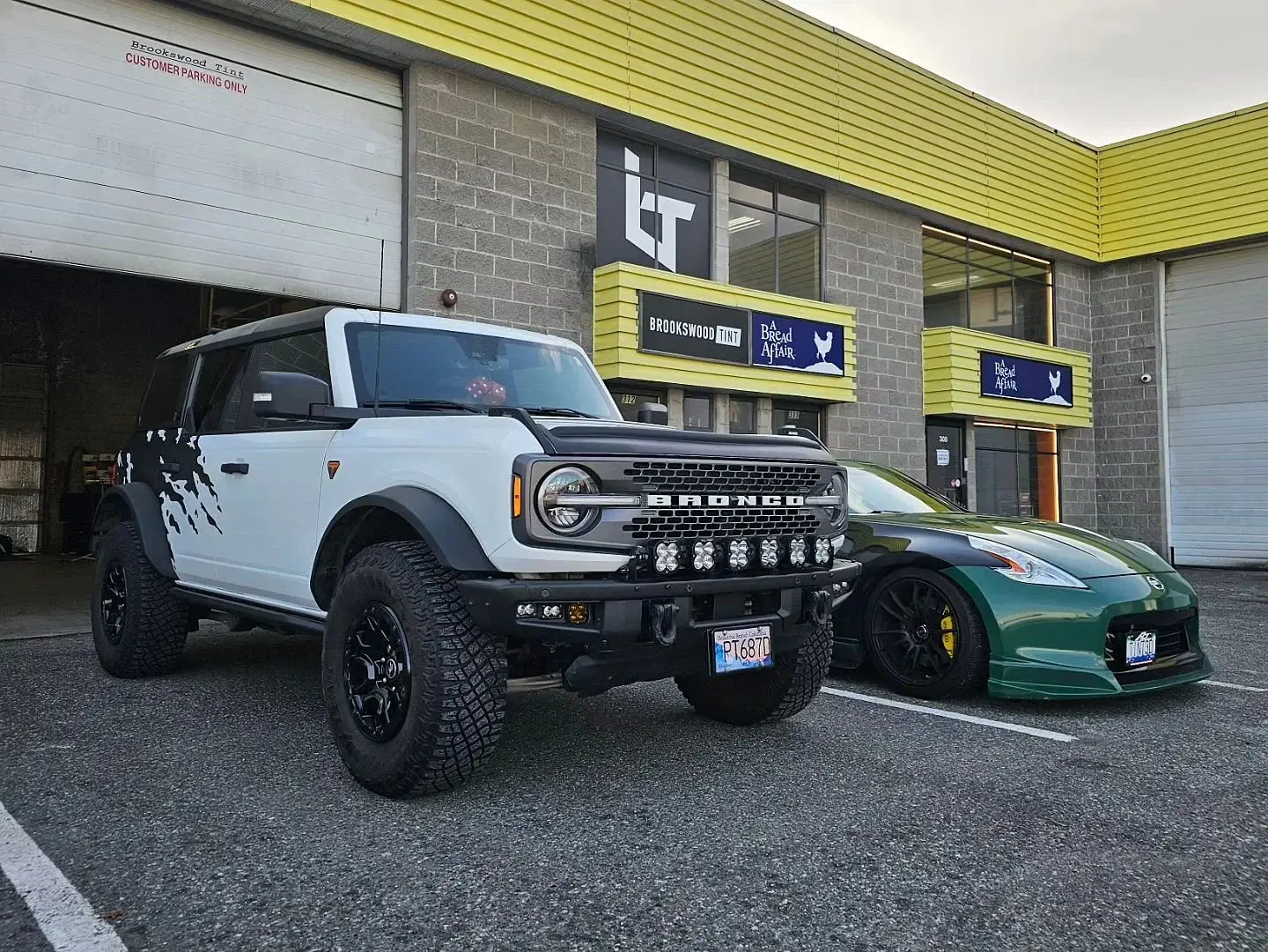
Those times are the shop’s published ranges. Among single panels, a satin black roof over gloss paint is the one the shop is asked for most. The white Ford Bronco on this page shows the middle ground: black graphics across part of the body, with the factory white left showing everywhere else.
Two questions narrow it down quickly. Do you want the car to read as a different car, or as a sharper version of the same one? And how long will you keep it? A full colour change is the biggest commitment of film and bay time. A roof, mirrors and a blacked-out grille change the look a great deal while leaving most of the paint uncovered.
Which finish should you choose, and how long is it rated to last?
Pick the finish for how it looks, then check how long its maker rates it, because the ratings aren’t equal. On Avery Dennison’s SW900 data sheet, a solid colour is rated for twice as long as a metallic or pearlescent film on vertical panels, and two and a half times as long as a colour-shift film.
Avery’s figures for its Zone 1 conditions, in years:
| SW900 finish family | Vertical panels | Horizontal panels |
|---|---|---|
| Black and white | 12 | 3 |
| Solid colours | 10 | 2 |
| Metallic and pearlescent, including Rugged | 5 | 2 |
| Metallics with gold flake | 3 | 1 |
| Extreme Textures (carbon fibre, brushed metallic) | 4 | 1 |
| Color Flow (colour-shift) | 4 | 1 |
| Diamond Line | 3 | 1 |
Avery treats a panel as vertical only when its face is within 10° of upright. A surface tilted more than that is rated at the horizontal figure, and Avery’s terms drop again in its Zones 2 and 3. The SW900 data sheet also states that the term of Avery’s warranty equals the product’s durability.
3M divides its 2080 warranty by climate zone rather than by finish. Its warranty zone list puts Canada in Zone 2, and the 2080 warranty card gives Zone 2 terms of 7 years on vertical surfaces and 2 years on horizontal ones. The shop itself publishes 5 years of manufacturer cover on the vinyl; check which film, and which term, goes with the colour you pick. For a car that lives outdoors in the Fraser Valley, how long a car wrap lasts in BC works through what those ratings mean.
Gloss, satin or matte vinyl
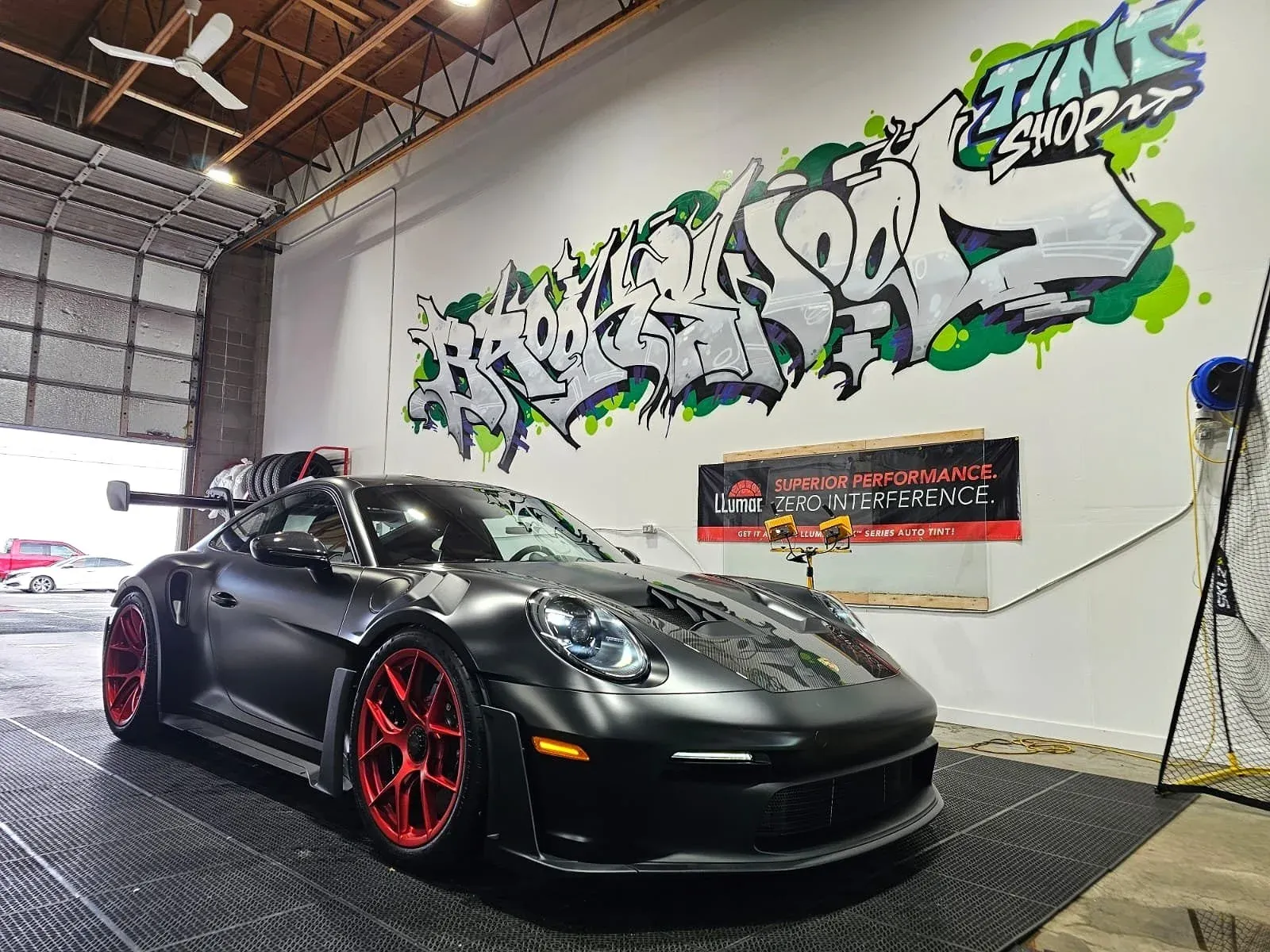
Gloss looks most like paint and is the easiest to keep clean. Satin and matte look flatter and ask for gentler products: Avery warns that its matte films “are subject to extreme color and gloss shift when exposed to cleaners, wax, and polish,” and tells owners to test anything on a hidden spot first. Satin black wraps and matte black wraps compare the two looks on real cars.
Colour-shift, metallic and textured
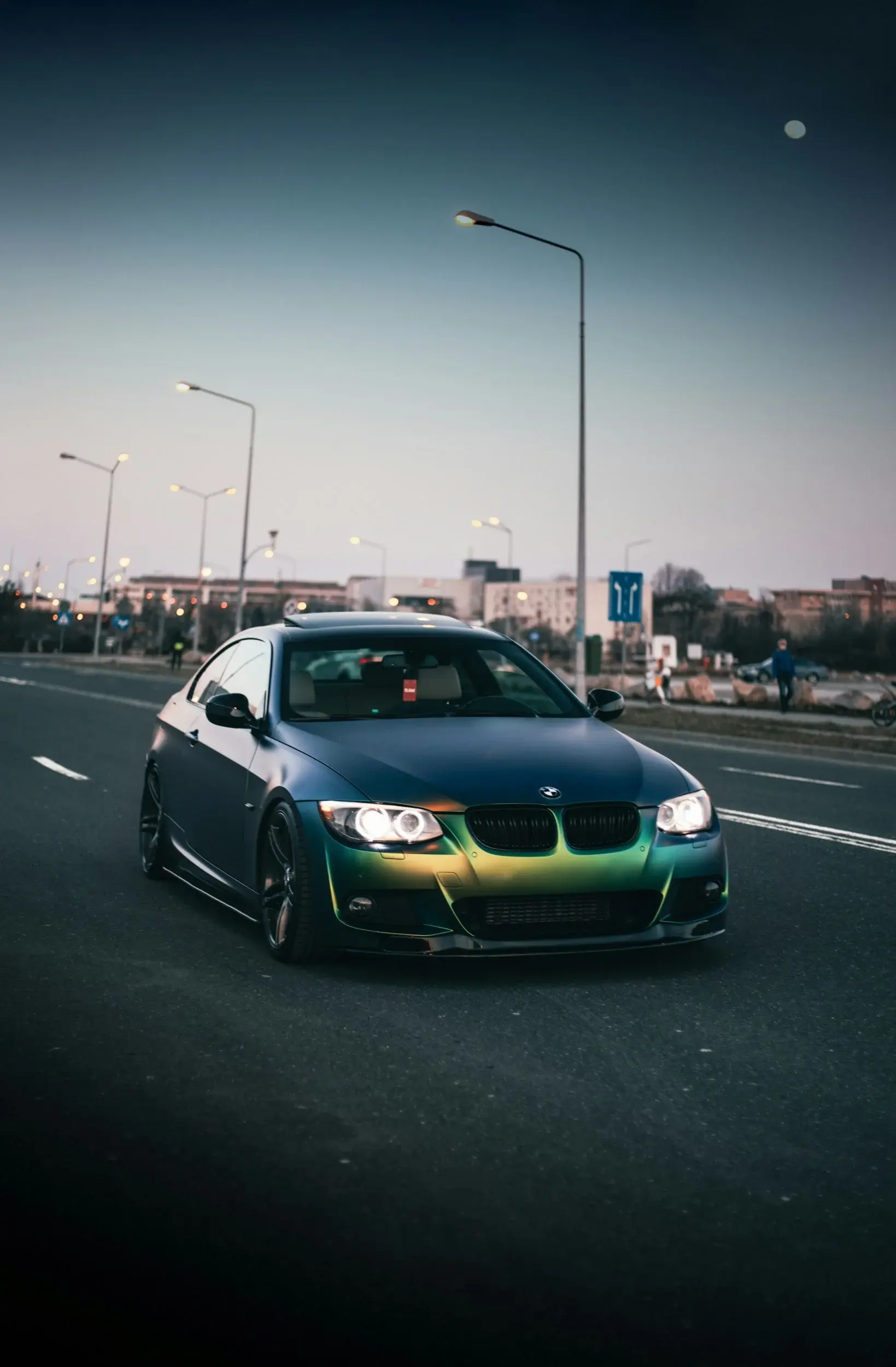
These are the finishes that change with the light, and they sit at the short end of Avery’s table. Both makers also tell installers to lay directional films in one orientation over the whole car, because metallic, pearl and colour-flip films can look different when a piece is turned. The colour-shift wrap page covers how they behave over curves.
Colours that may not fully hide the paint
Avery lists a group of SW900 colours, mostly yellows and oranges plus a few reds, that “may be considered less than fully opaque” and can let paint lines of a different colour show through. Going light over dark paint? Ask about opacity for your exact colour code before you commit.
3M 2080 or Avery Dennison SW900: what changes for the buyer?
Less than the brand debate suggests. Both are cast vinyl colour-change films with adhesives you can slide and reposition, both are applied dry, and both makers want a single production lot on one car. The differences that reach you are the colour list, the warranty structure and a few installation details.
| 3M Wrap Film Series 2080 | Avery Dennison SW900 | |
|---|---|---|
| Material | Multi-layer cast vinyl | Cast vinyl |
| Face thickness | 3.5 mil without adhesive, measured on 2080-M12; other designs vary slightly | 3.2 to 4.7 mil, depending on the colour |
| Adhesive | Controltac for sliding and repositioning, Comply air-release channels | Easy Apply RS, for positioning and bubble-free application |
| Application | Dry only, 18 to 24 °C | Dry only; minimum 10 °C for flat and simple curves, 16 °C where curves get complex |
| Warranty set by | Climate zone and panel angle | Finish family, climate zone and panel angle |
| Colour between lots | Can vary; use one lot per vehicle | Slight shift possible; use rolls from one production lot |
Avery notes that its films 4 mil or thicker, a list that includes several reds, its white pearls and its black carbon fibre, “may have reduced conformability”. 3M’s gloss and high-gloss 2080 colours carry a clear protective layer that can stay on while the film is laid, to cut down scratches during installation. The full side-by-side is on 3M 2080 vs Avery SW900, and each line has its own page: 3M 2080 wrap film and Avery Dennison SW900.
Keep the lot number: both makers warn that colour can shift between production lots. That matters after the install too. If a panel is damaged next year, its replacement may come from a different lot, so keep the colour code and lot number from your invoice or warranty card.
Is your paint ready for a wrap?
Sound factory paint is what both makers design their films for. Resprayed, flaking or poorly bonded paint is the risk, because vinyl adhesive can lift weak paint when the wrap comes off, and neither warranty pays for that.
The makers’ documents are direct about it:
- For 2080, 3M’s intended surface is standard OEM vehicle paint, and on powder-coated or water-based paint it wants adhesion tested first. Paint that comes away with the film isn’t covered either: the card rules out “paint pull during film removal process”.
- Avery lists “non-OEM painted vehicles” and paint with a poor paint-to-substrate or paint-to-paint bond among the unsuitable uses for SW900. Once automotive paint is more than 5 years old, Avery stops warranting removal from it, and it won’t cover staining found under film that had already cracked or discoloured.
- Avery also rules out SW900 over existing graphics without pre-approval, so an old wrap comes off before a new one goes on. Car wrap removal explains that job.
Bring three things to the quote: a list of any panels you know were repainted, photos of chips or clear coat that’s flaking, and the car’s age. Chips raise their own questions, answered in can you wrap a car with rock chips, and the removal risk is laid out in does a vinyl wrap damage paint.
Where can’t vinyl go on a BC car?
Painted panels and trim are fair game. Glass and lamps are where BC draws lines: nothing on the front side windows, nothing on the windshield below its top 75 mm, the back glass only with an outside mirror on each side, and nothing over a lamp lens if the car faces an inspection.
Window glass and graphics
BC’s tint rule isn’t limited to tint. MVAR s. 7.05(8) applies to “any material that reduces the light transmitted” through a window, so perforated window graphics and lettering on glass are held to the same zones as film:
| Glass | Vinyl or graphics allowed? |
|---|---|
| Windshield | Only within 75 mm of the top |
| Front side windows | No |
| Side windows behind the driver | Yes |
| Rear window | Only with outside mirrors on both sides |
Inspectors work from the same zones. In the 2025 Vehicle Inspection Manual, item 13d fails side glass ahead of the driver’s seat back if anything aftermarket tints it, whether film, another material or a coating. Avery adds a practical note of its own, that it doesn’t recommend SW900 as block-out film on windows.
On BC front door glass, nothing that cuts light is road-legal, no matter how pale. The usual ticket is $109 according to Mission RCMP, and officers can add a Notice & Order that makes you strip the material and pass an inspection. Brookswood Tint fits window film to front doors only on request, after explaining that risk, and the rule itself is on can you tint front windows in BC.
Headlights, tail lights and signals
Lamps have a reject item of their own. Section 6, item 1.0(a) of the 2025 manual fails any lamp lens that is “covered in any manner” or that cuts the light it lets through. Vinyl over a headlight, tail light or signal fits that description, and even clear film over a lens may be questioned, so plan the wrap to stop at the lamp edges. Lamp film is covered on are smoked taillights legal in BC.
Sensors and cameras
The 2080 bulletin tells users never to apply the film over sensors, radar or autonomous-driving equipment, and leaves it to the owner and the vehicle maker to confirm compatibility. Newer bumpers and grilles carry parking sensors and radar units, so ask how those spots will be handled.
What should a wrap quote include?
A useful quote names the film line and colour code, lists the panels and door jambs, says which parts come off the car, and states the warranty. Brookswood Tint doesn’t publish wrap prices; each job is quoted for the vehicle.
What moves the price
- Coverage. Accents and single panels take a small share of the film and bay time a full colour change needs.
- The vehicle. Its size and shape set how much film is used and how many parts are removed so the vinyl can wrap around edges.
- Door jambs. Wrapping them hides the old colour when a door opens, and adds time; can you wrap door jambs covers the trade-off.
- The finish. 3M says its high-gloss colours need extra consideration before installation, and directional films have to be laid in one orientation.
- Paint prep. Repairs or correction before the wrap are separate work.
Why wrap quotes differ from shop to shop is explained on car wrap cost in Langley.
Questions worth asking any wrap shop
- Which film line and colour code, and will the whole car come from one lot?
- Which panels and parts come off, and are door jambs included?
- How is the film trimmed on the car? 3M recommends its Knifeless Tape for all cutting when 2080 goes on a vehicle, and its Primer 94 on stretched areas, especially film edges.
- Which warranty term applies to my colour, and to the hood and roof?
The warranty paperwork
What 3M’s card promises is film free of material and manufacturing defects, “including yellowing, bubbling or cracking”. It excludes misuse, accidents, misapplication, ordinary wear and “dents caused by physical impact of rocks or road debris”, and it belongs to the original purchaser only. Avery treats abrasion and loss of gloss as normal wear that no Avery warranty covers. The shop’s terms for vinyl and every other film it fits are on the warranty page.
Insurance
Colour is one of the examples ICBC gives. Its Autoplan page asks you to talk to a broker if you’re modifying your vehicle, and a colour change heads its list of examples; with out-of-date details, it warns, “you may not be covered if you have a claim.” Do you tell ICBC if you wrap your car goes through it step by step.
How do you look after a wrap through a wet BC winter?
Wash it by hand or in a touchless wash with a gentle cleaner, keep solvents and unapproved waxes off it, and never scrub. Both makers’ care rules are stricter than most owners expect.
| Care point | 3M 2080 | Avery SW900 |
|---|---|---|
| Cleaner | Wet, non-abrasive, solvent-free, pH 3 to 11 | Non-abrasive, pH 5 to 9, free of alcohol, ammonia, chlorine and petroleum distillates |
| Scrubbing | “Never scrub the film” | Abrasion counts as normal wear, not a defect |
| Waxes and coatings | Coatings are excluded from the 2080 warranty; approved waxes are listed in 3M’s FAQ | Products with petroleum distillates or solvents, such as soaps, waxes or protective coatings, “void any warranty” |
For storage, 3M’s advice is a temperature-controlled garage, and it suggests parking clear of shrubs, trees and anything else that could scratch the film. The coating question gets its own answer in can you ceramic coat a vinyl wrap, and the washing routine is in how do you wash a wrapped car.
Installation in winter is a separate issue. Neither film is made for cold installs: 2080 goes on between 18 and 24 °C, and SW900 needs at least 10 °C even on a flat panel. Abbotsford’s average November low is 2.7 °C in Environment Canada’s 1981–2010 normals, which is why a winter wrap is indoor work, not a driveway job; can you wrap a car in winter has the detail.
How do you book a wrap at Brookswood Tint?
Start the quote with the car’s year, make and model, the coverage you have in mind, and a colour name or film code if you’ve settled on one; send it via the quote form for vinyl wraps or as a text to 604 534 6433. Photos help, especially of repainted panels, chips or old graphics.
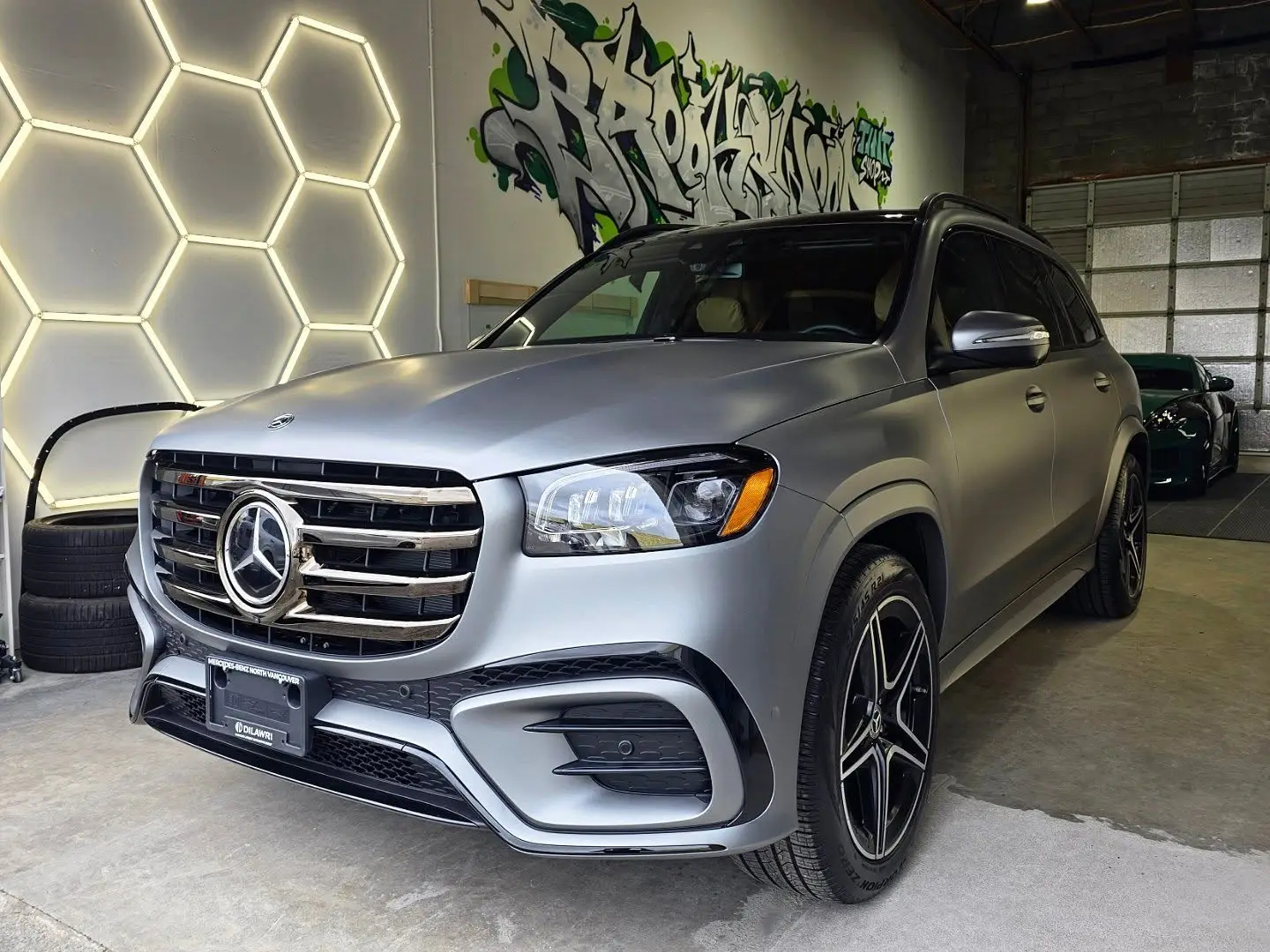
Plan your schedule around the job: the shop publishes 3 to 5 days for a full colour change and the same day to 2 days for single panels and accents, with commercial and livery work quoted per design. The bay is Unit 312 at 20560 Langley Bypass, and drop-offs happen Monday to Saturday during the 9:00 to 17:00 day. Still torn between a new colour and clear protection? PPF vs vinyl wrap sets the two side by side, and finished cars, the matte gunmetal GLS among them, are in the gallery.